Leaders from three Dutch political parties have reached a new coalition agreement, setting the stage for an unusual minority government in the Netherlands. This comes nearly three months after an election that saw a surprise victory for the centrist D66 party.
The liberal-progressive, pro-European D66, led by likely new Prime Minister Rob Jetten, will join forces with the conservative Christian Democrats and the right-wing VVD. Together, they will hold just 66 seats in the 150-seat lower house.
This coalition excludes the far-right Freedom Party (PVV), led by anti-Islam figure Geert Wilders, which D66 narrowly beat in October’s close election. Both parties originally won 26 seats, though seven PVV MPs have since broken away.
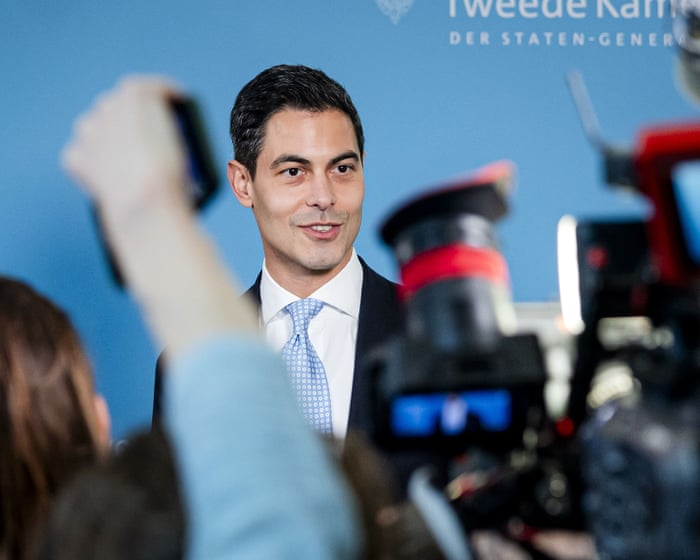
“We’re incredibly eager to get started,” said the 38-year-old Jetten, who is set to become the country’s youngest-ever prime minister, as he announced the deal on Tuesday night. “We’re going to do it as a three-party coalition, but we’d also like to work with other parties.”
He added, “We now want to tackle all the major issues facing us—international security, domestic security, providing affordable homes, getting migration under control, and investing in the new economy.”
Jetten said the government’s plans, to be detailed on Friday, include “enormous investment” in defense and “in the Netherlands itself.” He emphasized, “We want to manage finances carefully so that we do not pass debts on to future generations.”
Driven by what Jetten called its “positive message,” D66 surged to an unexpected win, finishing just 30,000 votes ahead of the PVV, which was the largest party in the previous short-lived coalition until Wilders withdrew over an immigration dispute.
The new cabinet is expected to be formally sworn in by mid-February but will need to collaborate with opposition parties in the fragmented parliament to pass laws. It also lacks a majority in the senate, which can block legislation from the lower house.
The three parties made the rare decision to govern without a majority after VVD leader Dilan Yeşilgöz ruled out including the left-leaning GroenLinks/PvdA alliance, which won 20 seats, calling it too radical. Similarly, VVD efforts to include the radical-right JA21 party were blocked by D66. “We do not consider that wise at this time, given everything that needs to be done,” Jetten said earlier this month.
However, GroenLinks-PvdA leader Jesse Klaver stated this month that his party is open to negotiating issue-by-case agreements with the new coalition, aiming to provide what he termed “responsible opposition.”
Klaver said global instability and the need to “help move the Netherlands forward” mean the government cannot afford to fail, and his party would support it on major issues like environmental reforms and accelerating housebuilding.
He drew the line, though, at any attempts to unfairly raise taxes on ordinary workers, cut healthcare funding, or weaken employment protections to make firing easier.
Following the recent split in Wilders’ PVV, which lost nearly a third of its seats, GroenLinks-PvdA is now the largest opposition party and could give the government a majority in both houses if it cooperates.
The breakaway group, led by long-time PVV MP Gidi Markuszower, criticized Wilders’ election strategy, saying that “insulting Islam” might be acceptable but “does not solve voters’ problems,” and faulted his failure to enroll party members beyond himself.
Meanwhile, two other far-right parties, Forum voor Democratie (FvD) and JA21, gained seats in the election and continue to rise in the polls. Wilders called the split a “black day” but expressed “every confidence” that his party would endure.
Frequently Asked Questions
Of course Here is a list of FAQs about the Dutch coalition deal framed in a natural tone and with clear direct answers
Beginner General Questions
1 What is a coalition deal and why does it take so long in the Netherlands
A coalition deal is an agreement between different political parties to form a government together In the Netherlands no single party ever wins a majority so they must negotiate a shared plan This process involves compromise on many complex issues which is why it often takes months
2 Which parties finally formed this coalition
The coalition consists of four parties the centerright VVD the centerleft D66 the Christian democratic CDA and the centrist ChristenUnie
3 What was the D66 election surprise mentioned
In the March 2021 election D66 led by Sigrid Kaag performed much better than expected becoming the secondlargest party This surprise win gave them significant leverage in the coalition talks forcing other parties to address more of D66s progressive priorities
4 What are the main points of the new coalition agreement
Key focuses include major new climate investment tackling the housing crisis increasing healthcare funding and reforms to childcare and immigration policies Its a mix of progressive and fiscally cautious policies
5 Who is the new Prime Minister
Mark Rutte remains Prime Minister leading his fourth consecutive cabinet This new government is often called Rutte IV
Advanced Detailed Questions
6 Why did these specific four parties end up together
After the election several combinations were tried This quartet represented the most stable center option that could achieve a majority It balances the progressive push of D66 with the more conservative leanings of VVD and CDA with ChristenUnie often acting as a bridge on social issues
7 What were the biggest sticking points during the three months of negotiations
Major hurdles were