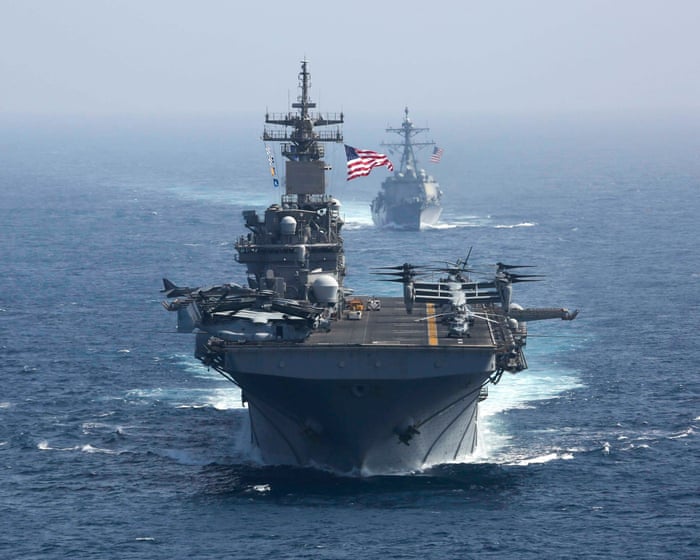
The possibility of a U.S.-Iran conflict appears to be growing after Donald Trump warned that time is running out for Tehran. He announced that a significant U.S. naval force is advancing toward the region “with great power, enthusiasm and purpose.”
On social media, the U.S. president stated that the fleet, led by the aircraft carrier USS Abraham Lincoln, is larger than the one deployed to Venezuela earlier this month before Nicolás Maduro’s removal. He emphasized that it is “prepared to rapidly fulfill its missions with speed and violence if necessary.”
Trump urged, “Hopefully Iran will quickly ‘Come to the Table’ and negotiate a fair and equitable deal – NO NUCLEAR WEAPONS – one that is good for all parties. Time is running out, it is truly of the essence!”
He added a stark warning: “As I told Iran once before, MAKE A DEAL! They didn’t, and there was ‘Operation Midnight Hammer,’ a major destruction of Iran. The next attack will be far worse! Don’t make that happen again.”
This is Trump’s clearest signal yet that he is prepared to launch a military strike soon if Iran refuses to negotiate an agreement on its nuclear program. European diplomats had anticipated a crisis over the weekend and noted signs of Israeli concern about potential Iranian retaliation.
Recently, it has become evident that Trump aims not only to restrict what remains of Iran’s already compromised nuclear program but also to limit its long-range missile capabilities, which are central to Iran’s military strategy. In recent weeks, Trump has also suggested that Iran’s Supreme Leader, Ali Khamenei, should step down—a demand Iran is certain to reject.
Some may view this sudden escalation as a convenient distraction for Trump, who faces domestic political pressure over violence involving homeland security officers in Minnesota.
Iran’s Foreign Minister, Abbas Araghchi, stated that he will not negotiate under threat but is open to talks without preconditions. He has communicated these terms through various intermediaries to Trump’s special envoy, Steve Witkoff.
In the past day, Araghchi or Iranian President Masoud Pezeshkian have engaged with diplomats from Saudi Arabia, Qatar, and Egypt. These Arab nations are actively seeking ways to restart discussions without Iran being forced to accept predetermined outcomes. They played a key role in persuading Trump to hold off on an attack three weeks ago, but Trump now has more military options and seems focused on securing a nuclear deal rather than punishing Iran for its crackdown on street protests.
Tehran remains deeply suspicious of talks with the U.S., especially after negotiations last June were interrupted when the U.S. allowed Israel to launch an attack aimed at eliminating Iran’s leadership and destroying its civilian nuclear sites.
Turkish Foreign Minister Hakan Fidan urged the U.S. to separate its broader demands regarding Iran’s missile program and regional militia support from the nuclear issue. He warned that if Witkoff insists on addressing all matters simultaneously, Iran is unlikely to engage.
Trump has demanded that Iran abandon its domestic uranium enrichment program, allow UN nuclear inspectors to return, and transfer its stockpile of highly enriched uranium to a third party, likely Russia. Iran has consistently resisted giving up its enrichment capability but has been willing to impose strict limits on its stockpile.
Since the last round of talks ended with an Israeli and U.S. attack that killed 1,000 people and severely damaged key nuclear sites, Iran has been further weakened by a collapsing currency and soaring inflation.
With its nuclear facilities already impaired, the primary targets in any future conflict would likely be Iran’s leadership. The June attack revealed Israel’s capability to strike at the heart of Iran’s command structure.The United States holds near-total dominance of the skies over Iran. However, nearly all Gulf states, fearing retaliation from Iran, have stated they will not allow the U.S. to use their airspace or military bases to launch an attack.
Iranian officials responded by saying, “We will strike the exact base and location from which any air operations against us are launched. We will not attack other countries, as we do not consider them enemies. We will raise our defensive readiness to the highest level in response to the U.S. military buildup. If the Americans are willing to negotiate without predetermined conditions, Iran will accept.”
Frequently Asked Questions
Frequently Asked Questions USIran Tensions The Nuclear Deal
BeginnerLevel Questions
1 What is the Iran nuclear deal
The Iran nuclear deal formally called the Joint Comprehensive Plan of Action is an agreement reached in 2015 between Iran and several world powers In exchange for lifting economic sanctions Iran agreed to strict limits on its nuclear program to prevent it from building a nuclear weapon
2 Why is President Trump warning that time is running out
President Trump has long criticized the deal as flawed His warning suggests he believes the current terms are insufficient and that if the agreement isnt renegotiated or significantly altered to address issues like Irans ballistic missile program and regional activities the US may withdraw entirely and potentially increase pressure including military options
3 What would war between the US and Iran look like
Its unlikely to be a traditional declared war More probable scenarios include targeted military strikes cyber warfare or clashes involving US allies in the region and Irans proxy forces A fullscale invasion is considered very unlikely due to the immense cost and complexity
4 What are the main benefits of the nuclear deal
The main benefit was verifiably freezing Irans nuclear program bringing it under intense international inspection This reduced the immediate threat of a nucleararmed Iran and provided stability It also opened trade opportunities for companies in countries that lifted sanctions
5 What are the main criticisms of the deal
Critics argue it doesnt permanently prevent Iran from eventually pursuing nuclear weapons doesnt address Irans development of ballistic missiles and does nothing to curb Irans support for militant groups in the Middle East which destabilizes the region
Advanced Practical Questions
6 What happens if the US completely withdraws from the deal
If the US withdraws it would likely reimpose all its previous sanctions and potentially add new ones This could cause the entire agreement to collapse as Iran may resume unlimited nuclear enrichment European companies would face a difficult choice between trading with Iran or the much larger US market