When it comes to Europe’s economy, peace, and security, it’s clear that decisions need to be made largely at the European level to be effective. But electoral politics still happens mostly at the national level. The upside of this mismatch is that European countries have governments with different political priorities and leanings. Unlike in the US, where one presidential election can completely change the country’s direction—as we’ve seen under Donald Trump—this kind of dramatic shift hasn’t happened in Europe so far. That might be about to change.
Last week, Pedro Sánchez took a big risk in Spain by calling a snap election for next month. This came after an unlikely alliance of the conservative People’s party (PP), the far-right Vox, and the Catalan pro-independence party Junts blocked his major housing reform plan in parliament. If the socialist prime minister—praised by progressives worldwide but criticized by Europe’s right and Trump’s US—loses this election gamble, Spain could end up with a conservative/far-right coalition, which is currently leading in the polls.
Besides Spain, France, Italy, Poland, Finland, Greece, Estonia, and Slovakia will all hold elections in the coming year. In the four largest—France, Italy, Poland, and Spain—far-right or nationalist populist parties could either stay in power (Italy), return to it (Poland), or be elected for the first time (France and Spain). This could drastically change Europe’s landscape.
Europe has been shifting to the right for a while, with far-right parties joining coalitions in various countries at different times. Centre-right and far-right groups can now form a majority in the European parliament, especially around anti-climate and anti-migration policies. But while this shift has slowed European integration, its policy effects haven’t been as quick and extreme as what we’ve seen in the US under Trump.
That’s because the rightward move hasn’t been uniform. In the Netherlands last year, Geert Wilders’s far-right Freedom party lost at the polls, and the liberals bounced back. This year, Hungary’s authoritarian slide was stopped and is now reversing after Viktor Orbán was defeated in a landslide. Most recently, in Sweden, support for the far right, which had backed the outgoing centre-right government, dropped. The opposition bloc, led by the Social Democrats, narrowly won. So, while the far right is rising across the continent—Alternative für Deutschland’s recent win in eastern Germany shocked Europe—it’s not dominant everywhere all the time.
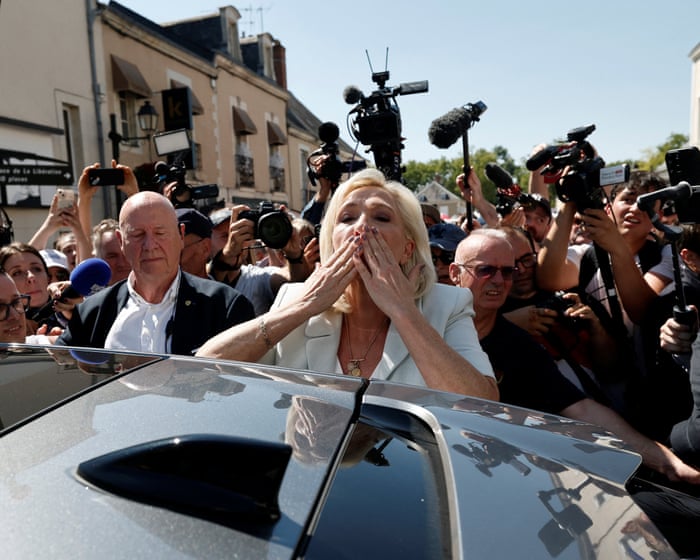
But if the upcoming elections bring Marine Le Pen to the French presidency, keep Giorgia Meloni as Italian prime minister (possibly with an even more right-wing coalition), return Law and Justice to power in Poland, and create a conservative/far-right government in Spain with Vox, Europe’s face could change dramatically.
If all these countries, plus some smaller ones, elect far-right or nationalist populist governments, they wouldn’t have enough votes to control the EU’s policy direction. But they would form a blocking minority, ending any hope of deeper EU integration in areas like finance, energy, defense, and technology.
View image in fullscreenAndy Burnham with Friedrich Merz in Berlin after Burnham ‘opened the door to Britain rejoining the EU’ Photograph: Filip Singer/EPA
And it’s not just about numbers. These far-right leaders would inspire and radicalize each other, supported by Maga America and Silicon Valley’s algorithms. Outside Italy, many think Meloni has softened in power. If that’s true, it’s largely because she’s been surrounded by people like Emmanuel Macron, Donald Tusk, andSánchez, among others. If leaders like these were replaced by figures such as Le Pen, Jarosław Kaczyński, and Alberto Núñez Feijóo, with support from Vox’s Santiago Abascal, Meloni herself would behave differently, more in tune with her real political instincts. All this could lead not just to a slow weakening of the European integration project—muddling through with the unambitious plans we’ve seen in recent years—but to its hollowing out, or even outright collapse. The EU as we know it would struggle to keep its purpose, especially if no deal is reached on its next seven-year budget in the coming months. The irony is that European political diversity remains, but outside the EU, it’s not just Canada that wants closer ties. More importantly, the UK may have started the slow process of reversing its exit. It took 10 years for a British prime minister to speak plainly, publicly admit that Brexit has done more harm than good, and open the door to rejoining the EU, as Andy Burnham has now done. Skip past newsletter promotion Sign up for This is Europe The most pressing stories and debates for Europeans – from identity to economics to the environment Enter your email Sign up after newsletter promotion It has taken a decade to recall the purpose of European unity and the emptiness of petty nationalism – just as Europe risks forgetting its dark past and stands on the edge of falling apart. Now may be the moment for the UK to remind its European neighbours what it means to be out there, all alone. Nathalie Tocci is a Guardian Europe columnist.
Frequently Asked Questions
Here is a list of FAQs based on the article Europes major election season is about to begin It could change everything by Nathalie Tocci
The Basics
What is this article about
Its about the upcoming elections for the European Parliament These elections happen every five years and the next ones are a really big deal because the results could change how the entire European Union works
What is the European Parliament
Its the only part of the European Union that is directly elected by the people Think of it like the US Congress or a national parliament but for the whole EU It helps make laws that affect all member countries
Who is Nathalie Tocci
She is a political scientist and a special advisor to the EU She writes about European politics and foreign policy so shes an expert on this topic
When are these elections happening
They are scheduled for June 69 2024 People in all 27 EU member countries will vote during this time
Why does the article say it could change everything
Because the elections might lead to a big shift in power More people are voting for farright and nationalist parties If these parties win a lot of seats they could weaken the EUs ability to work together on big issues like climate change supporting Ukraine and immigration
The Details
What are the main political groups in the European Parliament
There are several large groups The biggest ones are
The European Peoples Party Centerright
The Socialists and Democrats Centerleft
Renew Europe Centrist and liberal
The Greens Focused on environmental issues
The Left Leftwing
Identity and Democracy European Conservatives and Reformists These are the farright and nationalist groups that are expected to gain more power
What do these parties want
The farright and nationalist parties generally want to give more power back to individual countries and reduce the power of the EU They are often against immigration and less supportive of sending aid to Ukraine The more traditional parties want to keep the EU working together as a strong union
Why are people voting for the farright now
The article