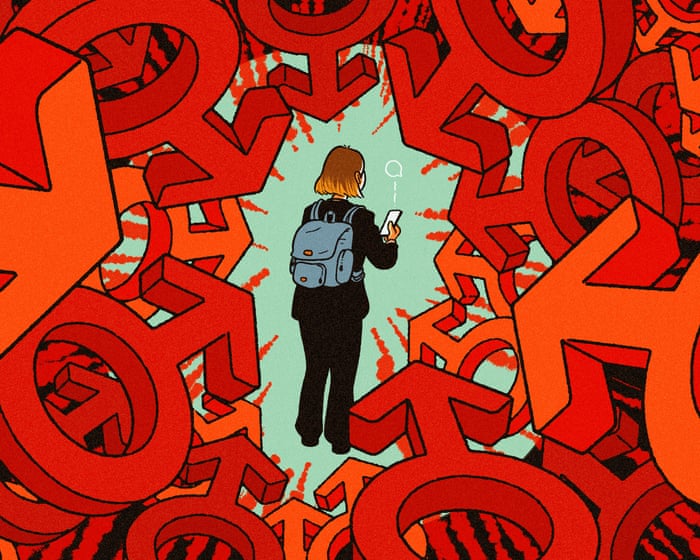
If you’re like my parents, you probably wouldn’t understand most of what shows up on my social media, no matter how much I try to avoid it.
Take this recent Instagram reel as an example: “Do y’all females ever tell ur homegirls ‘Sis chill you letting too many dudes hit?’” In plain terms, that means: “Women, do you ever tell your friends they’re being promiscuous and need to stop sleeping with so many guys?” This video, posted by a 19-year-old guy, popped up on my feed without me looking for it or ever engaging with similar content. The comments underneath were pure misogyny. One said, “Women see body count as a leaderboard and they try to outdo each other,” which basically translates to calling all women competitively promiscuous.
Look at how the word “female” is used in these posts. It’s not neutral here—it’s an insult. Teenage boys use it to degrade us, reducing us to animals. You never see boys called “males,” but girls are constantly labeled “females,” like we’re sows or calves, less than human. We’re also called “thots” (slang for whores), “community pussy,” and “bops.” “Bop” stands for “been over passed,” a derogatory term for a girl they think has been with too many people. Online, sexual equality has disappeared. It’s perfectly acceptable for boys to have sex, but when girls do, they’re called worthless and treated like objects. I saw a TikTok comment that said, “When community pussy tries to insult me, I just want to beat that bitch up.”
I’m 15 and in school. Like most teenagers, I spend a lot of my free time on social media, scrolling through short videos on Instagram and TikTok. All my friends use these apps, many for hours each day. I actively try to steer clear of online misogyny, but I run into it constantly whenever I open these apps. It only takes a few minutes to come across subtle or blatant sexism—comment sections on a girl’s post filled with remarks about her body, videos by men or boys with degrading jokes, even serious topics like domestic violence or rape being trivialized and mocked.
A few days ago, I saw an Instagram reel of a young woman sharing how she was raped six years ago, struggled with suicidal thoughts afterward, but eventually rebuilt her life. Among the comments—mostly from men—were things like, “Well at least you had some,” “No way, she’s unrapeable,” “Hope you didn’t talk this much when it happened,” and “Bro could have picked a better option.” Seeing those comments, which had thousands of likes and plenty of agreement from other boys, made me feel sick.
If a girl my age posts any video of herself online, the comments will be filled with objectifying and hateful remarks, no matter what the video is about. If she wears something revealing or simply has a larger chest, she’ll be sexualized and abused. Out of nowhere, there might be hundreds of comments insulting her specific features or rating her looks on a scale of 1 to 10. “Sub5,” for example, means someone rated below a 5. I’ve even seen videos where boys tell unattractive people they should end their lives.
Despite the sexual way boys my age talk about us online, there’s also an extreme focus on female purity and virginity. In my age group, sex is often called “cracking,” where men do the cracking and women get cracked. “Body count”—referring to how many people someone has slept with—is only used to shame women. A girl with a “high body count” is considered “used up” and worthless. As one boy put it on Instagram, “You can always tell if she’s ran through.”
Often, it feels like we’re hated not just for being sexual, but simply for existing. I would be lying ifI said I wasn’t bothered by seeing boys my age post things like, “Men are better in pretty much every way,” or, “Women just fake emotions to make us feel sorry for them.” Words like “bitch” are the mild part. One of the worst labels is “foid”—a term from incel culture that’s now going mainstream—which treats women as less than human, like female humanoids.
And what does it do? If I spend even ten minutes on an app like Instagram, I close it feeling disheartened and unhappy to be a girl. When the comments under a video of a girl my age are filled with disgusting, objectifying remarks about her body from boys, it makes me deeply uncomfortable in my own skin and leads me to compare myself to her—especially if she’s beautiful and still called unattractive. The endless emphasis on beauty as worth, and all the videos picking apart specific features—some of which I have—have made me start to hate my own face, as hard as that is to admit. But the worst part is knowing how much hatred men and boys hold for all women and girls, myself included.
Social media has ruined my self-esteem and my relationship with being a girl in this world. Almost every day I feel hatred toward my gender, my appearance, or even teenage boys as a whole. The misogyny I see from boys my age online—which spills into real life too—has made me resentful and bitter toward them, no matter how hard I try not to be. As wrong as it feels, I keep wondering whether there are really any boys out there who aren’t misogynistic to some degree, and I’ve even questioned whether I’ll ever find love because of it. I know boys are also victims of harmful content, not just the ones spreading online misogyny—they’re learning this from adults who post hateful videos first. But even so, I feel a huge divide now between girls and boys in my generation, especially when the way they talk about us in real life mirrors what they say online.
I can’t speak for every girl my age, but I often feel objectified, dehumanized, and disgusted by the hatred toward women I see online, and I’m sure most of my friends would agree. Banning social media for under-16s might stop young boys from seeing endless content that treats women with contempt. Boys this age are very influenced by the “cool” or “funny” packaging of what is really relentless misogyny. A ban might not solve everything, but it would help. If society can’t stop it, at least it can show it doesn’t approve.
Frequently Asked Questions
Of course Here is a list of FAQs about the experience of a 15yearold girl facing misogyny on social media framed in a natural tone
Understanding the Problem
Q What exactly is misogyny online It sounds like a big word
A It simply means hatred prejudice or disrespect directed at women and girls Online it can be insults about your intelligence appearance or worth because youre a girl or constant unwanted sexual comments
Q Isnt it just regular bullying or trolling What makes it misogynistic
A While all bullying is hurtful misogyny specifically targets your gender It uses stereotypes or reduces you to your body The insult isnt just youre stupid its youre a stupid girl
Q Why does this happen so much on social media
A Anonymity lack of immediate consequences and the sheer size of the internet allow people to say things they likely wouldnt in person Algorithms can also push extreme content and some platforms are slower to remove sexist harassment
Personal Impact and Responses
Q I get these comments and DMs daily Its exhausting Am I just being too sensitive
A No It is exhausting because its a constant lowgrade attack on your identity Feeling drained angry or sad is a normal reaction to persistent disrespect Your feelings are valid
Q What should I do when I get a hateful or sexual comment
A Your safety and peace of mind come first Use the DONT ENGAGE DOCUMENT DELETE rule Dont argue with them Screenshot the comment Report it to the platform Block the user Delete the comment from your space if you can
Q Should I tell someone Who can I talk to
A Absolutely Talk to a trusted adulta parent older sibling teacher or school counselor Showing them the screenshots helps them understand the severity You can also talk to a friend who gets it You dont have to handle this alone
Advanced Questions and Strategies