This CSS code defines a custom font family called “Guardian Headline Full” with multiple font weights and styles. It includes light, regular, medium, and semibold weights, each with normal and italic variations. The fonts are loaded from the Guardian’s servers in WOFF2, WOFF, and TrueType formats to ensure compatibility across different browsers.@font-face {
font-family: Guardian Headline Full;
src: url(https://assets.guim.co.uk/static/frontend/fonts/guardian-headline/noalts-not-hinted/GHGuardianHeadline-Bold.woff2) format(“woff2”),
url(https://assets.guim.co.uk/static/frontend/fonts/guardian-headline/noalts-not-hinted/GHGuardianHeadline-Bold.woff) format(“woff”),
url(https://assets.guim.co.uk/static/frontend/fonts/guardian-headline/noalts-not-hinted/GHGuardianHeadline-Bold.ttf) format(“truetype”);
font-weight: 700;
font-style: normal;
}
@font-face {
font-family: Guardian Headline Full;
src: url(https://assets.guim.co.uk/static/frontend/fonts/guardian-headline/noalts-not-hinted/GHGuardianHeadline-BoldItalic.woff2) format(“woff2”),
url(https://assets.guim.co.uk/static/frontend/fonts/guardian-headline/noalts-not-hinted/GHGuardianHeadline-BoldItalic.woff) format(“woff”),
url(https://assets.guim.co.uk/static/frontend/fonts/guardian-headline/noalts-not-hinted/GHGuardianHeadline-BoldItalic.ttf) format(“truetype”);
font-weight: 700;
font-style: italic;
}
@font-face {
font-family: Guardian Headline Full;
src: url(https://assets.guim.co.uk/static/frontend/fonts/guardian-headline/noalts-not-hinted/GHGuardianHeadline-Black.woff2) format(“woff2”),
url(https://assets.guim.co.uk/static/frontend/fonts/guardian-headline/noalts-not-hinted/GHGuardianHeadline-Black.woff) format(“woff”),
url(https://assets.guim.co.uk/static/frontend/fonts/guardian-headline/noalts-not-hinted/GHGuardianHeadline-Black.ttf) format(“truetype”);
font-weight: 900;
font-style: normal;
}
@font-face {
font-family: Guardian Headline Full;
src: url(https://assets.guim.co.uk/static/frontend/fonts/guardian-headline/noalts-not-hinted/GHGuardianHeadline-BlackItalic.woff2) format(“woff2”),
url(https://assets.guim.co.uk/static/frontend/fonts/guardian-headline/noalts-not-hinted/GHGuardianHeadline-BlackItalic.woff) format(“woff”),
url(https://assets.guim.co.uk/static/frontend/fonts/guardian-headline/noalts-not-hinted/GHGuardianHeadline-BlackItalic.ttf) format(“truetype”);
font-weight: 900;
font-style: italic;
}
@font-face {
font-family: Guardian Titlepiece;
src: url(https://interactive.guim.co.uk/fonts/garnett/GTGuardianTitlepiece-Bold.woff2) format(“woff2”),
url(https://interactive.guim.co.uk/fonts/garnett/GTGuardianTitlepiece-Bold.woff) format(“woff”),
url(https://interactive.guim.co.uk/fonts/garnett/GTGuardianTitlepiece-Bold.ttf) format(“truetype”);
font-weight: 700;
font-style: normal;
}
@media (min-width: 71.25em) {
.content__main-column–interactive {
margin-left: 160px;
}
}
@media (min-width: 81.25em) {
.content__main-column–interactive {
margin-left: 240px;
}
}
.content__main-column–interactive .element-atom {
max-width: 620px;
}
@media (max-width: 46.24em) {
.content__main-column–interactive .element-atom {
max-width: 100%;
}
}
.content__main-column–interactive .element-showcase {
margin-left: 0;
}
@media (min-width: 46.25em) {
.content__main-column–interactive .element-showcase {
max-width: 620px;
}
}
@media (min-width: 71.25em) {
.content__main-column–interactive .element-showcase {
max-width: 860px;
}
}
.content__main-column–interactive .element-immersive {
max-width: 1100px;
}
@media (max-width: 46.24em) {
.content__main-column–interactive .element-immersive {
width: calc(100vw – var(–scrollbar-width));
position: relative;
left: 50%;
right: 50%;
margin-left: calc(-50vw + var(–half-scrollbar-width)) !important;
margin-right: calc(-50vw + var(–half-scrollbar-width)) !important;
}
}
@media (min-width: 46.25em) {
.content__main-column–interactive .element-immersive {
transform: translate(-20px);
width: calc(100% + 60px);
}
}
@media (max-width: 71.24em) {
.content__main-column–interactive .element-immersive {
margin-left: 0;
margin-right: 0;
}
}
@media (min-width: 71.25em) {
.content__main-column–interactive .element-immersive {
transform: translate(0);
width: auto;
}
}
@media (min-width: 81.25em) {
.content__main-column–interactive .element-immersive {
max-width: 1260px;
}
}
.content__main-column–interactive p,
.content__main-column–interactive ul {
max-width: 620px;
}
.content__main-column–interactive:before {
position: absolute;
top: 0;
height: calc(100% + 15px);
min-height: 100px;
content: “”;
}
@media (min-width: 71.25em) {
.content__main-column–interactive:before {
border-left: 1px solid #dcdcdc;
z-index: -1;
left: -10px;
}
}The interactive content column has a left border and specific spacing for elements. Paragraphs following certain elements get extra top padding, and the first letter of these paragraphs is styled as a large, colored drop cap. Inline elements and figures are limited to a maximum width. Various color variables are defined for consistent theming.Pullquotes within specific containers should have a maximum width of 620 pixels.
Captions for showcase elements in main articles, features, standard articles, and comment sections should be positioned statically, spanning the full width up to 620 pixels.
Immersive elements should occupy the full viewport width, minus the scrollbar. On larger screens (over 71.24em), their width is capped at 978px, with caption padding adjusted at different breakpoints. On medium screens (46.25em to 61.24em), the maximum width is 738px. On smaller screens (under 46.24em), immersive elements align to the left edge with adjusted margins and caption padding.
For wider screens (over 61.25em), the furniture wrapper uses a grid layout with defined columns and rows. Headlines feature a top border, meta sections are positioned relatively, and standfirst text includes specific styling for links and paragraphs. Figures within this wrapper have no left margin and a maximum width of 630px when inline. On the largest screens (over 71.25em), the grid columns are reconfigured.The CSS code defines a grid layout for a webpage header, adjusting element positions and styles across different screen sizes. For smaller screens, it sets specific grid columns and rows, with an 80px row height. A 540px wide separator line appears above meta information, and standfirst text has a vertical border. On larger screens (over 81.25em), the grid changes to fractional units, the separator expands to 620px, and the vertical border shifts slightly.
Headlines use a 600-weight font, with a maximum width of 620px and 32px font size by default. On wider screens (over 71.25em), the headline max-width reduces to 540px, and the font size increases to 50px. Some decorative lines are hidden on medium to large screens.
Meta information and standfirst sections have adjusted margins and borders that match the header’s border color. Social and comment elements within the meta section also adopt this border color, while certain interactive components are hidden. Standfirst text has a 20px font size with specific padding.
The main media area is positioned within the grid’s “portrait” section, taking full width. On very small screens, it adjusts to the full viewport width minus scrollbars, with negative margins. Captions are absolutely positioned at the bottom of media with a semi-transparent background.The CSS code defines styles for a webpage layout, focusing on a dark-themed interface with specific adjustments for different screen sizes. It sets colors, spacing, and visibility for elements like captions, buttons, and headers, ensuring responsive design across devices. Key features include custom color variables for dark mode, hidden elements on smaller screens, and social media button interactions that change color on hover. The layout is centered with calculated margins for wider screens, maintaining a consistent aesthetic.This CSS code defines styles for a webpage component, likely a sidebar or content wrapper. It sets text colors, link hover effects, and layout adjustments for different screen sizes. The styles include rules for meta information, introductory text, and decorative borders that change based on the viewport width.The CSS code defines styles for comments and article headings, and includes custom font declarations for the Guardian Headline Full font family. Comments have a border color that matches the header’s border color. In articles, second-level headings (h2) are set to a light font weight, but if they contain a strong element, they become bold. The font-face rules load different weights and styles (like light, regular, medium, and semibold, in both normal and italic) of the Guardian Headline Full font from specific web addresses.The font “Guardian Headline Full” is defined with several styles: semibold italic (weight 600), bold (weight 700), bold italic (weight 700), black (weight 900), and black italic (weight 900). Each style includes files in WOFF2, WOFF, and TrueType formats from specific URLs.
Additionally, the “Guardian Titlepiece” font is defined in bold (weight 700) with the same file formats from a different set of URLs.
For iOS and Android devices, custom color properties are set, including a dark background (#1a1a1a), a feature color (#c70000), and a dark mode feature color (#ff5943). A new pillar color variable uses either a primary pillar or the feature color. In dark mode, it switches to a dark mode pillar or the dark mode feature color.
On iOS and Android, specific CSS rules apply to the first letter of the first paragraph following certain elements in article containers, ensuring consistent styling across different article types.For Android devices, the first letter of the first paragraph in standard or comment articles is styled with a secondary pillar color. On both iOS and Android, article headers are hidden, and the furniture wrapper has specific padding. Labels within the furniture wrapper use a bold, capitalized font with a new pillar color. Headlines are set to 32px, bold, with bottom padding and a dark color. Image figures are positioned relatively, with full-width margins and automatic height.For Android devices, images within article containers have a transparent background and a width equal to the full viewport minus the scrollbar, with an automatic height.
On both iOS and Android, the introductory text in article containers has top and bottom padding, with a right margin offset. The text uses specific serif fonts.
Links within this introductory text are styled with a colored underline that uses a custom color variable, removing any default background or border. When hovered over, the underline color changes to match the link color.
Additionally, the metadata sections in these containers share the same styling rules across both operating systems.This CSS code sets styles for article containers on Android and iOS devices. It adjusts margins, colors, padding, and button displays for various article types and their components.On iOS and Android devices, for feature, standard, and comment article containers, images that are not thumbnails or immersive are styled to have no margin, a width calculated from the viewport minus 24 pixels and the scrollbar width, and an automatic height. Their captions have no padding.
Immersive images in these containers are set to a width calculated from the viewport minus the scrollbar width.
Within the article body’s prose, quoted blockquotes use the new pillar color for their decorative element, and links are styled with the primary pillar color, an underline, and a specific offset. The underline color changes on hover to the new pillar color.
In dark mode, the furniture wrapper’s background color is set to #1a1a1a.For iOS and Android devices, the content labels in feature, standard, and comment articles use the new pillar color. Headlines in these articles have no background and use the header border color. The standfirst text and links, along with author bylines, also adopt the new pillar color. Icons in the meta section are styled with the same color. Captions for showcase images use the dateline color, and quoted text blocks in the article body are styled accordingly.For iOS and Android devices, the text color of quoted blocks within article bodies is set to a specific variable color.
Additionally, the background color for various article body containers on both iOS and Android is forced to a dark background using an important declaration.
Furthermore, on iOS, the first letter of paragraphs following specific elements within article bodies is styled, though the exact styling is not fully detailed in the provided text.This appears to be a CSS selector targeting the first letter of paragraphs in specific article containers on iOS and Android devices. The selector applies to various article types (standard, feature, comment) and accounts for different page structures and sign-in gate elements.This CSS code sets styles for specific elements on Android and iOS devices. It defines colors, padding, margins, and other visual properties for various article containers, buttons, and text elements. The code also includes dark mode preferences and sets certain headers to be invisible.The CSS code sets styles for article containers on iOS and Android devices. It removes margins from furniture wrappers and adjusts colors for labels, headlines, and links based on theme variables. Headlines are set to a light gray color, while labels and links use a custom color variable. Meta sections feature a striped background pattern and bylines are also styled in light gray.For iOS and Android devices, links within the meta section of feature, standard, and comment articles should use the new pillar color (or a dark mode feature color as a fallback).
Similarly, SVG icons within the meta section’s miscellaneous area should have their stroke set to the same color.
Labels for alerts within the meta section should be colored #dcdcdc, and this rule is important.
Any span elements with a data-icon attribute in the meta section should also adopt the new pillar color (with the dark mode feature as the alternative).For iOS and Android devices, the icon color within the meta section of feature, standard, and comment article containers is set to a custom pillar color, defaulting to a dark mode feature color.
On larger screens (71.25em and above), the meta section in these containers displays as a block with a top border, using the same pillar color or a default header border color. The miscellaneous content within the meta section then has its left margin adjusted.
Additionally, paragraphs and unordered lists within the article body of these containers have a maximum width of 620px. Blockquotes styled as “quoted” within the article body’s prose also receive specific styling.For the body’s prose, quoted blockquotes are styled with a secondary pillar color. On iOS and Android, links within article bodies are set to the primary pillar color, with an underline offset by 6 pixels in a light gray. On hover, the underline changes to the secondary pillar color.
In dark mode, the colors for both the blockquotes and links switch to a dark mode pillar color, including the hover effect for links.
For app rendering, various text and icon colors are defined using custom properties, such as a light gray for text and new pillar colors for icons and links. Byline text also adopts the new pillar color, with specific styling for elements that include a follow wrapper.
In light mode within apps, sponsor logos are inverted.
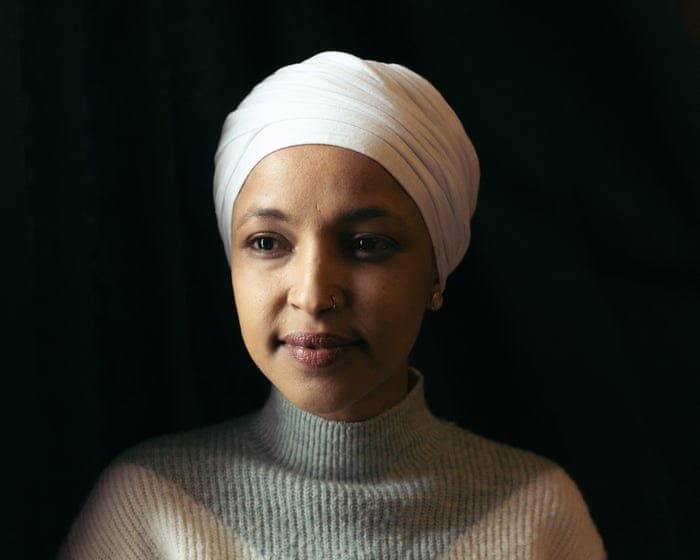
View image in fullscreen: The US representative Ilhan Omar in her office in Washington DC, on 12 December 2025. Photograph: Caroline Gutman/The Guardian
“That’s Teddy,” said Tim Mynett, husband of the US representative Ilhan Omar, as their five-year-old labrador retriever bounded around her office on Capitol Hill. “If you make too much eye contact, he’ll lose it. He’s my best friend—and he’s our security detail these days.”
The couple were sitting on black leather furniture around a coffee table. Apart from a sneezing fit that took her husband by surprise, Omar had an unusual Zen-like calm for someone who receives frequent death threats and is the subject of a vendetta from the most powerful man in the world.
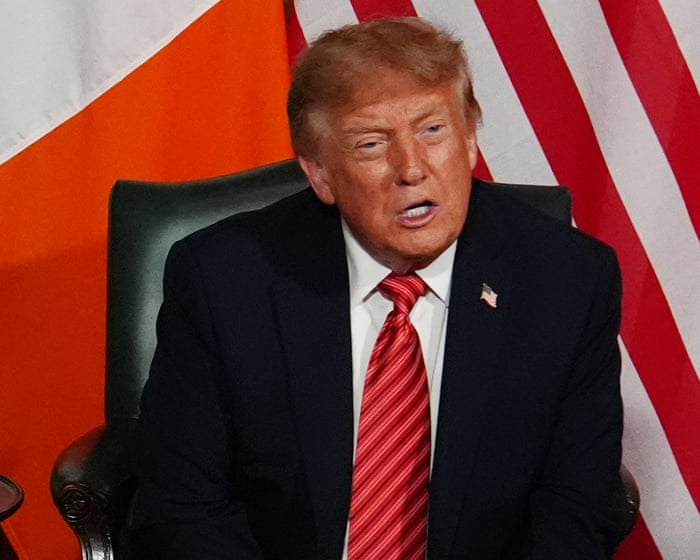
Speaking at a rally…At a rally in Pennsylvania last week, Donald Trump mocked Ilhan Omar’s hijab and falsely claimed that the Somali-born congresswoman married her brother to obtain U.S. citizenship. “Therefore she’s here illegally,” he said. “She should get the hell out. Throw her the hell out! She does nothing but complain.”
The president’s supporters erupted into a chant: “Send her back! Send her back!”
Omar responded to the comments, telling the Guardian on Friday, “They’re vile, and it is, I believe, a really unhealthy and creepy obsession that he has with me.” The 43-year-old, wearing a green, white, and pink striped sweater, added, “Everybody knows I came to the United States at the age of 12 as a refugee and became a citizen when I was 17. I’m a duly elected member of Congress, so my status is not in question in any way.”
Trump was supposed to be discussing the cost of living in Pennsylvania but quickly shifted to familiar xenophobic rhetoric. Omar, a Democrat from Minnesota, noted, “He likes to deflect when things aren’t going well for him. There is a clear failure so far in his presidency. He hasn’t been able to address the affordability issues that the American people are still feeling… Cue the bigotry. It’s the same playbook, and he just goes back to it; he doesn’t know anything else.”
Omar’s office walls are decorated with African-themed art, including a stylized painting of a woman in a colorful head wrap and a piece titled “Djibouti” featuring a drum, mortar and pestle, and a woven basket. Also displayed are a Jet magazine photo of Shirley Chisholm, the first Black woman elected to Congress, and an Essence magazine feature on Omar and other progressive “squad” members.
Born in Somalia, Omar fled the civil war with her family at age eight. They spent four years in a Kenyan refugee camp before arriving in the U.S. in the 1990s. She moved to Minneapolis in 1997 and became a U.S. citizen in 2000. Trump’s fixation on her dates back years. In 2019, he tweeted that Omar and other squad members should “go back and help fix the totally broken and crime-infested places from which they came.”
Trump has also repeatedly promoted the false claim that she married her brother—a rumor that began during her 2016 campaign for the Minnesota House of Representatives. Omar has called it “absolutely false and ridiculous” and provided a timeline of her marital history. Despite lacking evidence, the allegation persists in right-wing media.
Omar compares it to other conspiracy theories from the far right. “This was a story put in a blog that shouldn’t have been taken seriously by any reasonable person,” she said. “But there is, I believe, this severe desire on the right to find extreme ways to dehumanize people they don’t think should be seen as fully human. They keep trying to prove a negative to keep the story alive, like the ‘birther’ conspiracy about Obama or the claim that Hillary Clinton kept babies in a non-existent basement. This is their way of trying to make me into something I’m not.”
Omar married political consultant Tim Mynett in 2020, the same day the U.S. entered pandemic lockdown. Mynett, now 44, is sadly unsurprised by Trump’s latest attacks. “This isn’t our first rodeo,” he remarked. “During Trump’s first term…”He demonized my wife to the point where the U.S. government required us to have a full six-person security detail. “They identified a plot to attack her, and frankly, it was a very patriotic moment for me to learn that there are white men on racist message boards posing as racists to uncover truly evil people and then go out and protect my wife, an immigrant member of Congress,” he said. “That, to me, is one of the essences of America. Sure, it’s nothing new, but it’s upsetting to see this is where the leader of our country wants to focus national attention. It’s just shocking and very upsetting.”
Security is now a paramount concern for every politician. In 2024, the U.S. Capitol Police investigated 9,474 concerning statements and direct threats against members of Congress, including their families and staff—more than double the 2017 total of 3,939. Reminders of America’s surging culture of political violence are everywhere. In the corridors outside Representative Ilhan Omar’s office on Capitol Hill, some of her Republican colleagues have erected tributes to Charlie Kirk, the right-wing youth activist assassinated in September.
Omar’s friend Melissa Hortman, the former Minnesota House speaker, and her husband were shot dead at their home in June by a man disguised as a law enforcement officer. “In many ways, you think, where can you be safe?” Omar said. “When you have the president using dehumanizing language every single day, we know that message reaches the worst possible people in this country, and they then take action. We’ve had people incarcerated for threatening to kill me. We have people being prosecuted right now for threatening to kill me, so it is something that stays in the back of our minds. But I also worry about those people finding someone who looks like me in Minneapolis or across the country, thinking it’s me, and harming them.”
Omar recalled that when she became the first woman of color to represent Minnesota and one of the first two Muslim American women elected to the House of Representatives in 2019, Trump’s attacks led to her receiving the highest level of death threats of any member of Congress. “Now, during the four years when Biden was president, my death threats dropped to almost zero,” she said. “Now they are back up, so there is a clear correlation between his presidency and the political violence we see, as well as the political danger many members of Congress and elected officials feel across the country.”
She is determined not to let Trump’s “deranged attacks” undermine her day job in Congress, which includes voting and providing constituent services for the people who elected her. Her priorities this year have included trying to safeguard healthcare, climate regulations, and democracy while fighting back against Trump’s draconian immigration policies.
This includes her home state. Trump recently labeled Minnesota Somalis as “garbage” and said he did not want them in the U.S. He has linked his administration’s immigration crackdown against the Somali community to a series of fraud cases involving government programs, in which many defendants have roots in the East African country. Omar responded, “He is clearly scapegoating the Somali community. The individuals who committed the fraud have been prosecuted, many have already been sentenced, and there are more investigations and prosecutions to come. I don’t believe a majority of Americans agree that just because one person who shares your ethnicity does something wrong, you should be held accountable for their misdeeds.”
About 84,000 of the 260,000 Somalis in the U.S. live in the Minneapolis-St. Paul area. The overwhelming majority are American citizens. Almost 58% were born in the U.S., and 87% of foreign-born Somalis are naturalized citizens.But in a year where Immigration and Customs Enforcement (ICE) raids have terrorized communities nationwide, with masked agents seizing people from the streets, no one feels safe. This week, the Department of Homeland Security announced that its enforcement actions have led to over 605,000 deportations since January 20, while 1.9 million “illegal aliens” have left voluntarily.
Speaking about Minnesota, Omar said, “We’re seeing people slammed to the ground, handcuffed, detained for hours. We are seeing people told their documents aren’t real. We are seeing people tear-gassed. We saw one person run over on the road, all of it captured on camera. But what he wanted and hoped for was to find an undocumented community.”
“We’ve been here over 30 years. Nearly 60% of Somalis in Minnesota were born in the United States. These are people who have been mobilizing, preparing for his presidency, understanding that we have dealt with authoritarianism and dictatorship, so we are vigilant. The community is showing just how resilient it is.”
In his Pennsylvania speech, Trump also described Somalia as “the worst country in the world,” stating, “They have no military. They have nothing. They have no parliament. They don’t know what the hell the word parliament means. They have nothing. They have no police. They police themselves. They kill each other all the time.”
After years of denial, the president also admitted that a report from his first term was true: he did refer to African nations as “shithole countries” and expressed a preference for “nice” immigrants from Norway, Sweden, and Denmark—countries with predominantly white populations—over “filthy, dirty, disgusting, crime-ridden” Somalia.
When the rest of the world watches these performances, what must they think? Omar replied, “I believe it degrades our standing as Americans that we could elect someone who is not only a national embarrassment but an international one.”
“There isn’t a single thought the president expresses that is dignified. As Americans, we want to see ourselves as dignified people and wish to be represented by someone who carries themselves with dignity. I just cannot believe we have a president who denigrates Americans and different parts of America on a national and international stage every single day.”
The international community has also watched the U.S.’s drift toward authoritarianism with consternation and alarm. Democracy will survive, Omar insisted, “but in a very fragile way. His presidency has exposed some weaknesses and taught us that, while our institutions are strong, they are fragile against a dictatorship-like ruler. We must do more to create stronger guardrails to ensure the independence of our institutions remains.”
Despite his strongman posturing, opinion polls show Trump is now deeply unpopular, especially for failing to address America’s affordability crisis. Republicans suffered a major defeat in last month’s elections in New Jersey, Virginia, and New York, where democratic socialist Zohran Mamdani won the mayoral race decisively.
Omar believes Democrats can learn from Mamdani as they approach next year’s midterm elections for Congress. She said, “The biggest lesson from that election is how desperately the American electorate needs candidates to be authentic, to be themselves, and to talk about what really impacts their lives.”
“His focus on creating a more affordable New York, his focus on meeting people where they were, his focus on not talking down to people but…”I believe what won him the election was being in genuine conversation with people, and that’s what others need to do to succeed.
Mynett added, “I’m no politician, but I’d also say that young man’s fearlessness was incredibly contagious and inspiring—I think that’s another big reason he ended up where he did.”
Speaking of fearlessness, Mynett admires no one more than his wife. As he reflected on Omar’s courage under fire, he instinctively reached over and touched her arm. “The congresswoman always shows grace under pressure,” he said. “For anyone in the world to be targeted the way she has been—I’ve never met anyone who handles it better than my wife.
“Often I think back to all the trials she’s faced in her life—coming here as a child war refugee, there’s so much—but I don’t even think it’s that. I don’t believe it’s just her experiences. I think it comes from the core of who she is. She knows why she’s here, and she’ll never be shaken by anyone’s racist or bigoted actions toward her.”
Frequently Asked Questions
Of course Here is a list of FAQs about Ilhan Omars statement that Donald Trumps attacks represent an unhealthy and creepy obsession framed in a natural tone
FAQs Ilhan Omars Comments on Trumps Obsession
BeginnerLevel Questions
1 What exactly did Ilhan Omar say
She stated that former President Donald Trumps frequent and targeted attacks on her are an unhealthy and creepy obsession
2 When and why did she say this
She has made comments to this effect multiple times over several years often in response to specific incidents where Trump publicly singled her out criticized her or shared derogatory content about her online
3 What is she referring to as attacks
She is referring to Trumps repeated verbal and online criticisms which have included telling her and three other Congresswomen of color to go back to their countries labeling her as antiAmerican and antiSemitic and sharing edited videos that falsely portray her as being dismissive of the 911 attacks
4 Why does she call it unhealthy and creepy
Unhealthy suggests the behavior is disproportionate persistent and damaging to public discourse
Creepy implies the fixation feels personal invasive and goes beyond normal political criticism
Advanced Contextual Questions
5 Is this just a political disagreement or is it something more
Omar and her supporters argue it transcends standard political rivalry pointing to a pattern of singling her out with rhetoric they view as rooted in xenophobia and Islamophobia Critics of Omar argue Trump is simply engaging in hardball politics against a frequent critic
6 What are the potential benefits of her framing it this way
Political Framing It reframes Trumps attacks from legitimate criticism to a personal vendetta
Mobilizing Support It can galvanize her base and draw attention to what she sees as bigoted rhetoric
Shifting Focus It directs the conversation toward the nature of the attacks rather than the specific accusations
7 What are common criticisms or problems with her characterization
Political Strategy Critics say its a deliberate tactic to deflect substantive criticism of her own policy positions and statements by playing the victim