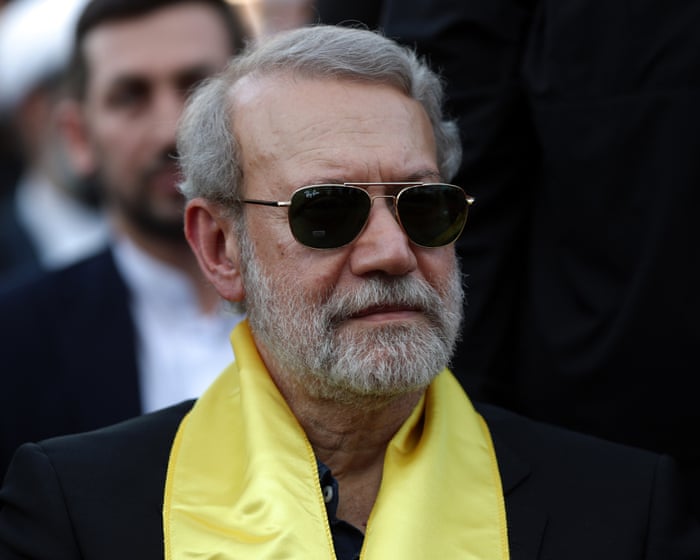
Israel claims to have killed a key Iranian political figure, national security chief Ali Larijani, in overnight strikes. If confirmed, this would make him the most senior Iranian official to die in the war since Supreme Leader Ali Khamenei was killed on the first day. Iran has not yet commented on the claim. Larijani’s death would remove a pivotal figure at the heart of the regime during a time of acute crisis, dealing a devastating blow.
Israeli Defense Minister Israel Katz said a separate strike killed Basij paramilitary force commander Gholamreza Soleimani and other senior Basij figures. Katz stated on Tuesday, “Larijani and the Basij commander were eliminated overnight and joined the head of the annihilation program, Khamenei, and all the eliminated members of the axis of evil, in the depths of hell.”
Iranian state media published a handwritten note by Larijani, who was effectively leading the political strategy behind Iran’s war effort, commemorating sailors killed in a U.S. attack. Their funeral is expected on Tuesday. However, the note does not prove he was still alive, as it was likely written before the Israeli strike.
If confirmed, these deaths demonstrate that Israel still possesses intelligence on the movements of Iran’s top leaders within Tehran and can use it, along with near-total U.S. control of Iranian airspace, to strike at will.
Larijani was seen days earlier on the crowded streets of Tehran during the annual Quds Day rally. He was appointed secretary of the Supreme National Security Council in August, following previous U.S.-Israeli attacks on Iran in June 2025. On Monday, he issued a statement appealing to Muslims worldwide to support Iran and challenging Gulf state leaders to explain why they continue to allow U.S. bases in their countries to be used against Iran.
Before the war, Larijani played a key diplomatic role alongside Foreign Minister Abbas Araghchi, attempting to persuade Gulf states to prevent an attack on Iran. He also visited Muscat, Oman, to meet with mediators.
The office of Israeli Prime Minister Benjamin Netanyahu stated that he had ordered “the elimination of senior officials of the Iranian regime.”
The U.S.-Israeli war on Iran is in its third week, with at least 2,000 people killed and no end in sight. The Strait of Hormuz remains largely closed, and U.S. allies have rejected calls from President Donald Trump to help reopen the vital waterway, through which about 20% of global oil and liquefied natural gas flows.
In the handwritten statement issued by Iranian state TV, Larijani praised the bravery of Iranian sailors killed when their ship was hit by missiles fired from a U.S. submarine off the Sri Lankan coast. He wrote, “Their memory will always remain in the heart of the Iranian nation, and these martyrdoms will strengthen the foundation of the Islamic Republic army for years within the structure of the armed forces.”
More than any other Iranian politician, Larijani combined Iran’s military and political strategy. His death underscores the dominant role of the Islamic Revolutionary Guards Corps (IRGC) in Iranian politics. On Monday, former long-time IRGC commander Mohsen Rezaee was appointed military adviser to the new supreme leader. Larijani had been seen as a pragmatic figure who helped steer nuclear negotiations with the West, but that image hardened after Khamenei’s death. Hours after U.S. and Israeli strikes killed Khamenei, Larijani delivered a defiant message, warning that Iran would make its enemies “regret” their actions and promising a forceful response.
An Israeli official said a strike on Larijani had originally been planned for the pre-dawn hours.The strike, originally planned for the previous night, was postponed at the last minute. According to the official, intelligence received Monday afternoon indicated Larijani was due to arrive at one of several apartments he used as a hideout. He was reportedly there with his son when the attack occurred.
Early Tuesday, as news spread that he had been targeted and his fate remained unclear, another senior Israeli official stated, “there was no chance he survived this attack.”
Born in Najaf, Iraq, in 1958, Larijani studied in Tehran and rose through the ranks of the state after the Islamic Revolution. He served as culture minister, head of state broadcasting, and for over a decade as speaker of parliament.
As chief nuclear negotiator, he played a key role in shaping Iran’s engagement with world powers and later backed the 2015 nuclear deal.
Though often seen as a pragmatist within the system, his stance had hardened in recent months as tensions with Israel and the U.S. escalated and diplomatic efforts faltered.
The U.S. had offered a reward of up to $10 million for information on senior Iranian military and intelligence officials, including Larijani, as part of a list of ten figures linked to the Islamic Revolutionary Guard Corps.
If Larijani’s death is confirmed, the number of senior Iranian officials killed by Israel since the start of the latest conflict would rise to ten. Among them are five other senior military commanders, including Ali Shamkhani, a close adviser to the supreme leader.
For the past several hours, massive explosions have been reported in various parts of Tehran and other cities across the country, including Ahvaz, Isfahan, and Shiraz.
Frequently Asked Questions
Disclaimer The following FAQ is based on unconfirmed reports from Israeli media As of the time of this writing there is no official confirmation from Iranian Israeli or other major international sources regarding the death of Ali Larijani This information should be treated as a rumor
Frequently Asked Questions
BeginnerLevel Questions
1 Who is Ali Larijani
Ali Larijani is a senior Iranian conservative politician and former speaker of Irans parliament He has held several highlevel security and governmental positions including Secretary of the Supreme National Security Council He is a key figure in Irans political establishment
2 Is it confirmed that he was killed
No As of now the reports are solely from certain Israeli media outlets and have not been officially confirmed by Iranian state media the Iranian government or Israeli militarypolitical officials Such reports should be considered unverified until confirmed by reliable official sources
3 What is an airstrike and who might have carried it out
An airstrike is an attack launched from an aircraft such as a fighter jet or drone The reports do not specify who carried out the alleged strike In the context of regional tensions speculation often points to Israel which has conducted strikes in Syria and the region against Iranianlinked targets
4 Why would someone target him
Ali Larijani as a former top security official and influential political figure is a symbol of the Iranian establishment Targeting such a figure would be a significant escalation potentially intended to destabilize Irans leadership or retaliate for Iranian actions in the region
Advanced Contextual Questions
5 What is the Supreme National Security Council in Iran
The SNSC is Irans highest security and defense policymaking body It coordinates all security intelligence military and foreign policy matters related to national security The Secretary of this council is a critically powerful position appointed by the Supreme Leader
6 How credible are these initial Israeli media reports
While some Israeli media have reliable intelligence sources initial reports on sensitive security matters can sometimes be inaccurate speculative or based on partial information It is a standard practice in journalism and intelligence analysis to await confirmation from multiple authoritative channels before considering an event as fact