Nearly 50,000 people have fled a sudden advance by Houthi forces in western Yemen, leaving entire villages empty and families trapped near frontline fighting with dwindling food supplies, according to aid workers. Civilians in the Middle East’s poorest country have become victims of a global struggle for control over one of the world’s most important shipping routes, threatening to turn Yemen’s intermittent conflict into a permanent war. In a lightning advance this week, the Iran-backed Houthi militants have seized a series of towns along the Red Sea coast from forces loyal to the US- and Saudi-backed Yemeni government. Hundreds of people are reported to have been killed. Many fear a return to the full-scale civil war that killed 150,000 people and pushed many others to the brink of famine.
The UN International Organization for Migration (IOM) said on Friday that 46,000 people had been displaced across Taiz and Hodeidah provinces, where steep green mountain ridges give way to dry coastal plains. For many families, this was the second or even third time they had been forced from their homes.
A significant number of people were seen leaving the city with their belongings. Fighting has cut key roads, and phone lines are down in some areas. “The scale of displacement is increasing rapidly,” said Joe Lowry, IOM’s Middle East and North Africa spokesperson in Cairo.
The most urgent needs were emergency shelters, cash assistance, food, drinking water, household items, healthcare and protection services. “Civilians are bearing the brunt of renewed frontline warfare, airstrikes, shelling, and large-scale displacement,” Lowry said. “Many of those fleeing have arrived with very few belongings after leaving suddenly, due to shelling and frontline advances.”
Lowry said aid workers were having to constantly reassess access and adapt movements as the situation changed. “It’s a highly fluid and uncertain situation marked by rapid territorial changes, population movements and growing concern among communities about further escalation,” he said.
The Houthi advance has come unexpectedly and fast, particularly the fall of the strategic port city of Mocha – widely regarded as the birthplace of the global coffee trade and the origin of the word for chocolate-flavored coffee.
Mohamed, 46, who left Mocha in the middle of the night, told Agence France-Presse there was an “apocalyptic” atmosphere in the city. Another man, Mujahid Tahami, who set off for the southern government-held city of Aden, said some families had fallen victim to “looting by gangs as they tried to flee.” Others reported that they had managed to flee in time, some on motorbikes, but other family members were not so lucky and were stuck.
Yemen analysts have long criticized the US and its allies for taking a security-focused approach to the country that undervalues diplomacy and development. Washington launched a campaign of drone attacks against Sunni al-Qaida militants for much of the 21st century, but did not pay significant attention to the hardline Shia Houthi insurgency until its forces claimed the capital in 2014.
By taking control of key areas this week, including islands off the coast, the anti-west Houthis hope to gain a direct presence near the Bab al-Mandab strait, a 20-mile stretch of water and vital trade and energy route that connects Asia with Europe. The strait’s name is roughly translated as “tThe “Gate of Tears” or “Gate of Grief” — its strong currents and winds made the passage between the Arabian Peninsula and Africa’s east coast hazardous for centuries. Modern cargo ships have no physical trouble passing through. But if the Houthis were to close this natural chokepoint, the impact on the global economy could be disastrous. Ships would have to reroute around the southern tip of Africa, adding thousands of extra nautical miles. The fighting has already pushed the price of oil above $100 a barrel after weeks of trading closer to $80.
The fighting in Yemen, along with Houthi missile strikes on Saudi Arabia, represents the most significant violence in the country since the UN-brokered peace plan in 2022.
The UN special envoy for Yemen, Hans Grundberg, told an emergency security council meeting on Thursday that the country faced “a new and more dangerous phase of war.”
“This renewed war should alarm us all,” Grundberg said. “It effectively marks the end of the relative calm that Yemen has experienced for over four years since the UN-brokered truce. It not only threatens to plunge Yemen into a prolonged and expanding war, but also risks yet again dragging the country into the wider and unresolved regional confrontation, with global repercussions.”
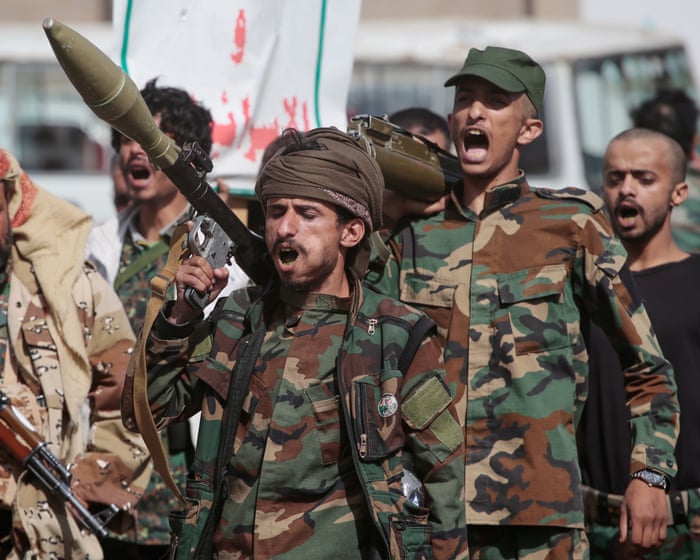
‘Civilians are bearing the brunt of renewed frontline warfare, airstrikes, shelling, and large-scale displacement,’ said Joe Lowry of the IOM. Photograph: Yahya Arhab/EPA
Instability in Yemen has been exploited by regional powers such as Saudi Arabia, Iran and the United Arab Emirates to fight proxy battles, and the failure to end the violence has led to the growth of powerful militias. The US-Israeli war on Iran has only heightened tensions, with regional animosity at an all-time high.
This has compounded one of the world’s worst humanitarian crises. The most recent UN humanitarian report, released last month, warned that the country of 40 million was facing a deepening malnutrition crisis, with roughly half the population facing acute food insecurity nationwide.
“Years of conflict, economic deterioration, displacement, climate-related shocks and regional tensions have steadily weakened livelihoods and household resilience,” the report warned. “At the same time, declining humanitarian funding and operational constraints are limiting the ability of aid organisations to provide assistance at the scale required.”
On the Red Sea coast, those who escaped the latest wave of fighting survived, but were left in shock.
“It’s a catastrophe, and the attacks are ongoing,” said Mohammed Khudairi, who fled the fighting to a displacement camp of wood-and-straw huts near the areas of Khokha. “We managed to leave, but others remain trapped there.”
Frequently Asked Questions
Here is a list of frequently asked questions about the displacement of nearly 50000 Yemeni civilians due to Houthi advances along the Red Sea coast
The Basics
What is happening in Yemen right now
Houthi forces are advancing along the Red Sea coast This fighting has forced nearly 50000 civilians to flee their homes in search of safety
Who are the Houthis
The Houthis are a political and armed group that controls large parts of Yemen including the capital Sanaa They have been fighting a civil war against the internationally recognized Yemeni government and a Saudiled coalition since 2014
Where exactly are people fleeing from
People are fleeing from areas along the western Red Sea coast This includes key port cities and surrounding towns that have become active frontlines in the conflict
Why are they fleeing
They are fleeing to escape the immediate dangers of war This includes airstrikes ground fighting artillery shelling and the fear of being caught in the crossfire between opposing forces
Where are these people going
Most are moving to safer areas inland or further south such as displacement camps or host communities in other governorates Many are heading toward cities like Aden or Marib which are considered safer
Deeper Questions
What is the Red Sea coast and why is it important
The Red Sea coast is Yemens western border It is strategically vital because it includes major ports like Hodeidah which are crucial for bringing food fuel and humanitarian aid into the country Controlling this coast is a major military objective
Is this a new crisis
No this is a new wave in a longrunning crisis Yemen has been in a state of civil war for nearly a decade However this recent advance has caused a sudden and massive new displacement of people in a short period
What is the difference between a migrant and a displaced person
A migrant chooses to move often for work or better opportunities A displaced person is forced to flee their home due to conflict violence or disaster but remains inside their own country The Yemeni civilians are IDPs
How does this compare to previous displacement waves in Yemen
Yemen already had one of the worlds largest displacement crises