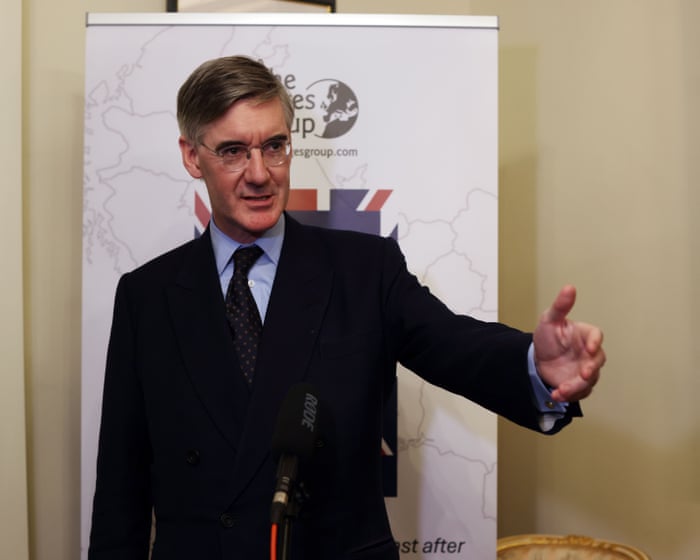
All the old gang were there: a reunion of the Brexit triumphalists. I was among the guests in the stately drawing room of Jacob Rees-Mogg’s Georgian townhouse in Westminster last week, as the Bruges Group gathered to celebrate the launch of the new book 75 Brexit Benefits: Tangible Benefits from the UK Having Left the European Union. Tory Brexiteers Iain Duncan Smith, Bill Cash, and John Redwood were all present—a gathering of the kind of Eurosceptics John Major once called the “bastards.”
Our host, Rees-Mogg, was in jubilant spirits, celebrating Keir Starmer’s recent speeches that acknowledged the economic damage caused by Brexit. In Labour’s new willingness to touch this live wire, the Bruges Group members welcomed the revival of the old conflict as their path back to the glory days of the referendum. Rees-Mogg chortled: “Starmer’s view that re-entering the European Union is the answer to our economy is as true as everything else he says.” There was much laughter as he left early for his State of the Nation slot on GB News.
Are they right that Labour reopening the Brexit wound will reignite the toxic passions of the referendum? Nothing has ever divided the country as much as that mendacious, xenophobic, and essentially frivolous Leave campaign. Its leaders were in it for fun and personal advancement: the Tory party was destroyed by it, and only Nigel Farage has truly benefited. The bitter campaign split families, workplaces, and neighborhoods, stirring anti-migrant hatred. Nothing in my lifetime has caused such deep political grief.
For all the anguish it caused the losing side, it soon became clear that it brought no corresponding joy to most Leave voters, who are still facing its real-life consequences. Soured political attitudes stem partly from the empty hyperbole of “Take back control” and a “sovereignty” that signifies nothing. Who feels empowered by a country falling further behind? The pernicious warning that 88 million Turks could “flood” into a UK remaining in the EU, and Farage’s “breaking point” poster showing streams of refugee men (not headed to the UK), entered the political bloodstream. Now, some of the newly elected Reform politicians are caught in the crudest racism, echoed by a Tory party unrecognizable from the days when Enoch Powell was ejected from the shadow cabinet for “racialist” speech—Robert Jenrick would have been shown the door back then.
Until now, Labour has lived in fear of the demagoguery that the referendum unleashed. It seemed best to pretend to agree, despite knowing that “making Brexit work” was impossible. Drawing red lines against joining the customs union and single market is now as deeply regretted by many in Labour as the manifesto’s fateful tax constraints. But the dam has broken because the truth about Brexit’s impact on UK growth can no longer be disguised.
At last, Starmer publicly acknowledges that Brexit “significantly hurt our economy” when “wild promises were made to the British people and not fulfilled.” Rachel Reeves first dared to speak the forbidden words, stating: “The cuts to capital spending and Brexit have had a bigger impact on our economy than was even projected back then.” Wes Streeting said Labour should undo “the economic damage done by Brexit,” while David Lammy refused seven times in one interview to rule out reversing Brexit, arguing it had “badly damaged our economy” and that Britain needs closer integration with Brussels—though rejoining the customs union was not “currently” government policy. No one will be sacked for breaking the line. Let’s have more ministerial truth-tellers preparing the country for the rocky trade-offs on the long, potholed road back. To deter others, Britain won’t get any deals that make leaving the EU look anything but semi-suicidal. Other models beckon—Switzerland and Norway—but they come at a cost in money and freedom.The Tories are gloating that Labour has fallen into the “remainer trap.” The Mail accuses Keir Starmer of wanting to “unravel Brexit,” while the Telegraph writes of a “cabal of remoaners” in a “plot to reverse Brexit.” But that old tactic may no longer work, now that the public views Brexit as a calamity by 56% to 31%. Even the overwhelmingly pro-Brexit media struggle these days to find tangible benefits; those much-touted trade deals outside Europe offer minuscule gains compared to what has been lost.
Worse reports arrive weekly. The latest comes from economists John Springford and Andrew Sissons, whose detailed analysis shows this trading nation floundering after being cut off from the EU. Grim new research from the National Bureau of Economic Research puts the cumulative loss so far at 6-8% of GDP—amounting to £240 billion in wealth and £90 billion in tax revenue every year. Consider how that would have changed last month’s budget.
“You do not need to have a PhD in economics to know that erecting unnecessary trade barriers with your biggest trading partner will hurt growth and raise the cost of living,” Starmer wrote in the Guardian.
This Labour shift may warm the hearts of some remainers, but as with its decision to scrap the two-child benefit cap, has it come too late to win back defectors who were repelled by political cowardice until now? Twice as many Labour voters are considering switching to the Liberal Democrats and Greens as to Reform—a fact that has finally reached strategists who had been overly focused on regaining Farage supporters.
Monday’s meeting of Volodymyr Zelenskyy, Friedrich Merz, and Emmanuel Macron at No. 10 underscores the urgent need for unity in the face of crisis, though the collapse of UK negotiations on defence contributions shows that no EU deals are easy, no matter how urgent.
Meanwhile, in the Rees-Mogg circle, their book of 75 “alternative facts” seemed like a relic from a bygone era. Unfortunately, the facts that are true are insignificant, while Brexit’s economic tsunami is airbrushed away. Some facts are correct: yes, we can have stricter animal protection laws since leaving Europe. Some are not: the cost of motor insurance is rising far more slowly in the EU than in the UK. Yes, Brexit made it possible to reduce the price of already-cheap bananas even further. And yes, we do escape £14-19 billion in EU contributions—but missing from this text is the up to £90 billion a year lost in Treasury revenues.
“You lot only talk economics. We talk of freedom that has no price,” a Bruges Group member tells me. That’s a good reminder of how they won the referendum: these cavalier romantics trounced the roundhead number-crunchers of the remain campaign. Surely the country wouldn’t be fooled by the same trick twice.
Polly Toynbee is a Guardian columnist.
Frequently Asked Questions
Of course Here is a list of FAQs about the topic Join me for a visit to Jacob ReesMoggs home The Brexit supporters are clearly shakenand it shows
General Context
Q Who is Jacob ReesMogg
A He is a prominent British Conservative politician and a very vocal traditionalist supporter of Brexit
Q What is this visit referring to
A It likely refers to a media segment interview or documentary where a journalist visits his home or constituency to discuss the current state of Brexit and its supporters
Q What does Brexit mean
A Brexit is the term for the United Kingdoms decision to leave the European Union which happened formally in 2020 after a 2016 public vote
About the Topic Reaction
Q Why would Brexit supporters be shaken
A Since Brexit the UK has faced various challenges including economic difficulties trade disruptions and political turmoil Some supporters may be disappointed that the promised benefits have been slow to materialize or overshadowed by problems
Q What does and it shows mean in this context
A It suggests that during the visit the interviewer observed clear signs of doubt frustration or defensiveness in ReesMogg or other Brexit supporters featured which they couldnt hide
Q Is this a pro or antiBrexit piece
A The title suggests a critical perspective aiming to show that even strong advocates are feeling unsettled by the current outcomes Its likely analyzing the gap between Brexit promises and reality
Q What kind of signs might show they are shaken
A This could include defensive body language conceding certain points expressing frustration with the current governments handling or acknowledging unforeseen complications
Deeper Analysis Implications
Q If a figure like ReesMogg seems shaken what does that signal
A It signals that the political narrative around Brexit is shifting When its most steadfast champions show doubt it can reflect a broader reassessment happening among the public and within the political movement
Q What are the main problems causing this reaction
A Key issues include complex trade barriers with the EU labor shortages in certain sectors increased bureaucracy for businesses inflation and ongoing disputes over Northern Irelands trade status