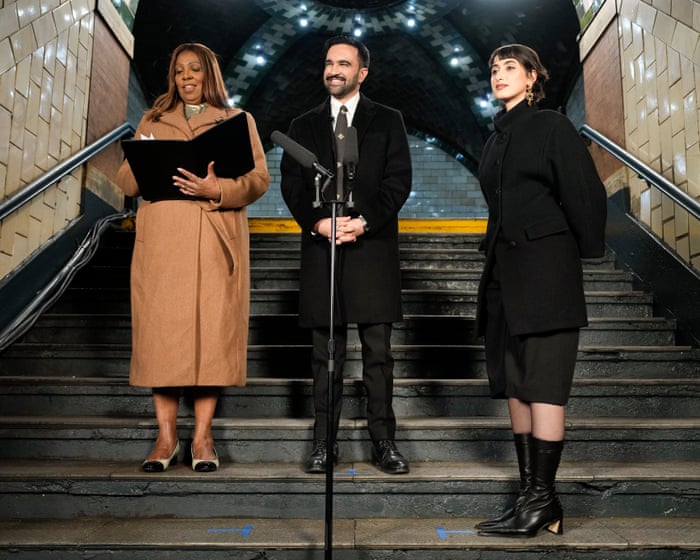
Zohran Mamdani was sworn in as mayor of New York City shortly after midnight in a private ceremony held in an abandoned Beaux-Arts subway station. This intimate event set the stage for a full day of celebrations, including a second, public swearing-in and a block party outside City Hall.
The 34-year-old Mamdani took the oath of office from New York Attorney General Letitia James. He was surrounded by his wife, Rama Duwaji, and members of his immediate family, including his mother, filmmaker Mira Nair, and his father, Mahmood Mamdani, a professor of African studies at Columbia University.
“This is truly the honor and the privilege of a lifetime,” Mamdani said. “I cannot wait to see everyone tomorrow as we begin our term.” He noted the significance of the location, the old City Hall subway station, calling it “a testament to the importance of public transit to the vitality, the health, the legacy of our city.”
Mamdani then introduced and welcomed the city’s new transportation commissioner, veteran city planner Mike Flynn. The mayor expressed his ambition to make New York’s public transit network “the envy of the world,” to which Flynn responded that he was accepting the “job of a lifetime.”
“Thank you all so much … and I will see you later,” Mamdani concluded, drawing laughter from the audience before departing up the wide subway stairs, followed by attendees.
The ceremony was also attended by outgoing mayor Eric Adams, who had initially been noncommittal but later said he wanted to be there “to show the smooth, peaceful transition of power.”
In honor of his Muslim faith, Mamdani was sworn in using a Qur’an, becoming the first New York City mayor to do so. He used his grandfather’s Qur’an and one that belonged to Black writer and historian Arturo Schomburg, which was lent by the New York Public Library.
A diverse group of New Yorkers selected by Mamdani for an inaugural committee also attended, including actor John Turturro, playwright Cole Escola, writer Colson Whitehead, as well as advocates, small business owners, and campaign workers who provided “perspective, guidance and cultural sensibility” for the event.
The midnight ceremony will be followed by a 1 p.m. public event where the new mayor will be introduced by political ally and Bronx Democratic Congresswoman Alexandria Ocasio-Cortez and sworn in by Vermont Senator Bernie Sanders.
Mamdani’s office stated that choosing the old City Hall subway station for the swearing-in reflected his “commitment to the working people who keep our city running every day.” In a statement, Mamdani said the station, which opened in 1904, represented “a city that dared to be both beautiful and build great things that would transform working people’s lives,” adding, “That ambition need not be a memory confined only to our past.”
The day’s events mark the culmination of a remarkable rise to power in the nation’s most populous city, both for Mamdani—a former political unknown—and for the democratic socialist movement he represents, though he was elected as a Democrat.
The first signs of Mamdani’s electoral potential emerged earlier in the year ahead of a primary vote where he defeated former governor Andrew Cuomo, who later ran as an independent. Mayor Adams, then under federal scrutiny, chose not to seek the Democratic nomination.
In April, Mamdani was trailing Cuomo 36% to 64%. Those numbers shifted after Mamdani’s savvy social media campaign took off and his robust grassroots efforts energized first-time voters struggling with the high cost of living in the post-pandemic economy.In a pandemic-stricken city, a campaign spokesperson credited Mamdani’s success to his relentless presence—”being everywhere all of the time.” With the help of over 10,000 volunteers who knocked on more than 100,000 doors, he advanced a platform focused on affordability, rent freezes, free metro transportation, city-run grocery stores, and the creation of a community safety department to invest in mental health programs across the city.
Democratic campaign veteran Hank Sheinkopf remarked that Mamdani “represents the city of the future—a more Asian city, a more Muslim city, and what could be a more leftwing city.”
In November, then-state assemblyman Mamdani won the election with 50.78% of the vote, defeating Republican activist Curtis Sliwa and Cuomo. In his victory speech, he affirmed his commitment to working New Yorkers who have long been shut out from the levers of power.
“Let the words we’ve spoken together, the dreams we’ve dreamt together, become the agenda we deliver together,” he declared. “New York, this power, it’s yours. This city belongs to you.”
Frequently Asked Questions
Of course Here is a list of FAQs about Zohran Mamdani being sworn in as Mayor of New York City written in a natural tone with clear direct answers
Basic Information FactChecking
Q Is Zohran Mamdani really the new mayor of New York City
A No this is not correct As of now Zohran Mamdani has not been sworn in as Mayor of New York City Eric Adams is the current mayor
Q Who is Zohran Mamdani then
A Zohran Mamdani is a New York State Assemblymember He represents District 36 in Queens He is a member of the Democratic Socialists of America
Q Where did this rumor come from
A It likely stems from confusion or satire Mamdani is a prominent progressive figure in NYC politics who is often discussed as a potential future candidate for higher office but he has not run for or won the mayoralty
Political Context Career
Q What does Zohran Mamdani do as a State Assemblymember
A He proposes and votes on state laws advocates for his districts needs in Albany and works on issues like housing healthcare and workers rights He is known for pushing progressive policies like Good Cause Eviction to protect tenants
Q Is he planning to run for mayor in the future
A He has not officially announced a campaign for mayor However his high profile and policy goals lead many political observers to believe he may consider a run for citywide office like mayor or public advocate in a future election cycle
Q What are some of his main policy positions
A His key focuses include
Housing Fighting for stronger tenant protections and against real estate speculation
Healthcare Advocating for a singlepayer universal healthcare system in New York
Transportation Supporting improved and free public transit
Taxation Pushing for higher taxes on the ultrawealthy to fund social services
Hypothetical Advanced Questions