I’ve been lucky enough to attend six Summer Olympic Games, but I’d never photographed a Winter Olympics before. They’ve always been too far away, and the UK has never been a major snowsport country, which limited their news appeal. This time was different. With Team GB anticipating a record medal haul and the Games held in northern Italy, I headed off with nervous excitement, drawn by the promise of fast-paced action sports set against beautiful snowy landscapes. I covered ski jumping, big air, ice hockey, biathlon, curling, and much more. A lot of it was new to me, but it was very enjoyable. There were new rules to learn and new challenges to face—I’ve certainly never had to wear sharp crampons at a football match.
The Games were full of contrasts. From a sporting perspective, the gentle grace of figure skating was offset by the full-on brutality of ice hockey brawls, while the delicate precision of curling was juxtaposed with the frantic chaos of short-track speed skating. Geographically and culturally, Livigno, perched high in the Alps near Switzerland, felt like a giant playground for modern snow sports—geared toward those who love to twist and twirl high in the sky—while Cortina, in the Dolomites, was far more old-fashioned and populated by the traditional skiing establishment. Milan, meanwhile, featured a cluster of modernist, edge-of-town arenas, with international fans happily taking the metro to and from events. But in my experience, transportation wasn’t always so convenient. The extensive travel between venues—I went to all but one—was exhausting, and catching a late-night bus over the mountains between Livigno and Bormio in a blizzard felt a bit hairy.The Latvian four-man bobsleigh team, led by pilot Jekabs Kalenda, at the Cortina Sliding Centre.
Austria’s Jonas Müller and Thomas Steu on their way to winning silver in the luge team relay.
The Unipol Forum in Assago, on the southern outskirts of Milan, which hosted short-track speed skating and figure skating.
Michelle Velzeboer of the Netherlands crashes in front of South Korea’s Choi Min-jeong in the final of the short-track speed skating women’s 3,000m relay.
USA’s Jordan Stolz on his way to silver in the men’s 1500m speed skating at the Milano Ice Park.
Team GB’s Charlotte Bankes (right) takes the final jump ahead of Italy (left) and France (centre) to win gold with her teammate Huw Nightingale in the mixed team snowboard cross final in Livigno.
Tormod Frostad of Norway on his way to victory in the men’s freestyle skiing big air final at the Livigno Snow Park.
A spectator sits in a deckchair with German and Swiss flags as heavy snow falls during the men’s freestyle skiing big air final.
Many winter sports are extremely fast. Lugers fly past at up to 93mph, and you often can’t see skiers coming over the slopes, so sometimes you only have milliseconds to react. There’s also a lot of jeopardy in winter sports, and the favourites don’t always finish—as was the case with American Lindsey Vonn, who crashed out of the slalom while I was waiting at the bottom of the slope hoping for a moment of triumph.
But I was in the right place at the right time for Matt Weston as he won his first gold medal for Britain in the skeleton. I’d seen him finish his previous runs and knew how far down the track he’d slide before getting up to celebrate. I also knew where his parents and fiancée were standing and imagined he’d react toward them. I got myself in exactly the right position, and he celebrated just as I hoped he would.
Matt Weston of Great Britain cannot contain his joy after sealing gold in the men’s skeleton.
American fans in shock at the finish line as they watch images of Lindsey Vonn crashing out of the women’s slalom.
Japan’s Ryoyu Kobayashi jumps during the men’s normal hill ski jumping at the Predazzo Ski Jumping Stadium.
A light show illuminates the ice before the men’s 1500m speed skating.
A multiple exposure of the South Korean team as they sweep a stone toward the house during their round-robin victory over Team GB in the women’s curling.
Dutch fans cheer as Kjeld Nuis of the Netherlands is introduced to the crowd before he went on to win bronze in the men’s 1500m speed skating.
Omar Visintin of Italy puts the brakes on after finishing his leg in the mixed snowboard cross quarter-final in Livigno.
Canada’s Sam Bennett (left) collides with Finland’s Niko Mikkola (centre), and they knock the goal off its moorings during their men’s ice hockey semi-final.
Kellie Delka of Puerto Rico competes on her second run in the women’s skeleton at the Cortina Sliding Centre.Tina Sliding Centre. Photograph: Tom Jenkins/The Guardian
Great Britain’s men’s curling team—Kyle Waddell, Hammy McMillan, Bobby Lammie, Grant Hardie, and Bruce Mouat—look disappointed after receiving their silver medals. Photograph: Tom Jenkins/The Guardian
Yuliia Dzhima of Ukraine competes in the women’s 15km individual biathlon. Photograph: Tom Jenkins/The Guardian
USA’s Breezy Johnson holds up an American flag after winning gold in the women’s alpine downhill skiing at the Tofane Skiing Centre near Cortina. Photograph: Tom Jenkins/The Guardian
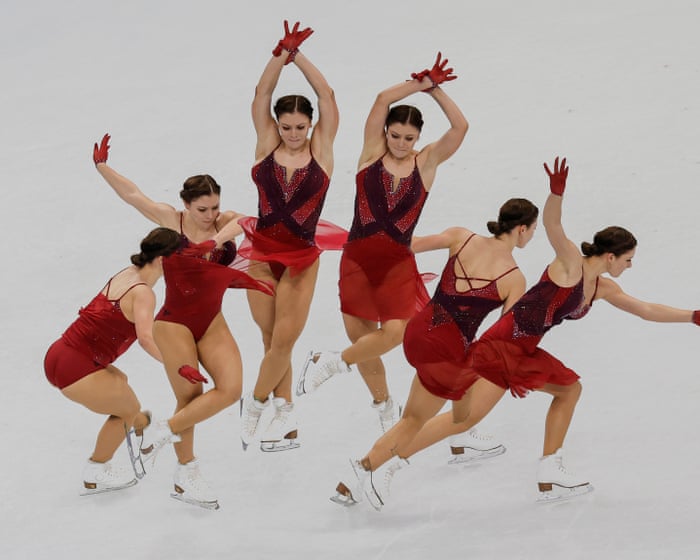
A multiple exposure captures Sofia Samodelkina of Kazakhstan spinning in the free skating portion of the women’s figure skating. Photograph: Tom Jenkins/The Guardian
Matilde Schwencke of Chile takes a jump near the end of the course, eventually finishing 27th in the women’s alpine downhill skiing. Photograph: Tom Jenkins/The Guardian
Vladyslav Heraskevych of Ukraine wears a helmet showing Ukrainian athletes killed in the war. His refusal to change his headgear led to disqualification by the IOC. Photograph: Tom Jenkins/The Guardian
While photographing the ski jumping, I wanted to create something more artistic. As the athletes flew through the dark sky past the floodlights, they looked otherworldly. I thought over-exposing them in-camera might make them resemble astronauts. I tried it, and it worked—their bodies were almost entirely silhouetted. A silhouette is usually a dark subject against a light background, but I wondered, “Why not the other way around?” Looking back, that’s one of my favorite images from the Games.
Ren Nikaido of Japan jumps during the men’s normal hill ski jumping on day three at the Predazzo Ski Jumping Stadium. Photograph: Tom Jenkins/The Guardian
Frequently Asked Questions
Of course Here is a list of FAQs about Tom Jenkins top Olympic Winter Games photos framed around the themes of Crampons Crashes and Creativity
General Beginner Questions
Q Who is Tom Jenkins
A He is an awardwinning sports photographer for The Guardian and The Observer famous for his dramatic and artistic photos of the Winter Olympics
Q What does Crampons Crashes and Creativity refer to
A Its a catchy way to describe the three key elements he often captures the specialized gear athletes use the highspeed drama and falls and his unique artistic eye in framing the action
Q Where can I see these photos
A They are regularly published in The Guardian and on their website during the Games You can also find curated collections in their Sport photography section
Q Why are his photos so popular
A They go beyond just showing who won He captures the raw emotion extreme conditions and breathtaking moments of athletic struggle and triumph making you feel like youre there
About the Crampons
Q Whats so interesting about photos of equipment like crampons or skis
A These closeup shots tell a story of precision and extreme conditions A closeup on a bobsled runner or a ski edge cutting into ice highlights the fine margins and technology behind the sports
Q How does he make snow and ice look so dramatic
A He uses light and weather to his advantage Shooting during the golden hour in blizzards or with backlighting can make snow glow or ice sparkle adding mood and texture
Q Does he use special cameras to shoot in the cold
A Yes professional cameras are weathersealed but photographers also use protective housings keep spare batteries warm and often have to shoot through challenging conditions like fog and freezing rain
About the Crashes
Q Is it ethical to photograph athletes when they crash
A Professional sports photographers see crashes as part of the story of competition The focus is on capturing the athletes resilience the moment of drama or the sheer