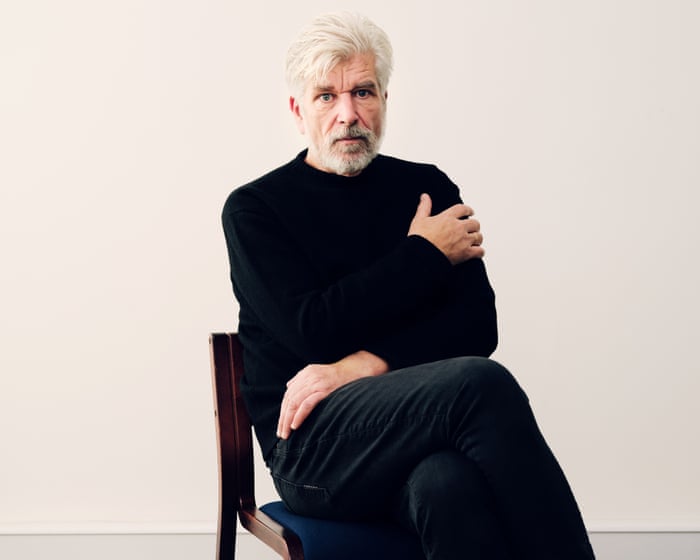
Karl Ove Knausgård’s Morning Star series might end up being even more expansive than his six-volume autofictional bestseller, My Struggle. Four books in, this massive work of supernatural existentialism presents a disturbing tale of the strange events that follow the appearance of a bright new star in the sky. Mysteries from the first three books include: who killed the musicians in the forest? What’s happening with the local wildlife? And why does it seem like no one is dying anymore? By the end of The School of Night, the most pressing question might seem surprisingly ordinary: who is Kristian Hadeland?
Scattered mentions of him appeared in the first 2,000 pages of the saga. In The Morning Star (2021), Kristian Hadeland was the 67-year-old man buried without mourners by the skeptical priest Kathrine Reinhardsen. In The Third Realm (2024), he was the unsettling character who hitched a ride with Kathrine’s husband, despite having supposedly died as the unloved man she buried.
The School of Night provides another perspective. Here, Kristian Hadeland is the author of a 500-page suicide note and the misanthropic narrator of a compellingly dark novel. From a remote Norwegian island where he plans to end his life, Kristian writes the story of how he reached this point, beginning with his time as a photography student in mid-1980s London.
Young Kristian has a good eye and confidence, even though a visiting professor suggests his photos are “a bit dull. Without temperament.” Soon after arriving from Norway, he meets the enigmatic Hans, a Dutch artist interested in artificial intelligence, and Vivian, who is directing a production of Christopher Marlowe’s Doctor Faustus. He forms an uneasy friendship with Hans and a hostile sexual relationship with Vivian. Kristian is instinctively unpleasant, quick to scorn everyone and everything, from homeless people to elderly women in jeans and coffee with milk.
When Kristian returns home for Christmas, he’s hostile toward his family as well. After his sister overdoses, he overhears his father calling him “a black hole… a narcissist, through and through.” Outraged, he goes back to London and withdraws into himself. He cycles through the rainy city, which feels like a graveyard. He steals a dead cat from a vet’s office, intending to photograph its skeleton. Like many of Knausgård’s male characters, he drinks heavily. Then, a chance meeting with a homeless man sets Kristian on a path from near ruin to astonishing success.
The Faustus subplot not only indicates Knausgård’s literary inspiration but also offers a lens through which to interpret the story. When the central crisis is resolved by a mysterious intervention from the Mephistophelean Hans, Kristian’s photography skills are miraculously transformed. “Every photograph seemed incandescent, it was as if I was being carried forward by some momentous force,” Kristian writes. Twenty-four years later, we find him preparing a retrospective of his work at New York’s Museum of Modern Art. But then, his life and success begin to fall apart.
Knausgård’s claim that he hardly plans or edits his work might unsettle those who have made it this far into the series, and could deter new readers. Each new installment in the Morning Star cycle has added to a feeling of creeping disorder rather than a grand design, and it’s unclear how The School of Night fits into the bigger picture—if there is one. The next two volumes, already published in Norway, seem to focus on the Løyning family, first introduced in The Wolves of Eternity (2023). Are the timeline inconsistencies and contradictions in the text intentional, part of a structure that defies rational understanding and is only partly visible? How else could the protagonist of The School of Night…Who is the man Katherine buries in The Morning Star? While some readers may delve into kabbalistic interpretations, I found myself immersed in Danish Reddit threads, studying Norwegian ferry schedules to track Kristian’s movements, and revisiting classic literature to see how the Faustus story might shed light on the world of The Morning Star. When Marlowe’s Faustus asks Mephistopheles, “How comes it, then, that thou art out of hell?” and the demon replies, “Why, this is hell, nor am I out of it,” it perfectly captures the bleak universe Knausgård has crafted.
As in the first three books, the author’s constant philosophical focus on death is evident, shown through the tension between a materialistic worldview and the haunting possibility of something beyond our understanding. Kristian seems to want to ignore this tension, yet he can’t explain Hans’s mysterious influence in his life, nor the sudden, devilish appearance of the Dutchman at a crucial moment in part one: “Abruptly, he threw back his head and stared into the sky, the orbs in his sockets rolled white. Three times in quick succession his mouth opened and closed like a fish’s.” Keen readers might remember a similar convulsion affecting Jesper, the musician suspected of murdering his three bandmates in a satanic bloodbath, in the chilling final pages of The Third Realm. These hints of the supernatural drive much of the saga’s momentum and eerie thrill. But can the mystery be sustained indefinitely?
Some readers may not be convinced. Knausgård’s prose can be erratic and even incoherent at times; even his admirers admit that you don’t read him for the beauty of his sentences. Moreover, spending 500 pages in Kristian’s unpleasant company is a lot to take—and getting the most out of The School of Night requires thousands of pages of background reading. (You’ll need to have paid close attention to feel the thrill of discovering that the house where Kristian writes his final testament belongs to Egil Stray, the author of the essay On Death and the Dead, which concludes The Morning Star and might serve as a Rosetta stone for the saga’s mysteries… and so on.)
A great deal depends on Knausgård’s ability to fulfill the immense promise of this sprawling epic. But for readers with the stomach, patience, and faith to continue, this millenarian work of fiction remains utterly fascinating. The School of Night by Karl Ove Knausgård, translated by Martin Aitken, is published by Harvill (£25). To support the Guardian, order your copy at guardianbookshop.com. Delivery charges may apply.
Frequently Asked Questions
Of course Here is a list of FAQs about a review of Karl Ove Knausgrds The School of Night designed to be clear concise and natural
General Beginner Questions
Q What is The School of Night about
A Its the sixth and final book in Karl Ove Knausgrds My Struggle series Its an autobiographical novel that continues his deep detailed exploration of his own life thoughts and relationships
Q Who is Karl Ove Knausgrd and why is he famous
A Hes a Norwegian author famous for the My Struggle series He became a literary sensation for his raw brutally honest and incredibly detailed writing about his own life
Q Do I need to read the other five books first
A Yes its highly recommended The School of Night is the conclusion to a single continuous narrative that builds from the first book
Q Is this book fiction or nonfiction
A Its a blurry line Its marketed as an autobiographical novel because its based entirely on his real life but he uses literary techniques and the people in it are real which has caused controversy
Content Reading Experience
Q Whats the writing style like Is it difficult to read
A Its known for its streamofconsciousness stylelong unbroken paragraphs that follow his thoughts wherever they go Some find it immersive while others find it challenging and slow
Q What are the main themes in this book
A Common themes are fatherhood art the meaning of life the anxiety of modern existence and the struggle between being an artist and a family man
Q Is there a plot or is it just his thoughts
A There isnt a traditional plot with a clear beginning middle and end The plot is the progression of his daily life his memories and his internal reflections on them
Q Why is the book so long
A Knausgrd aims to capture the totality of experience including mundane everyday details that most authors would leave out He believes these details are essential to portraying a true life
Expectations Critical Reception