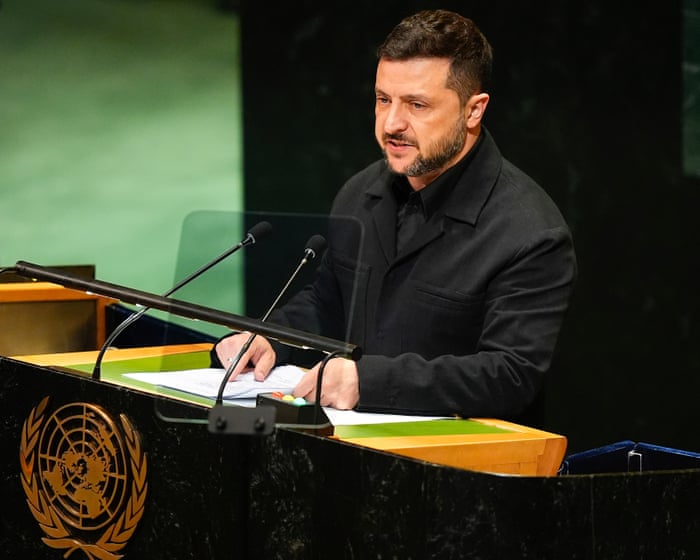
Ukrainian President Volodymyr Zelenskyy has called on world leaders to step in and stop Russia from triggering what he described as “the most destructive arms race in human history.” He warned that the merging of drone technology and artificial intelligence could lead to catastrophe.
Addressing the UN General Assembly, Zelenskyy aimed to rally not only Western nations but also China. His stark description of how Russia is using technology to transform warfare stood in sharp contrast to Donald Trump’s earlier suggestion that Russia’s military might be a “paper tiger.”
Zelenskyy cautioned that if left unchecked, Vladimir Putin would use drones to spread the war across Europe. “The facts are simple,” he told the UN. “Stopping this war now—and with it, a global arms race—is cheaper than building underground kindergartens or massive bunkers later. Stopping Putin now is cheaper than trying to protect every port and ship from terrorists. Stopping Russia now is cheaper than wondering who might one day build a simple drone armed with a nuclear warhead.”
He reflected that ten years ago, war looked very different. “No one could have imagined that cheap drones could create death zones stretching dozens of kilometres where nothing moves—no vehicles, no life. People used to think that only happened after a nuclear strike. Now it’s a reality caused by drones, and that’s without AI.”
Referring to recent Russian provocations across Europe, including a drone incursion into Poland, Zelenskyy said Putin is determined to “drive the war forward, wider and deeper… to continue this war by expanding it.” He reminded the audience that he had warned Europe earlier about Russia’s intentions, adding, “Now Russian drones are flying across Europe.” No country, he stressed, is immune to the spread of conflict.
Zelenskyy did not give a full assessment of the current state of the war in Ukraine, nor did he directly address Trump’s unexpected claim that Ukraine could reclaim all territory lost since 2022. He only mentioned having had a “good meeting” with the US president on Tuesday.
He argued that in today’s world, “only friends and weapons” protect nations—not international law or UN resolutions. Every country, he said, faces a choice: support peace or help Russia by continuing to trade with Moscow. Those who continue funding the war, he warned, are prolonging the captivity of prisoners of war, abducted children, and hostages.
Zelenskyy also expressed concern about Moldova falling under Russian influence. Moldova’s Prime Minister Dorin Recean claimed on Wednesday that Russia is spending hundreds of millions of euros to sway an upcoming parliamentary election that could disrupt Moldova’s path toward EU membership.
Before Zelenskyy’s speech, Moscow had dismissed Trump’s shift in tone—including his remark that Russia had been “fighting aimlessly for three and a half years”—a stark change from the red-carpet treatment Trump offered Putin during their recent summit in Alaska.
Kremlin spokesperson Dmitry Peskov suggested Trump’s comments were influenced by his meeting with Zelenskyy in New York. “Of course, President Trump heard Zelenskyy’s version of events. And apparently, that version shaped the assessment we heard.”
Peskov also stated that Russian forces are making slow but steady gains in Ukraine, describing the advance as deliberate and aimed at minimizing losses.
Dmitry Medvedev, Russia’s former president known for his inflammatory remarks, wrote on Telegram that Zelenskyy had drawn Trump into an “alternate reality” where Ukraine could win the war. But Medvedev expressed confidence that Trump would soon change his stance.No doubt, he’ll be back. He always comes back…. Most likely he’ll soon tell [Zelenskyy] to sign an act of capitulation,” Medvedev wrote.
Russian military bloggers seized on Trump’s remarks, interpreting them as a sign that he was trying to distance himself from the war—a conflict he once promised to end in days.
“The US is trying to wash its hands so it won’t lose face if Ukraine collapses,” wrote Dva Mayora, a Telegram channel linked to the Russian defense ministry.
On Tuesday, Trump gave an optimistic view of Ukraine’s chances in the war, claiming Russia was in serious economic trouble. It was one of his strongest expressions of support for Kyiv in recent months.
He said that if the Russian public learned what was “really going on with this war,” Ukraine could launch a counteroffensive to “take back all the territory occupied by Russia—and, who knows, maybe even go further than that.”
Trump’s shift in tone is helpful to Ukraine, but actions are needed as well.
Moscow’s invasion of Ukraine has hit the Russian economy hard. On Wednesday, the finance ministry proposed raising the value-added tax rate by two percentage points to 22%.
Also on Tuesday, Trump criticized European countries for what he called “embarrassing” purchases of Russian oil and gas. He demanded they “immediately cease all energy purchases from Russia” or “otherwise we are all wasting a lot of time.”
The EU has significantly cut its use of Russian oil and gas since 2022. In 2024, it bought 19% of its gas and 3% of its oil from Russia, down from 45% and 27% before the full-scale invasion.
European Commission President Ursula von der Leyen said that during a meeting with Trump at the UN, they “agreed on the need to cut Russia’s revenues from fossil fuels, and fast.” She added, “By 2027, Europe will have turned the page on Russian fossil fuels for good.”
Last week, von der Leyen announced plans to stop buying Russian liquefied natural gas by 2027, a year earlier than originally planned. The Commission also plans to expand sanctions to include 118 vessels in Russia’s “shadow fleet”—aging tankers used to transport Russian oil while evading Western price caps.
However, the EU has not yet ended an exemption granted to Hungary and Slovakia in 2022, allowing them to continue buying Russian oil. Both countries have resisted the plan to phase out Russian fossil fuels, despite pressure from Trump, who is an ally of Hungarian Prime Minister Viktor Orbán.
EU sanctions require unanimous agreement, although trade restrictions can be approved by a majority. It is still unclear when or how the latest proposals will be approved, with senior EU diplomats set to discuss the plans in the coming days.
Frequently Asked Questions
Of course Here is a list of FAQs about Zelenskyys call for UN intervention against Russia designed with clear questions and direct answers
Zelenskyys UN Speech Frequently Asked Questions
BeginnerLevel Questions
1 What did Zelenskyy ask the United Nations to do
He urged the UN to take immediate and decisive action to stop Russias fullscale invasion of Ukraine which he described as the most destructive arms race in history
2 Why did Zelenskyy call it an arms race
He used this term to emphasize that Russias aggression isnt just a local conflict but a global threat that forces other nations to rapidly increase their military spending and weapons development creating a dangerous and unstable world
3 What is the United Nations supposed to do in situations like this
The UNs primary purpose is to maintain international peace and security It can do this by imposing sanctions authorizing peacekeeping missions and facilitating diplomatic negotiations
4 Has the UN been able to stop the war so far
The UN has condemned the invasion and imposed sanctions but it has not been able to stop the fighting A major obstacle is Russias position as a permanent member of the UN Security Council which allows it to veto any resolution against itself
Advanced Practical Questions
5 What specific actions did Zelenskyy request from the UN
While his speech was a broad call for intervention he has previously pushed for a nofly zone over Ukraine more severe economic sanctions and a special tribunal to prosecute Russian leaders for war crimes
6 What is the main problem with the UN intervening effectively
The main problem is the structure of the UN Security Council Its five permanent members each have veto power Russia has used this veto to block any action directly against it
7 What does Zelenskyy mean by calling it the most destructive arms race in history
He is arguing that this conflict has broader implications than the Cold War It involves not just nuclear powers but also the rapid proliferation of advanced conventional weapons cyber warfare and disinformation making the potential for global escalation extremely high
8 What are some examples of the destructive arms race in this context
Examples include