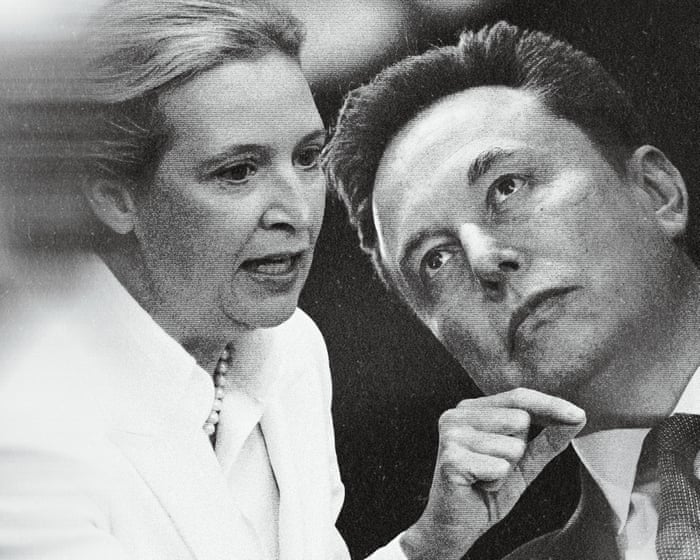
The Alternative für Deutschland (AfD) party shook European politics this week with a decisive win in a German state election, leaving it just a few seats short of forming the country’s first far-right state government since World War II. Elon Musk was delighted. “Gut gemacht!” Musk posted on X a week ago, using the German phrase for “well done” to congratulate AfD leader Alice Weidel. It was one of at least a dozen posts the Tesla and SpaceX CEO made about the AfD after the result. The AfD returned Musk’s praise, with the party’s Saxony-Anhalt leader, Ulrich Siegmund, thanking the tech mogul for his support. Siegmund, who wants German schools to focus less on responsibility for World War II and whose top staff includes four former members of a banned neo-Nazi youth group, called Musk a “visionary.” In recent years, Musk has become a central figure in the global far right, using his support and influence to back anti-immigrant activists, illiberal leaders, and nativist parties. Along with an obsession with race in the UK, much of that attention has focused on the AfD, and the major results in the Saxony-Anhalt election, along with Musk’s joy at their win, have renewed scrutiny of his ties to the party. Musk’s connections to the AfD and the German far right predate the Saxony-Anhalt vote and coincide with the billionaire’s own public shift to the right. His views on immigration, politics, and race, which he expresses constantly on X, have over the years become indistinguishable from many AfD policies. By boosting the AfD and receiving their admiration in return, Musk and the party have built a symbiotic relationship to spread their far-right views in both Germany and the US. Boosting the international far right As Musk became more involved in politics in 2024, backing Donald Trump’s reelection with over $100 million of his own money, he formed alliances with several other international far-right leaders who hold anti-immigration views and hostility toward democratic institutions. Musk has appeared onstage with Argentina’s chainsaw-wielding Javier Milei, presented an award to Italy’s ultraconservative prime minister, Giorgia Meloni, then attacked Italian judges ruling on migrant rights and gave a livestreamed speech at a rally for UK anti-Islam activist Tommy Robinson, where Musk claimed immigration was causing “the destruction of Britain.” Musk also connected with Naomi Seibt, a German climate crisis skeptic and anti-immigration activist who frequently posts on X and was 24 years old at the time. Musk began messaging her personally after seeing her posts, Seibt told reporter Paul Ronzheimer of Axel Springer’s Global Reporters Network, and she promoted the AfD to him in their chats. In late 2024, Musk wrote an opinion column for the German outlet Die Welt expressing his support for the AfD. Musk’s op-ed claimed that Germany was on the brink of “economic and cultural collapse” that could only be solved by the AfD, which he called “the last spark of hope” for the country. He also argued that the party wasn’t extreme, citing the example that its leader Weidel has a same-sex partner from Sri Lanka. “Does that sound like Hitler to you?” Musk wrote. As Musk took a prominent role in the second Trump administration at the beginning of 2025, he used his platform and newfound political power to further boost the AfD. In early January of that year, Musk hosted a livestream for Weidel that researchers found gave her a huge boost on the platform and led to a jump in German-language media coverage. “Musk did in fact have an agenda-setting effect on traditional media in Germany,” said Jan Rau, a researcher at the Research Institute Social Cohesion and Leibniz-Institute for Media Research. “You could see it very clearly. There was a huge spike in attention from traditional media for Weidel at that moment, and a lot of this attention was actually connected with Musk.” Weeks after hosting the livestream with Weidel, Musk also appearedSpeaking via livestream at an AfD rally, Musk told the crowd in Germany that there was “too much focus on past guilt, and we need to move beyond that.” This came just days after he caused an uproar by giving fascist-style salutes at a Trump inauguration rally. His comments drew condemnation from Jewish leaders, who accused him of trying to normalize the far right.
The limits of Musk’s influence
Musk’s closeness to Trump and his prominent role in the White House after the 2024 election expanded his political power—and fueled fears among foreign governments that he was meddling in their national affairs.
After buying Twitter in 2022, Musk made several changes that helped amplify the divisive, far-right politics of parties like the AfD. He reinstated previously banned far-right accounts, such as Martin Sellner, a pro-AfD, anti-immigration Austrian activist who has taken credit for mainstreaming nativist “remigration” policies. Musk also frequently promoted international right-wing accounts through reposts.
“The changes Musk made to the platform have made far-right communication much easier,” Rau said. “That’s helpful for the AfD in many ways.”
But researchers like Rau also argue that the right-wing bubble Musk has created on X has its limits. Only about 5% of Germans use X to find news, according to a 2026 Reuters Institute survey, and many mainstream figures in the country have publicly stopped using the platform. While some of Musk’s support for the AfD has reached mainstream attention, much of it in recent months has stayed confined to his captive audience on X.
Today, Musk is deeply unpopular in Germany. A YouGov poll last year found that only 19% of the country had a favorable view of the multibillionaire. Even fewer—just 13%—found his attempts to influence German politics acceptable. Even within the AfD, Musk is not entirely welcome.
“Musk’s boosting, in some quarters, is not particularly helpful,” said Oliver Marsh, an independent researcher formerly at the nonprofit Algorithm Watch. “A lot of the party are traditional German nationalists and don’t really approve of an American billionaire weighing in on German politics.”
While the AfD’s rise has more to do with Germany’s domestic politics and social dynamics than with Musk, that didn’t stop him from taking some credit for their success. Musk reposted a claim from a German right-wing media commentator that his ownership of X had caused a “vibe shift” that led to the AfD’s victory.
Musk defends the ‘far center’ AfD
In the days after the AfD’s election success in the state of Saxony-Anhalt, Musk both celebrated the result and tried to claim the party was not far-right at all but ideologically moderate. Musk posted that the party—which Germany’s own domestic intelligence agency labeled a right-wing extremist group last year—should be considered “far center.”
Musk also sought to reject American news media’s descriptions of the AfD as far-right, despite the party’s well-documented extreme views on issues such as immigration, Islam and LGBTQ+ rights. Musk posted multiple replies to the Wall Street Journal and CBS News after the state election, attacking the outlets for using “far right” in their coverage.
“You are lying by calling AfD ‘far-right,'” Musk responded to a CBS News post on X, adding in another post that “‘far right’ is a propaganda term.”
The AfD party platform includes bans on public displays of Islamic beliefs; opposes same-sex marriage and adoption, despite Weidel’s long-term domestic partnership with a woman, which includes children; emphasizes ethnic-German identity and calls for mass deportations. AfD leaders have also received criticism over the years for downplaying the Holocaust and making provocative references toNazism, with one of the party’s top members convicted in 2024 of using a Nazi paramilitary wing slogan during a rally. Weidel has claimed there is “a holy war against the German population” while calling for “remigration”, a term for mass expulsions once popular in far-right and white nationalist circles that has now been embraced by nativist parties as well as Musk and Donald Trump. Germany’s Chancellor Friedrich Merz responded to the AfD’s win this week by warning that the party’s true goals amounted to ethnic cleansing, a characterization which the far-right party denounced. “If what is being advocated here, namely ‘remigration’, were to become reality, it would be nothing other than a synonym for ethnic cleansing based on origin and skin colour,” Merz said. Musk once again defended the AfD, reposting a user criticising Merz’s allegation to his more than 241m followers. Musk’s views, which include a fixation on race and vocal opposition to immigration, have come to closely resemble those of Weidel and the AfD. “Anyone who opposes remigration is a traitor,” he posted in July.
Frequently Asked Questions
FAQs The AfDs Shocking Election Win in Germany and Elon Musks Reaction
1 What is the AfD
The Alternative for Germany is a rightwing political party founded in 2013 It started as a party opposing eurozone bailouts but later became known for antiimmigration and nationalist policies
2 What election did the AfD win
The AfD won a state election or achieved a major breakthrough in a national or regional vote marking the first time a farright party has won a German state election since World War II
3 Why is this win considered shocking
Because Germany has a strong political taboo against farright parties due to its Nazi history Mainstream parties have long refused to work with the AfD so its rise to first place is a historic shift
4 How well did the AfD actually do
In Thuringia the AfD won around 3233 of the vote becoming the largest party In Saxony it came a close second These are recordhigh results for the party
5 Why did Elon Musk react to this
Elon Musk has repeatedly criticized Germanys immigration policies and praised the AfD on his platform X He called the result a win for change and suggested it reflected public frustration with the status quo
6 What did Musk say exactly
He posted things like The AfD is the only party that will save Germany and celebrated the election result as a sign that voters want stricter borders and less EU control
7 Why does Elon Musk care about German politics
Musk owns Teslas only European factory near Berlin He has business interests in Germany and he often comments on global politics especially immigration and free speech issues
8 What does the AfD want
The AfD wants to drastically reduce immigration leave the EU or reform it heavily end sanctions on Russia and promote traditional German culture Some factions are openly extremist
9 Can the AfD actually govern
Probably not Even though it won the most seats in some states other parties refuse to form coalitions with it This is called a cordon sanitaire or firewall against the far right
10 What problems could this win cause
It could