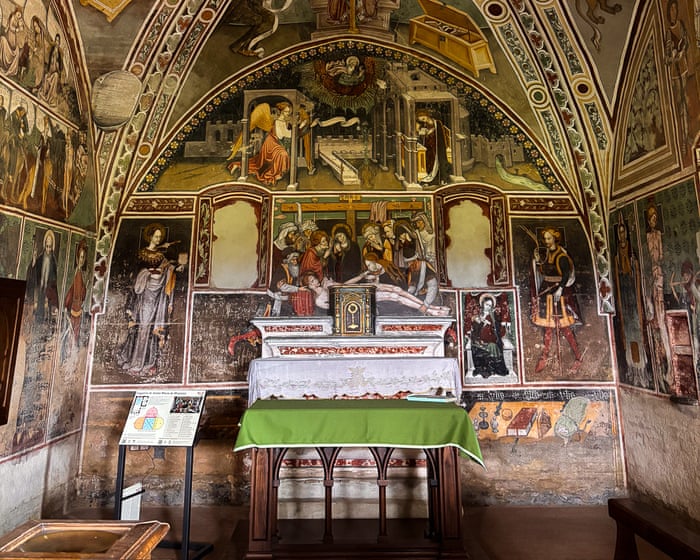
The Santa Maria di Missione chapel in Villafranca Piemonte, northern Italy, stands at the end of a long cornfield. Gentle mountains rise behind it, their outlines softened by the sun. Inside, the 15th-century frescoes by Lombard artist Aimone Duce are framed by autumn colors. This chapel is the municipality’s oldest religious building, serving about 4,000 people, and it stands on the site of an earlier structure dating back to 1037.
Inside the small chapel, my footsteps echo softly against the walls, breaking the quiet of the countryside. The sharp scent of plaster mixes with the earthy smell of the fields and the sweetness of wheat carried on the wind. Light filters through narrow windows, illuminating the vivid hues of a fresco depicting the seven deadly sins—a common theme in medieval art.
My eye is drawn to the back wall, where a Deposition scene unfolds above the altar, and higher up, a delicate Annunciation appears. Together, the frescoes reflect on human nature, its vices, frailty, and moral struggles. For this reason, the chapel is considered one of the finest examples of Italian International Gothic style.
Santa Maria di Missione is part of an open culture circuit called Cultura a Porte Aperte, created by the Council for Ecclesiastical Cultural Heritage of Piedmont and Valle d’Aosta, and the Fondazione CRT. The goal is to make sacred art accessible through a free app. Once downloaded, visitors can book and enter various registered churches using a smartphone, simply by scanning a QR code near the main entrance.
“These churches were almost always closed,” recalls Monsignor Derio Olivero, bishop of Pinerolo, a town about 25 miles southwest of Turin. “Sometimes I would set off to visit them, and the challenge was to find the key.”
More than 70 churches and chapels have been made accessible through the project. Inside, visitors can activate a multimedia narrative system—a story available in three languages that provides historical and artistic information, accompanied by music and directional lighting.
“I am particularly struck by the more isolated chapels, located in fields or on the edge of a forest,” says Olivero. “Many are in meadows or among vineyards—a paradise of silence and beauty. For the faithful, the project offers the chance to find a ‘private chapel’ for occasional refuge. The same is true for non-believers, who can experience it as a place to nurture their spirituality.”
Cultura a Porte Aperte allows visitors to explore churches independently and freely year-round. The sites are organized into six regional itineraries: Langhe and Roero; Monregalese; Colline Torinesi and Monferrato; Pinerolese and Saluzzese; Canavese and Valle d’Aosta-Via Francigena; and Val di Susa-Via Francigena. Olivero says the intention is to extend the project across Italy, with Lombardy already involved. “We are in contact with Lazio. I think about the impact the project could have with 700, or even 1,000 churches.”
He explains that the initiative boosts regional tourism, attracting both local and international visitors. “As a young priest, I was fascinated by small churches; they are rich in 15th-century frescoes but were often abandoned and locked.”
These spaces promote slow tourism, allowing visitors to discover the area, often through word of mouth. When I reach the small Piedmontese town of Lusernetta, I find the chapel…The Church of San Bernardino da Siena was built between 1450 and 1520 and is dedicated to Saint Bernardino, who traveled to the Lucerne valleys in 1425 to convert the Waldensians—a proto-Protestant community known for its strict adherence to the Bible. The simple interior features a series of frescoes by an anonymous painter known as the “maestro di Lusernetta.” However, the Madonna of Mercy and Child by Jacopino Longo on the left wall of the nave stands out: the Madonna, seated on her throne, shelters the family of the Counts of Luserna di Rorà—who commissioned the work—under her blue mantle.
These small churches are maintained by parish volunteers. “These spaces promote slow tourism, allowing visitors to discover the area, often through word of mouth,” says Luigi Capello, head of the local parish youth group and coordinator of pastoral activities. “This project enables us to accompany schools, communities, and care homes on visits. But we must not forget the importance of human contact. People can visit the churches independently, yet most who return ask to meet a volunteer—to hear the story in person.”
The streets of Pinerolo’s historic center, a municipality in Turin, are filled with the aromas of bakeries and florists. Inside the cafes, people quickly exchange greetings, grab an espresso, and leave. Just off the main street is the Chapel of Santa Lucia delle Vigne, surrounded by vineyards. Inside are 15th-century frescoes by Bartolomeo Serra and his workshop, depicting four episodes from the saint’s life. Six small wooden cubes serve as benches inside: dim light enters through the window, illuminating Saint Lucia’s face, which gazes at the viewer from every side of the nave. The silence is broken only by the narrator’s voice describing the painted scenes. “It’s almost like talking directly to the painter,” says volunteer Roberto Billia. “When the door opens, like a miracle, the lights come on and the recording starts. It’s magnificent.”
Frequently Asked Questions
Of course Here is a list of FAQs about the app When the church door opens its like a miracle designed to sound like questions from real users
General Beginner Questions
1 What is this app exactly
Its a free smartphone app that helps you find and visit thousands of normally closed or hardtoaccess churches chapels and religious sites across Italy It provides opening times locations and information so you can discover incredible art and architecture youd otherwise miss
2 Is it really free
Yes downloading and using the app to search for sites and view basic information is completely free Some locations may have a small entrance fee managed onsite which the app will note
3 Do I need an internet connection to use it
You need internet to search download details and get realtime updates Its a good idea to save information for your chosen sites while on WiFi at your hotel before heading out for the day
4 What kind of places does it include
It includes small rural chapels deconsecrated churches sites with unique frescoes or sculptures and even some larger churches with very limited irregular opening hours that arent widely advertised
Using the App Practical Tips
5 How do I find places near me
Open the app and allow it to use your location Youll see a map with pins You can filter by distance type of art or opening days
6 How accurate are the opening times
The times are provided by local volunteers and associations They are generally very reliable but its always smart to view the Notes section for any special instructions or contact info to doublecheck especially for very remote locations
7 Can I book tours or tickets through the app
No the app itself is not a booking platform Its main purpose is discovery and information It will tell you if you need to contact a local volunteer to arrange access
8 Whats the best way to plan a visit
Search in advance Dont wait until youre standing outside a locked door