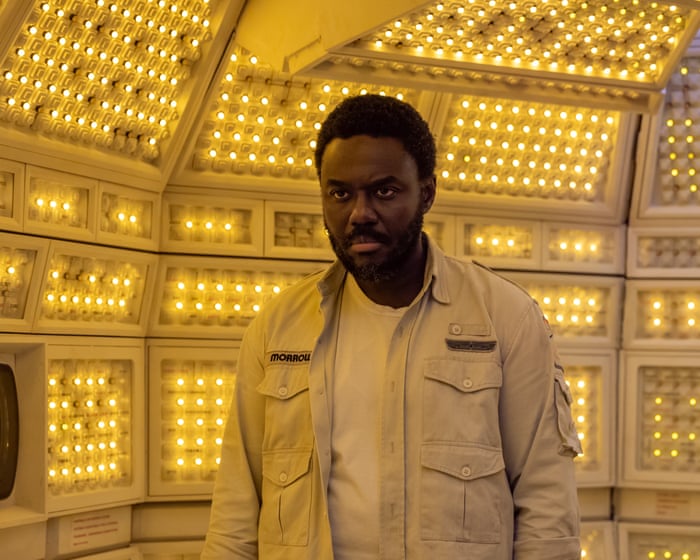
David Jonsson is the kind of actor who disappears so completely into his roles that it’s easy to forget you’re watching the same person each time. In Rye Lane, he’s a lovestruck south Londoner; in Industry, an Etonian banker with ice in his veins; in Alien: Romulus, a paranoid android. He’s now starring as Taylor, a heroin addict, in the ultraviolent British prison drama Wasteman—and for the first time, the 32-year-old actor says he is playing something close to himself.
“This is the most personal role I’ve done,” he says. “It’s so messed up because it’s a dark story about rehabilitation and addiction, but I know these men really well. Especially when you grow up somewhere like where I did.”
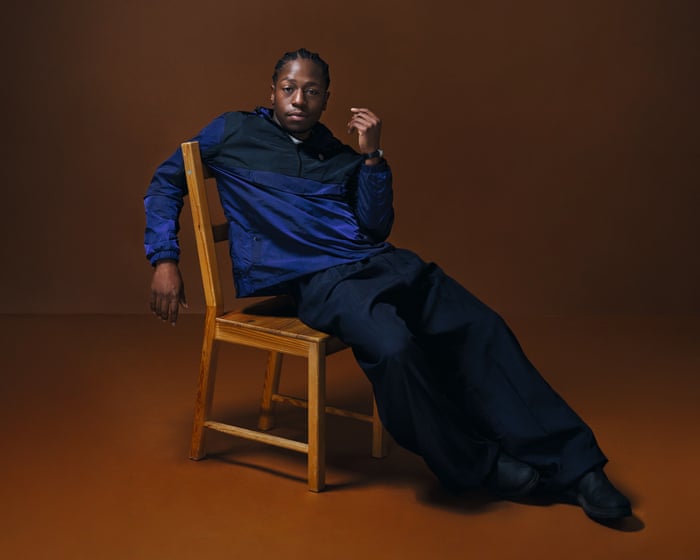
We meet on a Friday afternoon at a photo studio in Islington, closer to where Jonsson lives now in north London than to Custom House in the East End, where he grew up. He arrives wearing a beanie pulled tight over his cornrows and a windbreaker. He looks stylish but carries a delicate shyness that mirrors his character’s air of desperation.
Wasteman, which opens this month after a critically acclaimed festival run that earned five British Independent Film Awards (BIFA) nominations—including a Best Lead Performance nod for Jonsson—tells the story of Taylor, a young father who has spent 13 years in prison for a crime he committed as a teenager. In the film’s unflinching depiction of the British prison system, he’s labeled a “nitty,” UK slang for a desperate, pathetic drug addict. Jonsson lost 1.8 stone (about 25 pounds) to embody Taylor’s “wasted” physique. “I was mawga, properly skinny,” he says, slipping into patois.
Jonsson is the youngest of four children, born to working-class parents—his mother a police officer, his father an IT engineer at Heathrow. His background is Creole, with roots in Nigeria, Sierra Leone, and the Caribbean, and a Swedish surname that hints at truly global origins. But when he was 11, his parents separated, and the one stable thing in his life collapsed. “When you come from a broken home, it changes you,” he says. “That’s part of what happens with Taylor.” It’s the knock-on effect of incarceration that Wasteman portrays with devastating clarity: punishment doesn’t end with the prisoner.
At school, that instability turned into trouble, and he was expelled for fighting. “I wasn’t a bad kid at all,” he insists. “I was just a bit… distracted at the time.” He remembers coming home to tell his mother, who had just finished a night shift. She was one of the first Black PCSO officers in London, walking a beat in Islington for decades—the same area we’re sitting in now. Exhausted and deeply disappointed, she asked what he wanted to do with his life. It was one of those existential questions parents ask when you least want to hear it, and Jonsson surprised himself with his answer: he wanted to act. “My parents are hard workers: if you want something, then prove it. There’s no point talking about it.” That ethos seems to have stayed with him; he refers to acting as “a job” rather than “a craft” or “calling,” as many young actors do.
The irony of having a police officer mother isn’t lost on Jonsson: she spent a decade arresting boys like him, while he now plays a man brutalized by the very system she served. Does that complicate his thoughts on the prison system? “Of course. I have sympathy for everyone working to keep us safe. But growing up as a young Black man in London, I’ve had some weird things happen.” He won’t elaborate, but the implication is clear: his mother’s profession and his own experiences exist in an uncomfortable tension—a tension present throughout Wasteman.
After being expelled, he moved to a school in Hammersmith—a 90-minute commute across the city—and discovered acting through school plays and the National Youth Theatre. At 16, he won a scholarship…He was accepted to the American Academy of Dramatic Arts in New York, but spent much of his two years there skating in Washington Square Park before returning to London. After his mother suggested he audition for RADA, he quickly won a place.
“Wasteman” was, surprisingly, Jonsson’s first ever film audition. Fresh out of drama school and focused entirely on theatre, his agent sent him the script—not for the role of Taylor, but for Dee, the more traditionally violent convict character eventually played by Tom Blyth (a stark contrast to Blyth’s role in Netflix’s lighthearted rom-com People We Meet on Vacation). “I got my girlfriend at the time to draw a tattoo on my neck,” he recalls. “The director threw a punch at me. I threw a chair at him. I thought I nailed it.” Then he heard nothing. “I was like, ‘Oh: I guess I’m not as good as I thought.'”
The film had been with A24 and the Safdie Brothers, who ended up dropping the project to make the Adam Sandler crime drama Uncut Gems instead, leaving the project dormant for years. Meanwhile, Jonsson left RADA early to join Robert Icke’s stage revival of Mary Stuart, acting opposite Juliet Stevenson. His screen breakthrough came with Industry in 2020, the BBC and HBO series about ruthless young investment bankers. Cast as Augustus “Gus” Sackey, Jonsson visited Eton and Oxford to research the role of a privileged Black man navigating the overwhelmingly white world of high finance. The performance was revelatory, but after two series, just as the show was becoming a hit, he left. “You only get one life,” he told GQ in August 2025. “Life is short, art is long.”
His first role after Industry was Rye Lane, a joyful South London rom-com that premiered at Sundance to what Deadline called “sunny, irreverent” acclaim. Then came the BBC Christmas detective drama Murder Is Easy, in which Jonsson became the first Black actor to lead an Agatha Christie adaptation. That milestone resurfaced in the news on the morning we met—a BBC-commissioned review warning against “tick box” diversity casting had just been published, explicitly citing Murder Is Easy as an example of diversity being “superimposed” on a story. The review argues that “unless it’s very skillfully done, there is a danger it will feel overly didactic and preachy.”
Jonsson is diplomatic when I bring it up. “I’m always going to be British,” he says. “Britain will always be home for me. Even when I worked on Alien—this massive American studio film—they’d reference my British sensibility. And I’m like, ‘Yeah, that’s part of it. We do things differently on this tiny island.'” He has undeniably benefited from a shifting landscape; in the wake of Black Lives Matter, British broadcasters began addressing the whiteness of their output. What’s striking is that he’s already experienced different phases of the conversation—first subverting expectations in Industry, then receiving backlash as a Black lead in a period drama.
His casting as a Black android in 2024’s Alien: Romulus also sparked a predictable wave of criticism. But his race brought an unexpected edge to the film’s exploration of the ubiquitous sci-fi question, “What does it mean to be human?”, and the film’s $351 million box office haul showed the value of inspired casting. When director Fede Álvarez asked him to deliver the franchise’s most famous line—Sigourney Weaver’s battle cry, “Get away from her, you bitch!”—Jonsson understood the stakes. “I was like: ‘I don’t know—you’re kidding, right?'” Jonsson recalls, laughing.Fede said, “Just give me one.” I did, and that was the take that made it into the film.
He’s grinning as he tells the story, but the significance isn’t lost on him. Alien brought him visibility, and that visibility led to a 2025 Bafta rising star award. When he accepted it, he quipped, “Star, I don’t know, but rising—I guess.” Then he turned serious: “Growing up, I had the Denzel Washingtons and Idris Elbas, but they’re not me. There’s not enough space for diverse talent in this industry. I realize I have an important role in defining what Black is.”
It’s a responsibility he remains acutely aware of. “Every character I do, no matter what, I’m going to be a Black man first,” he says now, echoing the sentiment from his acceptance speech. “Until we change what it is [to be a Black man], everyone’s going to have a certain view on it, you know what I mean? But I think that is evolving.”
In Wasteman, Taylor’s Blackness is never explicitly discussed, yet it shapes everything—the way guards speak to him, the institutional contempt he faces, the lack of resources available to him. This feels deliberate: a crime drama with a Black lead where Blackness isn’t the story. Taylor faces no overtly racist guards or prison gangs. Instead, the racial dynamics are present but unstated, which makes them all the more insidious.
The preparation for the role was intense. Jonsson worked with a charity that reintegrates former inmates and watched “folders and folders” of iPhone footage shot inside British prisons. Many of the supporting cast are former inmates themselves. He watched Steve McQueen’s Hunger—the film about IRA hunger striker Bobby Sands—multiple times in the lead-up. “This feeling of people doing something beyond themselves in a contained existence. That’s what’s happening with Taylor. He’s waking up, hitting the drugs, fighting for his life daily, going to sleep, rinsing and repeating. You’ve got to have something keeping you going,” he says.
The idea of his character’s motivation clearly resonates: “Here comes the cringe,” says Jonsson, suddenly self-aware, “but I feel like I’m quite a complicated person. Sometimes I feel great and happy and sometimes I’m not. The darker stuff right now is interesting me.”
Faith, he explains, helps him navigate that darkness. He grew up in the church and still attends, describing it as his “north star,” though he’s careful not to be preachy. “Faith is a personal thing for me. It’s what keeps me going. Life is tough enough without having something outside you… there’s a lot of darkness behind this wall, you know?”
Perhaps the most devastating moment in Wasteman comes when Taylor speaks to his young son for the very first time—on FaceTime. Jonsson, too, met the actor playing his son for the first time during the scene. “The reaction I had is what made it into the movie. Imagine if that was your truth—for some people it is.” Taylor’s incarceration hasn’t just stolen his own life—it’s robbed his son of a father, perpetuating the exact cycle of absence that shaped Taylor himself.
If Wasteman represents one kind of intense male relationship under duress, The Long Walk represents another. The Stephen King adaptation follows a group of teenage boys forced to walk at a relentless pace until only one survives. Jonsson plays the buff Pete McVries opposite Cooper Hoffman’s Ray Garraty, a boy grieving his father’s death. The film’s premiere…The film is brutal—teenage boys walking themselves to death for public entertainment—but the real story lies in what happens between Ray and Pete as exhaustion strips them bare.
Shot in chronological order over six-and-a-half weeks in Winnipeg, the film required the cast to walk many miles each day. “We didn’t really know what we were getting ourselves into,” Jonsson recalls. “Baking sun, torrential rain, freezing cold. It was like a marathon.” By the end, he and Hoffman had covered about 350 miles together. The physical ordeal wasn’t method acting for its own sake—it was the point. “I don’t like acting tired. I’d rather just do it,” he says.
But it’s the emotional landscape—and his relationship with Hoffman—that affected Jonsson most deeply. “I’ve never met anyone like him,” he says of his co-star, the 22-year-old son of the late Philip Seymour Hoffman. “He’s phenomenal. But there’s always more with Cooper. Always something deeper.” While filming a scene in which Hoffman’s character talks about losing his father, Jonsson found himself genuinely moved by his co-star’s performance. “They say our job as actors is to listen. And listening to him was transformative for me.” He pauses, choosing his words carefully. “You do stop and think, ‘Where’s the line?’ And then you realize, that’s incredibly brave—putting something of yourself out there for other people.”
Now Jonsson and Hoffman are reuniting for the upcoming crime comedy The Chaperones. When Jonsson talks about their partnership, he invokes old Hollywood. “I think about Matt Damon and Ben Affleck teaming up, doing stuff again. I kind of dig that.” It’s a deliberate aspiration: two hungry young actors trying to recapture the magic of the late-’90s indie boom that gave rise to, among other things, Hoffman’s father. “We’ve got a chance to go to places we haven’t been,” says Jonsson. “That’s a gift.”
What’s next is characteristically ambitious. He’s currently filming Colman Domingo’s directorial debut Scandalous, playing Sammy Davis Jr. opposite Sydney Sweeney’s Kim Novak. He’s also intriguingly set to star in Frank Ocean’s long-awaited directorial debut, though details remain scarce. It’s a far cry from Custom House, yet Jonsson insists on treating it all as work rather than destiny. “That’s why I call it a job,” he says. “If I don’t, I’m in la-la land.”
Sitting cross-legged, beanie pulled tight, he seems remarkably at peace with not having all the answers. “I wish I could say I know what I’m doing,” he admits when asked about navigating this new level of visibility. It’s an unassuming approach—and perhaps a helpful one when it comes to completely disappearing into a role. But with Wasteman, for the first time, Jonsson isn’t disappearing at all. He’s showing us exactly who he might have been.
“It was scary, actually,” he says, hesitating slightly. The fear, he explains, wasn’t about the physical transformation or even the character’s darkness—it was about proximity. “I look at myself, someone who got kicked out of school, and I think: one wrong turn, one bad choice—that’s all it takes. Taylor made that choice. I didn’t, but I could have.”
Wasteman is released in UK cinemas on 20 February.
Frequently Asked Questions
Of course Here is a list of FAQs about David Jonssons statement Every role I take on I approach first and foremost as a Black man based on his career and interviews
Understanding the Statement
Q1 What does David Jonsson mean when he says he approaches roles first and foremost as a Black man
A He means his Black identity is a foundational lens through which he understands a characters experience in the world Its not the only thing but its a core inseparable starting point that informs his choices
Q2 Is he saying he only plays roles written specifically for Black characters
A Not at all Hes talking about his approach as an actor not the characters written background He brings his lived experience as a Black man to every role even if the characters race isnt specified or is different from his own
Q3 Isnt that limiting Shouldnt actors be able to become anyone
A Jonsson would likely argue its the opposite of limiting Its about bringing authentic specific humanity to a role All actors filter characters through their own experiences he is being intentional and honest about his primary frame of reference
Career Context Examples
Q4 How did this approach influence his role in Industry
A Playing Gus a young Black banker from a wealthy background Jonsson explored the unique pressures of being a first or only in elite predominantly white spacesa nuance informed by his perspective
Q5 What about his role in the new Alien series
A While details are secret he has suggested that bringing a specific grounded humanity is crucial in a scifi horror setting where characters often face isolation and systemic threatthemes that can resonate deeply with the Black experience
Q6 Why is he stepping away from televisions most talkedabout roles
A He has expressed a desire for creative challenge and variety moving away from the intense discourse surrounding shows like Industry to focus on different projects that allow him to grow without being defined by a single role
Broader Implications Discussion