It began with a fabricated Time magazine cover depicting Trump as a king. Since then, it has evolved into a full-blown phenomenon that academics are calling “slopaganda”—a troubling fusion of easily accessible AI tools and political messaging. According to Don Caldwell, editor of Know Your Meme, “shitposting”—the act of posting deliberately crude or offensive content online to provoke reactions—has now reached the level of “institutional shitposting.” This is trolling as official government communication, and no one has mastered it better than the Trump administration. This is a government that has not only granted the AI industry the regulatory freedom it wanted but has also adopted the technology for its own purposes. Here are ten of the most notable fake images released by the White House so far.
Trump as King
19 February 2025
The first AI image posted by the White House X account set the tone for Trump’s second term, marking a shift where the provocative online culture that helped bring him to power moved from fringe platforms like 4chan and Reddit into the mainstream. The image, showing Trump as a king on a fake Time cover, was shared alongside an announcement about repealing New York City’s congestion pricing. It played into fears that Trump would rule like a monarch. New York Governor Kathy Hochul even held up the image at a press conference, declaring, “New York hasn’t laboured under a king in over 250 years. We sure as hell are not going to start now.” The congestion charge, however, remains in place.
In another post on Truth Social in October, the president shared an AI-generated video showing himself as a king with a crown, flying over protesters in a fighter jet and dumping waste on them. House Speaker Mike Johnson defended the post, saying, “The president uses social media to make a point. He is using satire to make a point.”
Studio Ghibli Meme of a Woman Being Deported
27 March 2025
In March 2025, OpenAI’s Studio Ghibli-inspired meme generator became a sensation for its ability to transform any image into the beloved anime studio’s style—without Studio Ghibli’s permission. The White House used it on a photo of a woman in tears as she was arrested by ICE agents before deportation. The original photo, along with her name and alleged crimes, was included in the post.
For Caldwell, this showed how quickly the White House keeps up with online trends. “They’re hopping on brand-new, fresh memes,” he says, suggesting staff might be regular visitors to Know Your Meme. “The Studio Ghibli meme trend kicked off on March 25 on X; we covered it the next day, and the White House posted it the day after that.”
Trump as Pope
3 May 2025
This image demonstrates Trump’s knack for inserting himself into any conversation, even those unrelated to him, and how effective that can be. The image went viral, made global headlines, and drew outrage from Catholic groups and politicians. The New York State Catholic Conference responded, “There is nothing clever or funny about this image, Mr. President. We just buried our beloved Pope Francis, and the cardinals are about to enter a solemn conclave to elect a new successor of St. Peter. Do not mock us.”
As often happens with such posts, those who took offense were accused of lacking a sense of humor. “They can’t take a joke?” Trump said at a press conference afterward. “You don’t mean the Catholics, you mean the fake news media…”Trump’s supporters loved it.
Trump as Jedi
4 May 2025
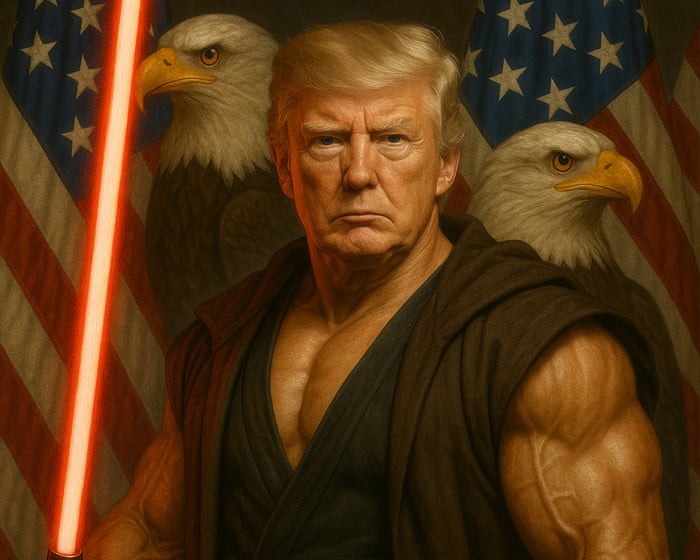
Trump has always been the subject of flattering fan art throughout his political career—remember the digital trading cards?—but AI has made creating it much easier. On May 4th, the White House crashed Star Wars Day with an image of the president as a muscular Jedi, lightsaber in hand, surrounded by flags and eagles. Never mind that his lightsaber is the wrong color (the heroes use blue) or that the White House’s claim to represent the Rebellion, not the Empire, sounded laughably hollow. This was pure fantasy.
In 2022, one of Trump’s trading cards awkwardly pasted his head onto a superhero’s body. Last July, he was somewhat less awkwardly superimposed onto Superman’s body to hijack the new movie’s launch. That same month, the White House portrayed a suited Trump heroically striding into the Colosseum. Fans and allies have since produced heaps of similar content themselves.
Hakeem Jeffries as a Mexican
29 October 2025
Why did the White House choose to depict Democratic House leader Hakeem Jeffries and Senate leader Chuck Schumer wearing sombreros and holding plates of tacos? The reason doesn’t matter. They look silly, it’s deliberately offensive, and once again, it seizes the world’s attention.
The image shows how hard it is to respond to this kind of content. It’s part of an ongoing joke that started a month earlier, when Trump posted a deepfake video putting a crude sombrero and mustache filter on Jeffries. That video was widely condemned as offensive and racist, including by Jeffries himself, who responded by posting a real photo of Trump with sex offender Jeffrey Epstein. The Trump administration then doubled down, playing the video on loop for hours on screens in the White House briefing room and creating more images in the same style to keep the trolling alive.
Welcome to the Golden Age
1 January 2026
Few outside the Trump administration believe the U.S. is in a “golden age,” but that hasn’t stopped Trump from repeating the claim. In January, the White House posted an AI video showing a golden White House facade behind a shower of gold coins, with the text “The White House? She’s in her Golden Age,” set to Bruno Mars’ song “24K Magic.”
Even if Trump’s Midas touch is mostly imaginary, this kind of wishful propaganda is more effective than it seems. According to a paper by researchers Michał Klincewicz, Mark Alfano, and Amir Ebrahimi Fard—who coined the term “slopaganda”—“neural representations of information that were shown to be false continue to influence people’s beliefs and reasoning after being corrected.” In other words, even when you know it’s fake, part of your brain still believes it.
Which Way, Greenland Man?
14 January 2026
On the surface, this looks like a simple “Trump wants Greenland” post. But it carries a much darker message.
Again, the post plays on a popular meme, as Caldwell explains: the “dramatic crossroads” image comes from the manga series Yu-Gi-Oh! and started trending online around 2021.
The slogan “Which way, Greenland man?” seems to reference a 1978 neo-Nazi text titled Which Way, Western Man?, in which white supremacist author William Gayley Simpson called for violence against and the deportation of Jewish and Black people, arguing that Hitler was right.
“It’s absolutely shocking to see such images being deployed by this administration,” said Heidi Beirich, co-founder of the Global Project Against Hate and Extremism, which monitors U.S. neo-Nazi groups. “The idea appeals to racists and white supremacists who think only white people should be in positions of power.”
In August, the Department of Homeland Security posted a mock ICE recruitment ad featuring an image of Uncle Sam.Uncle Sam stands at a crossroads under the slogan: “Which way, American man?” Earlier this month, the U.S. Labor Department shared an image with the phrase: “One Homeland. One People. One Heritage.” Critics noted its resemblance to Hitler’s slogan, “Ein Volk, ein Reich, ein Führer” (“One people, one realm, one leader”).
Daniel de Zeeuw, an assistant professor in digital media culture at the University of Amsterdam, explains that AI excels at recycling past imagery, creating a nostalgic, traditionalist aesthetic. This allows extremist present-day messages—like ICE’s militarized policing—to be wrapped in comforting, familiar visual styles, such as patriotic recruitment posters, 1980s action-movie graphics, or 1950s public service announcements (as seen in a recent image depicting Trump as a friendly milkman).
De Zeeuw adds that AI is inherently retrospective, trained as it is on historical material. This look aligns with the Make America Great Again movement, which frequently invokes an idealized past. Another striking example was a Department of Homeland Security post from last December: a vintage car on a deserted, palm-lined beach with the caption “America After 100 Million Deportations.” Ironically, the original artwork was by Japanese painter Hiroshi Nagai, who objected to its unauthorized use.
“It’s not going to be on Twitter,” an agent said while filming the arrest of Minneapolis civil rights lawyer Nekima Levy Armstrong, a prominent local activist, last Thursday. Yet within hours, it was: Homeland Security Secretary Kristi Noem posted a still from the video showing Armstrong calm and composed.
Thirty minutes later, the White House X account shared a heavily altered version of the same image. In this one, Armstrong appears exaggeratedly upset, with tears streaming down her face, and her skin tone seems darkened. The caption read: “Arrested: far-left agitator Nekima Levy Armstrong for orchestrating church riots in Minnesota.” In reality, Armstrong was protesting at a service led by a pastor allegedly tied to ICE and was later released without charges.
Until now, the White House’s AI-generated content had been obviously absurd—hard to mistake for real. This image, however, presented itself as an authentic photo, or at least didn’t clarify it wasn’t. It goes beyond AI-generated trolling; it’s an AI-assisted deepfake.
Much like Musk’s recent sharing of the Grok tool, which removed women and children’s clothing without consent, there’s something abusive here: AI was used to try to humiliate a woman by distorting her image to appear weaker and more distressed than she was.
De Zeeuw believes the deepfake’s lack of realism is intentional. “What’s being communicated is the falsification itself—showing the ability to fake images, to fake evidence.”
After the manipulation was exposed, White House deputy communications director Kaelan Dorr responded: “Enforcement of the law will continue. The memes will continue.”
In response to an image of Trump and a penguin walking toward a Greenland flag, some observers noted that penguins live at the South Pole. But Robert Topinka, a reader in digital media and rhetoric at Birkbeck, University of London, says that misses the point of such posts. “People continue to…”These statements are presented as if they were serious claims, arguments, or evidence, but they are actually emotional hooks meant to rally supporters. As one source notes, White House staffers have admitted to using AI because it’s the fastest way to produce content—not to convey truth, but to spread their propaganda.
For those familiar with internet culture, this references the recent “nihilist penguin” meme popular on TikTok. The meme originates from a scene in Werner Herzog’s 2007 documentary Encounters at the End of the World, where a penguin inexplicably breaks away from its colony and heads inland toward the Antarctic wilderness—and certain death. Herzog ponders, “But why?”—a question many have also asked about Trump’s quixotic pursuit of acquiring Greenland.
According to De Zeeuw, this imagery aligns with what Naomi Klein and Astra Taylor term “end times fascism,” where tech leaders and their enablers seem almost eager for the end of the world as we know it, marching toward oblivion much like Trump and his penguin counterpart. “It’s as if they know they’re heading toward the end, but they do so with a sense of joy.”
Frequently Asked Questions
Of course Here is a list of FAQs about The era of slopaganda 10 AI images shared by the White House and what they reveal written in a natural conversational tone
BeginnerLevel Questions
1 What does slopaganda even mean
Slopaganda is a new slang term combining slop and propaganda It refers to the use of obviously AIgenerated often poorly made or generic images by official sources to shape public perception or fill content gaps quickly
2 What were the AI images the White House shared
They were a series of 10 images posted on social media depicting AI visions of the future for various US states and territories They featured surreal often bizarre scenes like giant corncobs flying cars and strange cityscapes all generated by artificial intelligence
3 Why is this a big deal Was it illegal
Its a big deal because it marks a shift in how official government communications might use AI It wasnt illegal but it raised major ethical questions about authenticity transparency and the use of synthetic media from a trusted source
4 Whats wrong with using cool AI images Theyre just illustrations
The core issue is disclosure When a powerful institution like the White House uses AIgenerated images without clear labeling it blurs the line between reality and fabrication It can normalize slopcheap emotionally manipulative or factually untethered visualsin place of genuine documentation or thoughtful art
5 What do these images reveal
They reveal several things a push to be seen as techsavvy a potential shortage of genuine visual content for social media and a willingness to use loweffort AI slop for official messaging Most critically they show how easily AI can be used for soft propaganda creating aspirational but hollow visions without substance
AdvancedLevel Questions
6 How is this different from traditional propaganda or Photoshop
The scale and accessibility While governments have always used edited photos or staged footage AI allows for the instantaneous costfree creation of infinite alternate realities Slopaganda is often