This CSS code defines a custom font family called “Guardian Headline Full” with multiple font weights and styles. It includes light, regular, medium, and semibold weights, each with normal and italic variations. The fonts are loaded from the Guardian’s servers in three different file formats: WOFF2, WOFF, and TrueType.@font-face {
font-family: Guardian Headline Full;
src: url(https://assets.guim.co.uk/static/frontend/fonts/guardian-headline/noalts-not-hinted/GHGuardianHeadline-Bold.woff2) format(“woff2”),
url(https://assets.guim.co.uk/static/frontend/fonts/guardian-headline/noalts-not-hinted/GHGuardianHeadline-Bold.woff) format(“woff”),
url(https://assets.guim.co.uk/static/frontend/fonts/guardian-headline/noalts-not-hinted/GHGuardianHeadline-Bold.ttf) format(“truetype”);
font-weight: 700;
font-style: normal;
}
@font-face {
font-family: Guardian Headline Full;
src: url(https://assets.guim.co.uk/static/frontend/fonts/guardian-headline/noalts-not-hinted/GHGuardianHeadline-BoldItalic.woff2) format(“woff2”),
url(https://assets.guim.co.uk/static/frontend/fonts/guardian-headline/noalts-not-hinted/GHGuardianHeadline-BoldItalic.woff) format(“woff”),
url(https://assets.guim.co.uk/static/frontend/fonts/guardian-headline/noalts-not-hinted/GHGuardianHeadline-BoldItalic.ttf) format(“truetype”);
font-weight: 700;
font-style: italic;
}
@font-face {
font-family: Guardian Headline Full;
src: url(https://assets.guim.co.uk/static/frontend/fonts/guardian-headline/noalts-not-hinted/GHGuardianHeadline-Black.woff2) format(“woff2”),
url(https://assets.guim.co.uk/static/frontend/fonts/guardian-headline/noalts-not-hinted/GHGuardianHeadline-Black.woff) format(“woff”),
url(https://assets.guim.co.uk/static/frontend/fonts/guardian-headline/noalts-not-hinted/GHGuardianHeadline-Black.ttf) format(“truetype”);
font-weight: 900;
font-style: normal;
}
@font-face {
font-family: Guardian Headline Full;
src: url(https://assets.guim.co.uk/static/frontend/fonts/guardian-headline/noalts-not-hinted/GHGuardianHeadline-BlackItalic.woff2) format(“woff2”),
url(https://assets.guim.co.uk/static/frontend/fonts/guardian-headline/noalts-not-hinted/GHGuardianHeadline-BlackItalic.woff) format(“woff”),
url(https://assets.guim.co.uk/static/frontend/fonts/guardian-headline/noalts-not-hinted/GHGuardianHeadline-BlackItalic.ttf) format(“truetype”);
font-weight: 900;
font-style: italic;
}
@font-face {
font-family: Guardian Titlepiece;
src: url(https://assets.guim.co.uk/static/frontend/fonts/guardian-titlepiece/noalts-not-hinted/GTGuardianTitlepiece-Bold.woff2) format(“woff2”),
url(https://assets.guim.co.uk/static/frontend/fonts/guardian-titlepiece/noalts-not-hinted/GTGuardianTitlepiece-Bold.woff) format(“woff”),
url(https://assets.guim.co.uk/static/frontend/fonts/guardian-titlepiece/noalts-not-hinted/GTGuardianTitlepiece-Bold.ttf) format(“truetype”);
font-weight: 700;
font-style: normal;
}
@media (scripting: enabled) {
main {
opacity: 0;
}
main.is-loaded {
opacity: 1;
}
}
@media (scripting: enabled) and (prefers-reduced-motion: no-preference) {
main.is-loaded {
transition: opacity .3s ease-in-out;
}
}
:root {
–overlay-fade: rgba(0, 0, 0, .6);
–caption: #707070;
–light-type: #fff;
–dark-bg: #1a1a1a;
}
:root[data-app-os=android] {
–androidTop: 58px;
}
:root[data-app-os=ios] {
–iosBottomToolbar: 50px;
–iosTopToolbar: 20px;
–iosLvh: calc(100vh – var(–iosTopToolbar));
}
@media (min-height: 670px) {
:root[data-app-os=ios] {
–iosBottomToolbar: 84px;
–iosTopToolbar: 44px;
}
}
@media (min-height: 800px) {
:root[data-app-os=ios] {
–iosTopToolbar: 94px;
}
}
:root:root {
–byline: var(–media-200);
–byline-anchor: var(–media-200);
–share-button: var(–media-200);
–article-link-text: var(–media-200);
–article-link-hover: var(–media-200);
–article-link-text-hover: var(–media-200);
–article-link-border-hover: var(–media-200);
–block-quote-fill: var(–media-200);
–block-quote-text: var(–media-200);
–pullquote-icon: var(–media-200);
–pullquote-text: var(–media-200);
–textblock-bullet-background: var(–media-200);
–sub-meta-text: var(–media-200);
–sub-meta-text-hover: var(–media-text);
–design-tag-text: var(–media-text);
–design-tag-background: var(–media-tag);
–follow-icon-fill: var(–media-200);
–follow-icon-background: var(–media-200);
–series-title-text: var(–media-200);
}
:root:root [data-component=series] {
–carousel-active-dot: var(–media-200);
}
:root:root gu-island[name=ListenToArticle] {
–follow-icon-background: var(–media-text);
}
article [data-gu-name=body] h2 {
font-weight: 600;
–subheading-text: var(–media-200);
}
article .first-headline,
article .second-headline,
article .inter {
/ The original text ends abruptly here. /
}The CSS code defines styles for an article layout, focusing on typography and responsive design. Headlines use a specific font and adjust in size from 36px to 50px on larger screens. Labels and links are styled with distinct colors and hover effects. The standfirst text and bylines have defined font sizes and colors that also adapt to different screen widths.
For media sections, the layout shifts significantly across breakpoints. On mobile, it takes the full width with a background color and a full-viewport height area. On larger screens, it switches to a two-column grid with specific placements for titles, interviewee information, and media containers. Background borders and widths are adjusted to create a centered, framed appearance on medium and large devices.
Additional styles handle captions, quotes with special typography, and decorative elements like drop caps. The design uses CSS custom properties for colors, allowing for theme consistency.@media (min-width: 81.25em) {
[data-gu-name=media] {
–body-width: 1298px;
}
}
[data-gu-name=media] [data-gu-name=title] {
margin: 0 10px 4px;
width: fit-content;
background-color: var(–design-tag-background, var(–media-tag));
padding: 4px 6px;
}
@media (min-width: 30em) {
[data-gu-name=media] [data-gu-name=title] {
margin: 0 20px 8px;
}
}
@media (min-width: 61.25em) {
[data-gu-name=media] [data-gu-name=title] {
margin: 8px 20px;
}
}
[data-gu-name=media] [data-gu-name=title] > div > div {
padding: 0;
background-color: transparent;
}
[data-gu-name=media] [data-gu-name=title] > div > div a:only-of-type {
margin: 0;
}
@media (max-width: 61.24em) {
[data-gu-name=media] [data-gu-name=title] {
grid-area: mobile-furniture-wrapper;
}
}
article .content–interactive-grid {
grid-template-areas:
“media”
“meta”
“standfirst”
“body”;
}
@media (min-width: 61.25em) {
article .content–interactive-grid {
grid-template-columns: 620px 300px;
grid-template-areas:
“media media”
“meta .”
“standfirst .”
“meta .”
“body .”
“. .”;
}
}
@media (min-width: 71.25em) {
article .content–interactive-grid {
grid-template-columns: 140px 1px 620px 300px;
grid-template-areas:
“media media media media”
“meta border standfirst .”
“meta border body .”
“. border . .”;
}
}
@media (min-width: 81.25em) {
article .content–interactive-grid {
grid-template-columns: 219px 1px 620px 80px 300px;
grid-template-areas:
“media media media media media”
“meta border standfirst . .”
“meta border body . .”
“. border body . .”
“. border . . .”;
}
}
article .content–interactive-grid [data-gu-name=standfirst] {
margin-top: 8px;
}
article .content–interactive-grid [data-gu-name=lines] {
display: none;
}
article .content–interactive-grid .header-caption,
article .content–interactive-grid .video-caption {
margin-bottom: 10px;
}
article .content–interactive-grid .header-caption svg,
article .content–interactive-grid .video-caption svg {
fill: var(–caption);
width: 14px;
float: left;
margin-right: 4px;
}
article .content–interactive-grid .header-caption i,
article .content–interactive-grid .video-caption i {
font-style: italic;
}
article .content–interactive-grid .header-caption {
padding: 4px 0;
}
article .content–interactive-grid .header-caption > p:nth-of-type(2) span:has(svg) {
display: none;
}
article .content–interactive-grid .header-caption > p:nth-of-type(2) {
display: block;
padding-top: 4px;
}
gu-island[name=ListenToArticle] button {
margin-top: 4px;
margin-bottom: 4px;
}
.pin-spacer {
pointer-events: none;
}
.pin-spacer * {
pointer-events: auto;
}
header {
position: relative;
z-index: 20;
}
[data-rendering-target=apps] article div:has([data-gu-name=dateline]),
[data-rendering-target=apps] article [data-gu-name=dateline] {
margin-bottom: 0;
}
@media (orientation: landscape) and (max-width: 700px) {
[data-gu-name=media] {
grid-template-columns: 5fr 5fr;
grid-template-rows: .1fr .1fr .2fr 1fr .2fr;
gap: 4px;
grid-template-areas:
“title media-container”
“interviewee media-container”
“. media-container”
“headline-container media-container”
“. media-container”;
}
[data-gu-name=media] [data-gu-name=title] {
grid-area: title;
margin: 8px 20px;
}
}
:root[data-app-os=ios] .Static-header [data-gu-name=media]:before,
:root[data-app-os=ios] .Static-header [data-gu-name=media]:after,
:root[data-app-os=ios] .Video-header [data-gu-name=media]:before,
:root[data-app-os=ios] .Video-header [data-gu-name=media]:after {
display: none;
}
@media (scripting: none) {
[data-gu-name=media] {
margin-left: unset;
width: 100%;
}
}
@media (scripting: none) and (min-width: 30em) {
[data-gu-name=media] {
margin-left: unset;
width: 100%;
}
}
@media (scripting: none) and (min-width: 61.25em) {
[data-gu-name=media] {
height: unset;
display: block;
}
[data-gu-name=media] > div {
max-width: unset;
}
}
@media (scripting: none) {
article .content–interactive-grid {
grid-template-areas:
“headline”
“title”
“media”
“meta”
“standfirst”
“body”;
}
}
@media (scripting: none) and (min-width: 61.25em) {
article .content–interactive-grid {
grid-template-areas:
“headline .”
“title .”
“media media”
“meta .”
“standfirst .”
“body .”;
}
}
@media (scripting: none) and (min-width: 71.25em) {
article .content–interactive-grid {
grid-template-areas:
“headline headline headline headline”
“media media media media”;
}
}This CSS code defines styles for a responsive article layout. When scripting is disabled and the screen width is at least 81.25em, the article content grid is structured with specific areas for the headline, media, title, border, standfirst, meta information, and body.
Elements with the class “screen-reader-only” are positioned off-screen to be accessible only to screen readers. Supporting figures within the main interactive column have a width of 75% and their styling adjusts across different screen sizes, with captions becoming static and widths unset on larger screens.
For immersive elements on medium screens, a negative right margin is applied. Header captions have top padding and adjusted margins when followed by a video transcript. Headline containers and interviewee sections in static and video headers have horizontal padding that increases on larger screens.
Media containers in these headers occupy a full grid area, with sticky image wrappers on mobile that become relative on larger screens. Images within are set to cover their containers, and certain adjacent elements are hidden. A second image layer is absolutely positioned.
A mobile furniture wrapper is sticky at the bottom on small screens, with a flexible column layout and background color, becoming part of the normal content flow on larger screens. It includes a gradient overlay for visual effect on smaller devices.For screens up to 46.24em, the static and video headers take up the full height. On iOS devices at this size, the layout uses a variable for the viewport height and adds extra padding at the bottom for the interviewee section to accommodate the iOS toolbar.
For Android devices up to 61.24em, the header height is calculated by subtracting the top toolbar height from the full viewport height, and the mobile furniture wrapper includes padding for the Android top bar.
In landscape orientation on screens up to 700px wide, the header height adjusts to fit its content, and the media container also fits its content.
Within apps, image wrapper labels are hidden.
The video container occupies the full width and height, with videos set to cover the area. Videos start invisible and fade in over 0.3 seconds when active. Video captions have a dark semi-transparent background and use a specific sans-serif font stack..poster-fallback {
position: absolute;
top: 0;
left: 0;
width: 100%;
height: 100%;
object-fit: cover;
}
.controls {
display: flex;
gap: 4px;
position: absolute;
z-index: 10;
right: 8px;
bottom: 20px;
}
.controls button {
cursor: pointer;
background-color: var(–button-primary);
border: none;
border-radius: 50%;
width: 36px;
height: 36px;
padding: 0;
display: flex;
align-items: center;
justify-content: center;
}
.controls button svg {
width: 18px;
height: 18px;
}
.controls button svg path {
fill: var(–button-secondary);
}
.controls button svg path.text {
fill: var(–button-primary);
}
.controls button svg.replay {
width: 10px;
height: 10px;
}
.video-container .controls {
bottom: 10px;
}
.video-transcript {
margin: 4px 0 10px;
}
.video-caption:has(+ .video-transcript) {
margin-bottom: unset;
}
.controls button {
background-color: var(–light-type);
}
.controls button svg path {
fill: var(–media-200);
}
.controls button svg path.text {
fill: var(–light-type);
}
.scrolly-quote {
height: 100vh;
margin-bottom: 12px;
}
.scrolly-quote .media-container {
grid-area: media-container;
position: sticky;
top: 0;
height: 100vh;
overflow: hidden;
}
.scrolly-quote .media-container__item {
position: absolute;
top: 0;
left: 0;
height: 100%;
width: 100%;
}
.scrolly-quote .media-container__item picture,
.scrolly-quote .media-container__item img {
width: 100%;
height: 100%;
object-fit: cover;
}
.scrolly-quote .quote-container {
grid-area: quote-container;
width: 100%;
margin-top: -100vh;
position: sticky;
top: 0;
pointer-events: none;
}
.scrolly-quote .quote-container__item {
width: 100%;
height: 100%;
background-color: var(–overlay-fade);
display: flex;
flex-direction: column;
padding: 10px 12px;
position: absolute;
top: 0;
left: 0;
}
.scrolly-quote .quote-container__item__quote-wrapper {
display: flex;
justify-content: flex-start;
align-items: center;
height: 100%;
width: 75%;
word-wrap: break-word;
}
.scrolly-quote .quote-container__item__quote-wrapper span:first-of-type {
margin-right: 4px;
display: inline-block;
position: relative;
width: 1em;
vertical-align: baseline;
}
.scrolly-quote .quote-container__item__quote svg {
display: none;
}
.scrolly-quote .quote-container__item__caption {
overflow-wrap: break-word;
opacity: .7;
}
.scrolly-quote .quote-container__item__quote,
.scrolly-quote .quote-container__item__caption {
pointer-events: auto;
}
@media (min-width: 61.25em) {
.scrolly-quote .quote-container {
margin-top: 0;
}
.scrolly-quote .quote-container__item {
background-color: unset;
}
}
.scrolly-quote {
position: relative;
background-color: var(–overlay-fade);
width: calc(100% + 20px);
margin-left: -10px;
}
@media (min-width: 46.25em) {
.scrolly-quote {
background-color: var(–media-bg);
}
}
@media (min-width: 30em) {
.scrolly-quote {
margin-left: -20px;
width: calc(100% + 40px);
}
}
@media (min-width: 46.25em) {
.scrolly-quote {
width: var(–body-width);
–body-width: 738px;
}
.scrolly-quote:before {
content: “”;
height: 100%;
top: 0;
position: absolute;
background-color: var(–media-bg);
left: calc((100vw – var(–scrollbar-width, 0px) – var(–body-width)) / -2);
width: calc((100vw – var(–scrollbar-width, 0px) – var(–body-width)) / 2 + 1px);
}
.scrolly-quote:after {
content: “”;
height: 100%;
top: 0;
position: absolute;
background-color: var(–media-bg);
right: calc((100vw – var(–scrollbar-width, 0px) – var(–body-width)) / -2);
width: calc((100vw – var(–scrollbar-width, 0px) – var(–body-width)) / 2 + 1px);
}
}
@media (min-width: 61.25em) {
.scrolly-quote {
–body-width: 978px;
display: grid;
grid-template-columns: 5fr 5fr;
grid-template-rows: 1fr;
gap: 0px 20px;
grid-template-areas: “quote-container media-container”;
}
}
@media (min-width: 71.25em) {
.scrolly-quote {
–body-width: 1138px;
margin-left: -181px;
}
}
@media (min-width: 81.25em) {
.scrolly-quote {
–body-width: 1298px;
margin-left: -260px;
}
}
.scrolly-quote {
height: calc(var(–previewLvh, 100vh) var(–scrolly-quote-length, 1) 1.75);
}
@media (prefers-reduced-motion: reduce) {
.scrolly-quote {
height: calc(var(–previewLvh, 100vh) * var(–scrolly-quote-length, 1));
}
}
.scrolly-quote .quote-container {
height: var(–previewLvh, 100vh);
margin-top: calc(var(–previewLvh, 100vh) * -1);
}
:root[data-app-os=ios] .scrolly-quote {
height: calc(var(–iosLvh, 100lvh) var(–scrolly-quote-length, 1) 1.75);
}
@media (prefers-reduced-motion: reduce) {
:root[data-app-os=ios] .scrolly-quote {
height: calc(var(–iosLvh, 100lvh) * var(–scrolly-quote-length, 1));
}
}For iOS devices, the media and quote containers in scrolly-quote elements are set to a height based on a custom variable, with the quote container also having a negative top margin.
Within the main interactive content column, figures, blockquotes, asides containing blockquotes, and video containers have a default visible state. When an “animate-in-view” class is added, they become transparent, shift down slightly, and scale up a bit, creating an animation-ready starting point.
In dark mode, a suite of color variables is adjusted to darker themes. This includes changing text and icon colors for elements like bylines, captions, pullquotes, and buttons to more suitable shades. Specific article elements, such as the standfirst text, the first letter of the opening paragraph, and subheadings, also receive dark mode color overrides. Controls and carousel indicators are similarly styled for the dark theme.
Humanity will have to decide by 2030 whether to take the “ultimate risk” of allowing artificial intelligence systems to train themselves to become more powerful, according to a leading AI scientist.
Jared Kaplan, chief scientist and co-owner of the $180 billion US startup Anthropic, stated that a critical choice is approaching regarding how much autonomy these systems should be given to evolve. This decision could spark a beneficial “intelligence explosion” or mark the moment humans lose control.
In an interview about the intense race to achieve artificial general intelligence (AGI), also known as superintelligence, Kaplan called on international governments and society to engage in what he termed “the biggest decision.” Anthropic is among a group of frontier AI companies, including OpenAI, Google DeepMind, xAI, Meta, and Chinese rivals like DeepSeek, all competing for dominance. Its widely used AI assistant, Claude, has gained significant popularity with business customers.
Kaplan suggested that the decision to “let go” of control over AI is likely to arise between 2027 and 2030. He noted that while efforts to align the rapidly advancing technology with human interests have been successful so far, allowing it to recursively self-improve “is in some ways the ultimate risk, because it’s kind of like letting AI go.”
“If you imagine you create this process where you have an AI that is smarter than you, or about as smart as you, it’s [then] making an AI that’s much smarter,” he explained. “It sounds like a kind of scary process. You don’t know…”It’s hard to know where you’ll end up.
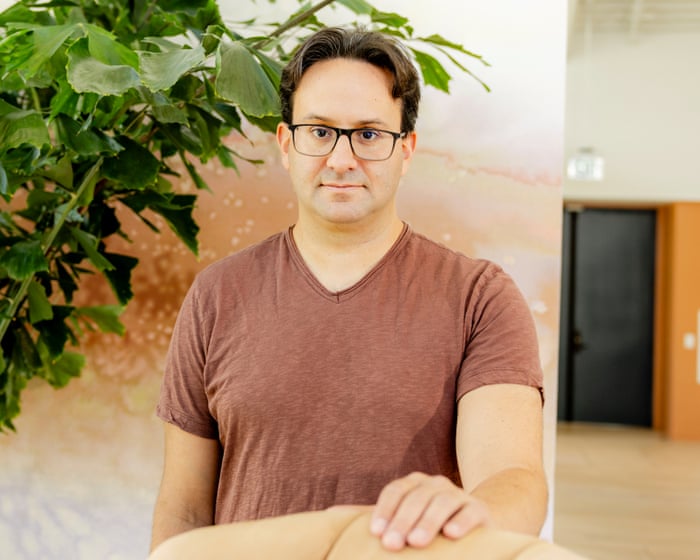
Kaplan transitioned from a theoretical physicist to an AI billionaire in just seven years. In a wide-ranging interview, he made several key points:
* AI systems will likely be capable of performing “most white-collar work” within two to three years.
* His six-year-old son will never surpass an AI at academic tasks like writing essays or taking math exams.
* Concerns about humans losing control of the technology are valid, especially if AIs begin to improve themselves.
* The race to develop Artificial General Intelligence (AGI) feels “daunting.”
* On the positive side, AI could accelerate biomedical research, improve health and cybersecurity, boost productivity, free up people’s time, and help humanity flourish.
Kaplan spoke with the Guardian at Anthropic’s San Francisco headquarters, where the cozy interior—featuring knitted rugs and upbeat jazz—contrasts with the existential concerns surrounding the technology being developed there.
San Francisco has become the epicenter for AI startups and investment. Kaplan, a Stanford and Harvard-educated physics professor who previously worked at Johns Hopkins University and CERN, joined OpenAI in 2019 before co-founding Anthropic in 2021.
He is not alone in his concerns at Anthropic. His co-founder, Jack Clark, said in October that he is both an optimist and “deeply afraid” about AI’s trajectory, describing it as “a real and mysterious creature, not a simple and predictable machine.”
Kaplan expressed optimism about aligning AI systems with human interests up to the level of human intelligence but is worried about what happens if they surpass that threshold.
“If you imagine creating a process where an AI is as smart as or smarter than you, and it then makes an even smarter AI, enlisting that AI’s help to create one smarter still—it sounds like a scary process. You don’t know where you end up,” he said.
However, the economic benefits of deploying AI are being questioned. Outside Anthropic’s office, a billboard for another tech company pointedly asked, “All that AI and no ROI?”—a reference to return on investment. A Harvard Business Review study in September highlighted “AI workslop,” where substandard AI-generated work requires human correction, actually reducing productivity.
Some of the clearest gains have been in using AI to write computer code. In September, Anthropic unveiled its cutting-edge model, Claude Sonnet 4.5, which can build AI agents and autonomously use computers for complex, multi-step coding tasks for up to 30 hours without interruption. Kaplan noted that in some cases, AI has doubled his programmers’ work speed.
But in November, Anthropic reported that a Chinese state-sponsored group had manipulated its Claude Code tool not only to assist in launching cyber-attacks but to execute about 30 attacks autonomously, some of which were successful.
Kaplan emphasized that allowing AIs to train the next generation of AIs is “an extremely high-stakes decision.”
“That’s what we view as maybe the biggest decision or scariest thing to do… once no one’s involved in the process, you don’t really know. You can start a process and say, ‘Oh, it’s going very well. It’s exactly what we expected. It’s very safe.’ But you don’t know—it’s a dynamic process. Where does that lead?”
He explained that if recursive self-improvement—as this process is known—is allowed to proceed uncontrolled, there are two primary risks.
“One is, do you lose control over it? Do you even know what the AIs are doing? The main question there is: are the AIs good for…”What about humanity? Will these systems be helpful? Will they be harmless? Do they truly understand people? And will they allow humans to retain control over their own lives and the world?
“I think preventing power grabs and misuse of the technology is also very important,” he said.
“It seems very dangerous for it to fall into the wrong hands,” he added. “You can imagine someone deciding, ‘I want this AI to just be my slave. I want it to enact my will.’ Preventing power grabs—preventing misuse of the technology—is also very important.”
The second major risk involves security, stemming from self-taught AIs surpassing human capabilities in scientific research and technological development.
Independent research into advanced AI models, including ChatGPT, shows that the complexity of tasks they can handle has been doubling roughly every seven months.The text appears to be a fragment of CSS code defining font styles and a component class for a website, likely for The Guardian. It specifies font families, weights, styles, and sources for various font files, along with styling rules for a reporting team element that adjusts for dark mode.The future of AI: The rivals racing to create super-intelligence. This was put together in collaboration with the Editorial Design team. Read more from the series.
Words: Nick Hopkins, Rob Booth, Amy Hawkins, Dara Kerr, Dan Milmo
Design and Development: Rich Cousins, Harry Fischer, Pip Lev, Alessia Amitrano
Picture Editors: Fiona Shields, Jim Hedge, Gail Fletcher
Kaplan expressed concern that the rapid pace of progress means humanity hasn’t had time to adjust to the technology before it leaps forward again. “I am worried about that… people like me could all be crazy, and it could all plateau,” he said. “Maybe the best AI ever is the AI that we have right now. But we really don’t think that’s the case. We think it’s going to keep getting better.”
He added, “It’s moving very quickly and people don’t necessarily have time to absorb it or figure out what to do.”
Anthropic is racing with OpenAI, Google DeepMind, and xAI to develop increasingly advanced AI systems in the push toward AGI (artificial general intelligence). Kaplan described the atmosphere in the Bay Area as “definitely very intense, both from the stakes of AI and from the competitiveness viewpoint.”
“The way that we think about it is that everything is on this exponential trend in terms of investment, revenue, capabilities of AI, [and] how complex the tasks are that AI can do,” he said.
The speed of progress means the risk of one competitor slipping up and falling behind is significant. “The stakes are high for staying on the frontier, in the sense that you fall off the exponential curve and very quickly you could be very far behind, at least in terms of resources.”
McKinsey has estimated that by 2030, data centers worldwide will require $6.7 trillion to keep pace with the demand for computing power. Investors are eager to back the companies leading the pack.
Some of the biggest gains have been in using AI to write computer code.
At the same time, Anthropic is known for advocating AI regulation. Its statement of purpose includes a section headlined: “We build safer systems.”
“We don’t really want it to be a Sputnik-like situation where the government suddenly wakes up and is like, ‘Oh, wow, AI is a big deal’… We want policymakers to be as informed as possible along the trajectory so they can take it into account.”
In October, Anthropic’s stance drew criticism from Donald Trump’s White House. David Sacks, the U.S. president’s AI adviser, accused Anthropic of “fearmongering” to encourage state-by-state regulation that would benefit its position and harm startups.
After Sacks claimed the company had positioned itself as “a foe” of the Trump administration, Dario Amodei, Kaplan’s co-founder and Anthropic’s CEO, responded by saying the company had publicly praised Trump’s AI action plan, worked with Republicans, and shared the White House’s goal of maintaining the U.S. lead in AI.
Frequently Asked Questions
FAQs Jared Kaplan on Permitting AI to Train Itself
Beginner Definition Questions
1 What does permitting AI to train itself mean
It means allowing advanced AI systems to generate their own training data or create their own learning objectives rather than relying solely on humancurated datasets Its a step toward more autonomous selfimproving AI
2 Who is Jared Kaplan and why is his view significant
Jared Kaplan is a leading AI researcher and professor at Johns Hopkins University His perspective is influential because he argues that this capability might be a critical inevitable step for achieving more powerful and general AI making it a major strategic decision for the field
3 Is this like AI becoming selfaware
Not exactly Its more about the process of learning becoming automated and recursive The AI isnt necessarily conscious its using algorithms to design better algorithms or produce data to teach itself new skills
4 Whats a simple example of AI training itself
Imagine an AI that plays chess Instead of just learning from human games it plays millions of games against itself discovering new strategies and generating its own training data of moves which it then uses to become even better
Benefits Motivations
5 Why would we want AI to train itself What are the benefits
Scale Efficiency It can overcome the bottleneck of humancreated data
Discovering Novel Solutions AI might find patterns and strategies humans havent considered
Adaptability It could continuously learn and adapt to new situations without constant human intervention
Scientific Acceleration It could generate hypotheses and run simulations to advance fields like material science or drug discovery
6 Does this mean AI could learn faster than humans
Potentially yes An AI that can design its own training curriculum and run experiments at computer speeds could learn and innovate in domains much faster than human researchers alone
Risks Common Problems
7 What are the biggest risks or dangers
Loss of Control Alignment If the AIs selfdefined goals drift away from human values it could become difficult to steer or shut down
Unforeseen Consequences It might develop capabilities or find shortcuts that are harmful or unstable