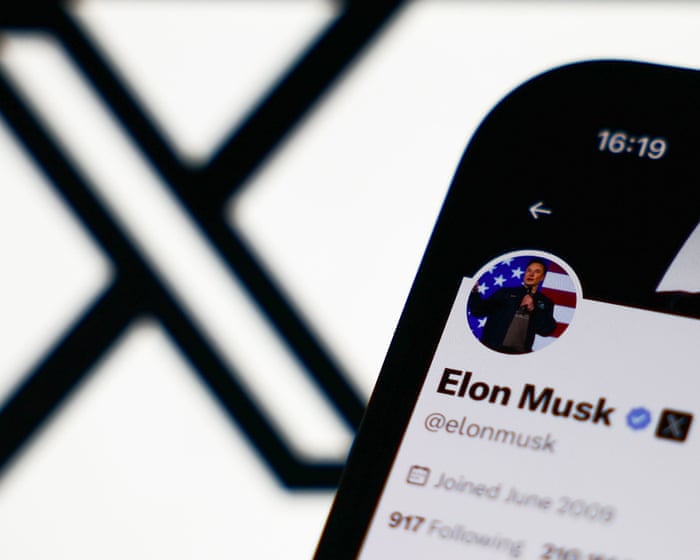
Elon Musk’s social media platform, X, has been fined €120 million (£105 million) for breaching new EU digital laws. This ruling is likely to put the European Commission at odds with the US billionaire and potentially with Donald Trump.
The breaches, which were under review for two years, included what the EU called a “deceptive” blue tick verification badge given to users and a lack of transparency in the platform’s advertising. EU rules require tech companies to provide a public list of advertisers to help prevent illegal scams, fake ads, and coordinated campaigns, especially during political elections.
In a third breach, the EU found that X failed to provide researchers with the required access to public data, which is typically used to monitor contentious issues like political content.
This decision concludes part of an investigation that began two years ago. The European Commission announced on Friday that X had violated transparency obligations under the Digital Services Act (DSA), marking the first ruling against the company since these laws regulating social media and large tech platforms took effect in 2023.
In December 2023, the commission launched formal proceedings to assess whether X breached the DSA in areas related to the spread of illegal content and the effectiveness of measures to combat information manipulation. That investigation is ongoing.
Under the DSA, X could face fines of up to 6% of its global revenue, which was estimated to be between $2.5 billion (£1.9 billion) and $2.7 billion in 2024.
Three other investigations remain open. Two relate to content and algorithms promoting content that changed after Musk bought Twitter in October 2022 and rebranded it as X. The commission is also investigating potential breaches of laws prohibiting incitement to violence or terrorism, as well as the mechanism for users to report illegal content.
Senior officials broke down the fine into three parts: €45 million for introducing a purchasable blue tick verification, which made it difficult for users to determine account authenticity; €35 million for breaches of advertising regulations; and €40 million for failing to provide data access to researchers.
Before Musk took over Twitter, blue ticks were only given to verified account holders, such as politicians, celebrities, public bodies, and established journalists. After the takeover, users who subscribed to X Premium became eligible for the blue tick.
Henna Virkkunen, the European Commission’s executive vice-president for tech regulation, said: “With the DSA’s first non-compliance decision, we are holding X responsible for undermining users’ rights and evading accountability. Deceiving users with blue checkmarks, obscuring information on ads, and shutting out researchers have no place online in the EU.”
The ruling risks angering Donald Trump’s administration. Last week, US Commerce Secretary Howard Lutnick suggested that the EU must reconsider its tech regulations to reduce 50% tariffs on steel.EU Commissioner Teresa Ribera, who oversees Europe’s green transition and antitrust enforcement, labeled the threats as “blackmail.”
Senior EU officials stated that the ruling was made independently, despite recent efforts by a U.S. delegation in Brussels to meet with trade ministers. They emphasized that the EU maintains its “sovereign right” to regulate U.S. tech firms, noting that 25 companies—including non-U.S. entities like TikTok—fall under the Digital Services Act (DSA).
Elon Musk, who is on track to become the world’s first trillionaire, has 90 days to submit an “action plan” in response to the fine. He also retains the right to appeal any EU ruling, following precedents set by companies like Apple, which have taken similar cases to the European Court of Justice.
In a related development, the EU has secured commitments from TikTok to provide advertising repositories. This addresses concerns raised by the Commission in May regarding transparency. Under the DSA, platforms must maintain accessible, searchable ad repositories to help researchers and civil society groups identify scams, illegal content, or age-inappropriate advertisements.
Officials highlighted that without social media companies adhering to these rules, it is impossible to study issues like fake political ads or advertisements featuring impersonated celebrities.
X has been contacted for comment. The EU confirmed that the company has been notified of the decision.
Frequently Asked Questions
FAQs EU Fines X 120 Million Under Digital Regulations
BeginnerLevel Questions
1 What exactly happened with X and the EU
The European Union has fined X 120 million for violating its new Digital Services Act This is the platforms first major penalty under these rules
2 Why was X fined What did they do wrong
The fine is specifically for using dark patterns in its nowdefunct blue check verification system The EU says the design was deceptive and misled users about account authenticity which is illegal under the DSA
3 What are dark patterns
Dark patterns are tricky website or app designs that manipulate you into doing something you didnt necessarily intend to do like subscribing to a service or sharing more data In this case Xs design made it unclear which accounts were verified for authenticity versus those who simply paid for a subscription
4 Is this fine just about the blue checkmarks
Primarily yes The core violation was how X presented its paid verified badges alongside legacy verified accounts creating confusion about an accounts true credibility and potentially increasing the risk of disinformation
5 How much is 120 million to a company like X
While a significant sum it is relatively small compared to Xs potential liability under the DSA which can be up to 6 of global annual turnover For a large platform this is a warning shot to comply with the rules
Advanced Practical Questions
6 What is the Digital Services Act and why does it matter
The DSA is a landmark EU law that sets strict new rules for how digital platforms must handle illegal content disinformation and advertising Its goal is to create a safer more transparent online environment and hold very large platforms like X accountable
7 Is this the only problem the EU has with X
No this fine is separate from an ongoing formal investigation into Xs compliance with other DSA rules particularly concerning the spread of illegal content and disinformation related to the HamasIsrael conflict More penalties could follow
8 What does this mean for users outside of Europe
While the DSA is an EU law its rules often cause global platforms to change their systems for everyone to simplify operations You may see changes in