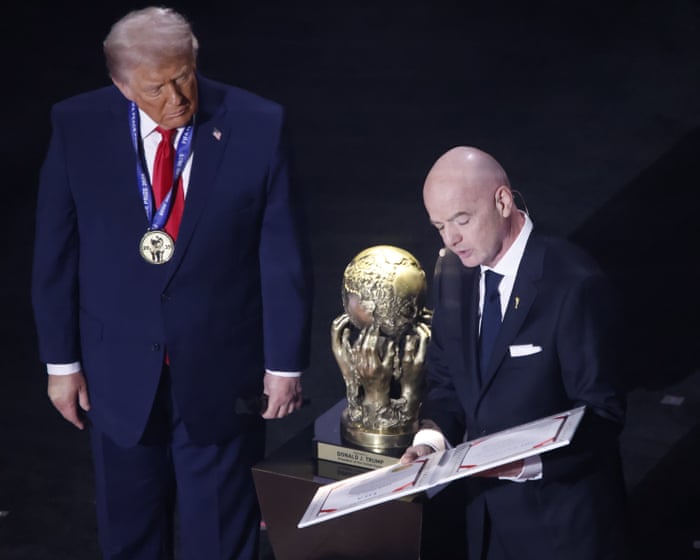
On the same day Donald Trump received a custom “peace prize” from his new friend, FIFA President “Johnny” Infantino, his administration released an equally flashy national security strategy. This relatively short document is saturated with Trump’s style and ideology. It begins with the characteristically humble claim that the president has brought “our nation—and the world—back from the brink of catastrophe and disaster.”
Even though the strategy largely formalizes the ongoing actions and statements of Trump and his administration, it should serve as a warning to the world, especially Europe.
The document advocates for an aggressive form of foreign policy interference, explicitly setting the goal of “promoting European greatness” for the United States. Its language could have been taken directly from Viktor Orbán’s speeches during the 2015–16 refugee crisis: “We want Europe to remain European, to regain its civilizational self-confidence.” Even more alarmingly, the document claims that Europe’s “economic decline is eclipsed by the real and more stark prospect of civilizational erasure.”
The entire section on Europe is steeped in decades of far-right ideology and propaganda. It blames the EU and migration policies for “transforming the continent and creating strife, censorship of free speech and suppression of political opposition, cratering birthrates, and loss of national identities and self-confidence.” According to the document, if “present trends continue, the continent will be unrecognizable in 20 years or less. As such, it is far from obvious whether certain European countries will have economies and militaries strong enough to remain reliable allies.” Indeed, the Trump administration believes that “within a few decades at the latest, certain NATO members will become majority non-European.”
Expanding on this theme in an interview with Politico, Trump argued this would make these countries “much weaker.”
These arguments strongly echo two theories considered foundational in contemporary far-right circles. The first is Oswald Spengler’s The Decline of the West, whose thesis on the cyclical decline of civilizations was used by the German far right to criticize the “perversion” and “weakness” of the democratic Weimar Republic. The second is The Great Replacement, published in 2011 by French novelist Renaud Camus, which transformed long-standing “native” fears into a more explicit conspiracy theory, accusing European elites of using immigration to replace rebellious “native” populations with a more docile and dependent electorate. Over the past decade, the “great replacement” conspiracy theory has become mainstream in U.S. right-wing circles through figures like Steve Bannon and Tucker Carlson.
The document implies that the nativist fever dream encapsulated in these ideas gives the Trump administration the right, if not the duty, to intervene in European affairs: “American diplomacy should continue to stand up for genuine democracy, freedom of expression, and unapologetic celebrations of European nations’ individual character and history.” And it is clear where it sees its allies: “America encourages its political allies in Europe to promote this revival of spirit, and the growing influence of patriotic European parties indeed gives cause for great optimism.”
In other words, the U.S. believes it is crucial to its national security to “Make Europe great again,” and that the European far right is the only political force capable of achieving this. Consequently, its “broad policy for Europe” prioritizes “cultivating resistance to Europe’s current trajectory within European nations” (meaning the far right) and “building up the healthy nations of central, eastern, and southern Europe”—particularly “aligned countries that…The text suggests that some countries “want to restore their former greatness” (such as Hungary and Italy). While the document is vague on specifics, it makes clear that a Trump administration priority is to pressure Europe into adopting a radical free speech policy, closer to the U.S. approach—especially regarding far-right speech—and not limited to social media. Another goal is to normalize relations with Russia, or as the document phrases it, to “reestablish strategic stability with Russia.” Though not explicitly called a future ally, Russia is clearly not treated as an adversary either.
In a broader sense, the national security strategy seems inspired less by an idealized 1950s America—often assumed to be the vision behind “Make America Great Again”—and more by the Monroe Doctrine of 1823. Articulated by President James Monroe, this doctrine warned European powers not to interfere in the “western hemisphere” (the Americas), which he declared a U.S. sphere of interest. The Trump administration’s policy document promises to “assert and enforce” a “Trump corollary” to the Monroe Doctrine, in which the U.S. would “enlist” countries worldwide to help safeguard American national interests.
None of this is entirely new—consider Vice President JD Vance’s 2025 speech at the Munich Security Conference, which launched an ideological attack on Europe’s democratic model. But now that it is laid out in an official document, perhaps European leaders will finally understand that “daddy” is serious. And if the document is too long or vague for them, let me summarize it clearly and concisely: the current U.S. government believes its national security is best served by the destruction of liberal democracy in Europe. In other words, the U.S. is not merely an unwilling ally—it is a willing adversary. It is time to act accordingly.
Cas Mudde is the Stanley Wade Shelton UGAF professor of international affairs at the University of Georgia and author of The Far Right Today.
Frequently Asked Questions
Of course Here is a list of FAQs based on the provided statement
FAQs The US as Europes Adversarial Ally
BeginnerLevel Questions
1 What does it mean to call the US a reluctant ally
It means that while the US and Europe are formally allied there is a perception that American commitment is inconsistent driven more by selfinterest or domestic politics than by unwavering solidarity with European goals
2 How can the US be both an ally and an adversary
This describes a complex relationship The US is an ally in terms of military defense and shared economic interests It is seen as an adversary when its political actions economic policies or ideological influence directly challenge European unity values or strategic autonomy
3 What is farright ideology in this context
It refers to a political worldview that emphasizes nationalism skepticism of multilateral institutions a focus on sovereignty and borders and often a rejection of progressive social policies The claim is that this ideology influential in US politics fundamentally conflicts with core European Union values
4 Isnt this just about Donald Trump
While the Trump presidency brought this tension to the forefront the perspective argues the issue is deeper It suggests that strains of American exceptionalism isolationism and nationalist politics have long existed and continue to influence US policy toward Europe regardless of the administration
Advanced Practical Questions
5 What are concrete examples of the US acting as an adversary to Europe
Economic Policy Imposing tariffs on European steel and aluminum during the Trump administration framing the EU as a foe on trade
Foreign Policy Unilaterally withdrawing from international agreements crucial to Europe like the Iran Nuclear Deal or the Paris Climate Accord
Technology Industry Passing legislation like the Inflation Reduction Act which European leaders criticized as a subsidy war that could draw green investments away from Europe
6 How does this adversarial relationship affect everyday Europeans
It can create economic uncertainty impact jobs in targeted industries force Europe to spend more on its own defense and create diplomatic friction that complicates coordinated responses to global challenges like climate change or relations with