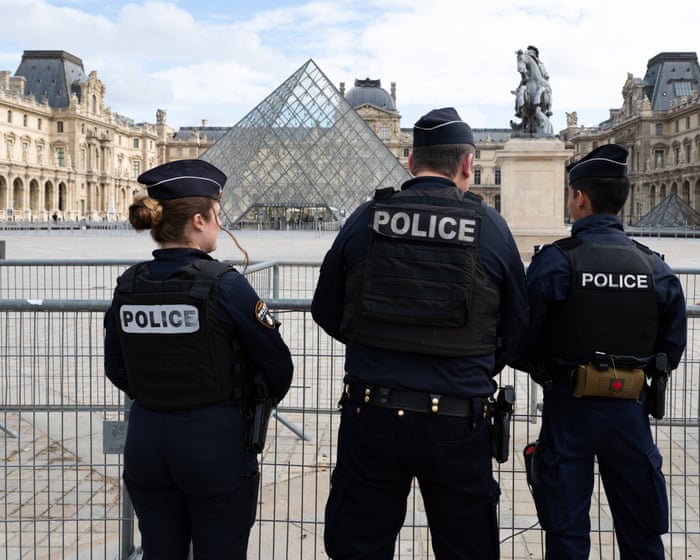
A scathing investigation into the theft of crown jewels from the Louvre in October has revealed that the thieves escaped with just 30 seconds to spare, due to a series of preventable security failures at the Paris museum.
The investigation, ordered by the culture ministry after the embarrassing daylight heist, found that only one of two security cameras was working near the break-in point on the morning of Sunday, October 19th. Agents in the control room lacked enough screens to monitor footage in real time, and poor coordination meant police were initially sent to the wrong location when the alarm sounded, according to a report detailed to the French senate’s culture commission.
“It highlights an overall failure of the museum, as well as its supervisory authority, to address security issues,” said commission head Laurent Lafon.
One of the most startling findings was the narrow escape window. “Give or take 30 seconds, the Securitas guards or the police officers in a car could have prevented the thieves from escaping,” lead investigator Noël Corbin told senators. He stated that modern CCTV, more resistant glass, or better coordination could have prevented the loss of the jewels, valued at an estimated €88 million and still missing.
Major security weaknesses had been flagged in multiple studies presented to Louvre management over the past decade, including a 2019 audit by experts from Van Cleef & Arpels. That report specifically identified the riverside balcony used by the thieves as a vulnerability, easily accessible with an extendable ladder—exactly the method used in the heist.
Corbin confirmed that current Louvre director Laurence des Cars was unaware of this audit, which was commissioned by her predecessor, Jean-Luc Martinez. “The recommendations were not acted on, and they would have enabled us to avoid this robbery,” Corbin said, citing a lack of coordination between the two administrators.
Police believe they have arrested all four intruders, who carried out the heist in the Apollo Gallery in about 10 minutes before escaping on motorbikes.
The revelations increase pressure on Des Cars, the first woman to lead the Louvre, appointed by President Emmanuel Macron in 2021. Questions have persisted about whether the theft was avoidable and why the world’s most-visited museum seemed so poorly protected.
France’s lower house of parliament is conducting its own inquiry, while Des Cars and Martinez are scheduled to be questioned by senators next week. Last month, the state auditor criticized the “woefully inadequate pace” of security upgrades, noting the museum had prioritized “high-profile and attractive operations” over its own protection.
Guy Tubiana, a senior police officer and security adviser for the culture ministry who participated in the investigation, told senators he was “stunned” by his findings. “There was a succession of malfunctions that led to catastrophe, but I never would have thought the Louvre could have so many malfunctions,” he said.
Louvre staff are planning to strike on Monday to protest what they see as chronic understaffing and overcrowding; the museum welcomed 8.7 million visitors last year.
Separately, the museum recently disclosed that a water leak in late November damaged 300 to 400 journals, books, and documents in its Egyptian department.
Frequently Asked Questions
Of course Here is a list of FAQs based on the statement The investigation revealed that the thieves escaped the Louvre with just 30 seconds before police arrived
Beginner Factual Questions
1 What actually happened at the Louvre
A famous art heist occurred where thieves successfully stole artwork and managed to escape the museum a mere 30 seconds before police arrived on the scene
2 When did this Louvre theft happen
This specific detail comes from the investigation of the infamous 1990 robbery of the Louvre On the night of May 19th thieves stole several paintings including a version of JeanBaptisteCamille Corots The Gypsy
3 What does 30 seconds before police arrived mean
It means the thieves getaway was extremely close The investigation concluded that if the police had been just half a minute faster they would have likely caught the thieves in the act or during their escape
4 What did they steal
In the 1990 heist they stole several 19thcentury paintings The most notable was The Gypsy by Corot along with works by artists like CharlesFranois Daubigny
Advanced Analytical Questions
5 How could an investigation determine such a precise time gap
Investigators likely pieced together timelines from the last triggered alarm or broken security seal witness reports CCTV footage timestamps the dispatch time of the police call and the official police arrival time logged by the first officers on scene
6 Does the 30second detail imply the theft was an inside job or exceptionally wellplanned
It strongly suggests an extremely wellplanned operation Knowing security patrol routes alarm response times and having a flawless escape route timed to the second points to meticulous planning potentially with insider knowledge of procedures
7 What are the main security failures highlighted by this 30second window
It highlights critical failures in response time onsite security and potentially barrier security
8 Were the stolen artworks ever recovered
Yes in this case most of the