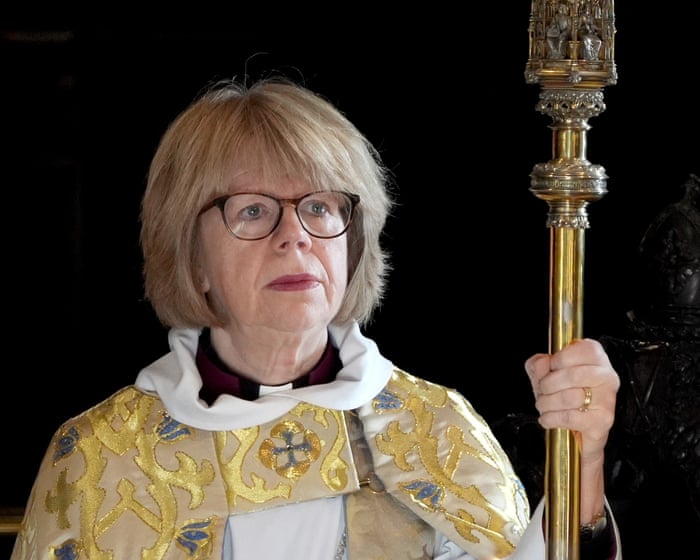
The incoming Archbishop of Canterbury has warned in her Christmas Day sermon that “our national conversations about immigration continue to divide us, when our common humanity should unite us.”
Speaking in her current role as the Bishop of London, Dame Sarah Mullally told St Paul’s Cathedral: “Joy is born exactly where despair expects to triumph. As joy breaks through in our lives, it gives us the opportunity to become people who make room.
“Room in our homes. Room in our churches. Room in our public conversations and in the attitudes we hold. This joy asks us to allow our lives to be interrupted by the needs of others, just as the people of Bethlehem were interrupted.”
Mullally continued: “This insight matters because our own society carries uncertainties that can wear us down. Many feel the weight of economic pressure. Some feel pushed to the margins.
“Our national conversations about immigration continue to divide us, when our common humanity should unite us.”
Many people also “experience the hardship and injustice of inequality,” she said.
The bishop added: “These issues do not define the whole of our life together, yet they can leave us wondering whether the world is fraying at the edges.
“We who are Christians then hold fast to joy as an act of resistance. The kind of joy that does not minimize suffering but meets it with courage.”
She told the Christmas congregation: “God chooses to be born precisely into a world like ours. A world of limited resources and crowded homes.
“A world of political tension and uncertainty. A world where people do their best to offer kindness even when they feel stretched. God does not wait for perfect conditions. God arrives in the midst of the incomplete.”
In his Christmas Day sermon, the Archbishop of York also spoke of divisions in society and how he was “intimidated” by Israeli militias during a visit to the Holy Land this year.
Stephen Cottrell said he was stopped at checkpoints and that militias told him he could not visit Palestinian families in the occupied West Bank.
“We have become, I can think of no other way of putting it, fearful of each other, and especially of strangers,” he said. “We cannot see ourselves in them. And we, therefore, spurn a common humanity.”
He described how YMCA charity representatives in Bethlehem, who work with “persecuted Palestinian communities” in the West Bank, gave him an olive wood nativity scene carving depicting a “large grey wall” blocking the three kings from getting to the stable to see Mary, Joseph and Jesus.
“It was sobering to see this wall for real on my visit to the Holy Land, and we were stopped at various checkpoints and intimidated by local Israeli militias who told us that we couldn’t visit Palestinian families in the occupied West Bank,” he said.
He said that, as well as “thinking about the walls that divide and separate the Holy Land,” he also thinks of “all the walls and barriers we erect across the whole of the world.”
He continued: “And perhaps, most alarming of all, the ones we build around ourselves and construct in our hearts, and of how our fearful shielding of ourselves from strangers.
“The strangers we encounter in the homeless on our streets, refugees seeking asylum, young people robbed of opportunity and growing up without hope for the future, means that we are in danger of even failing to welcome Christ when he comes.”
In October, Mullally was named as the first female Archbishop of Canterbury.
A former chief nursing officer for England, who was made a dame in 2005 in recognition of her services to nursing and midwifery, she will take up her new role next year.In recognition of her contributions to nursing and midwifery, she has served as the Bishop of London since 2018. The Confirmation of Election ceremony on January 28 at St Paul’s Cathedral will formally establish Mullally as the Archbishop of Canterbury. She will continue as Bishop of London until that time, with her enthronement scheduled for March 25 at Canterbury Cathedral.
Justin Welby, the 105th Archbishop of Canterbury, formally resigned in early January after announcing his intention to step down in November 2024, following criticism of his handling of one of the church’s most serious abuse scandals.
In his Christmas sermon, Pope Leo condemned the conditions facing Palestinians in Gaza. He reflected that the story of Jesus being born in a stable shows how God “pitched his fragile tent” among the people of the world.
“How, then, can we not think of the tents in Gaza, exposed for weeks to rain, wind and cold?” he said.
Leo celebrated his first Christmas after being elected by the world’s cardinals in May to succeed the late Pope Francis.
During Thursday’s service attended by thousands in St. Peter’s Basilica, Leo also expressed sorrow over the plight of the homeless worldwide and the destruction caused by ongoing global conflicts.
“Fragile is the flesh of defenseless populations, tested by so many wars, ongoing or concluded, leaving behind rubble and open wounds,” said the pope.
“Fragile are the minds and lives of young people forced to take up arms, who on the frontlines feel the senselessness of what is asked of them and the falsehoods that fill the pompous speeches of those who send them to their deaths,” he added.
In his Urbi et Orbi (“to the city and the world”) message and blessing, delivered at Christmas and Easter, Leo called for an end to all wars around the globe. Speaking from the central balcony of St. Peter’s Basilica to thousands gathered in the square below, he lamented conflicts—whether political, social, or military—in Ukraine, Sudan, Mali, Myanmar, Thailand, Cambodia, and elsewhere.
Frequently Asked Questions
Of course Here is a list of FAQs about the incoming Archbishop of Canterburys Christmas sermon on immigration
Beginner General Questions
1 What did the Archbishop of Canterbury actually say
In his 2022 Christmas sermon the incoming Archbishop Justin Welby warned that the heated national debate on immigration was creating deep divisions in society He urged people to see immigrants as individuals with dignity not just as a political issue or a problem to be solved
2 Why would an Archbishop talk about immigration in a Christmas sermon
He connected the Christmas storywhere Mary and Joseph were travelers seeking shelterto the modern experience of migrants He argued that Christian teachings on compassion hospitality and seeing the stranger as a neighbor are directly relevant
3 Was he saying there should be no immigration controls
No he did not call for open borders His main point was about the tone and character of the debate He criticized dehumanizing language and urged for a more compassionate respectful discussion that recognizes the humanity of migrants
4 What was the main reaction to his comments
Reactions were mixed Some praised him for a moral and timely message while others criticized him for being out of touch or for wading into a political debate from a religious platform
Advanced Deeper Questions
5 What did he mean by the debate dividing us
He meant that the issue is often framed in extreme us vs them terms This rhetoric can fuel hostility make constructive compromise impossible and damage the social fabric by turning communities against each other
6 How is this linked to his role as a spiritual leader
As the head of the Church of England his role includes being a moral voice for the nation He sees it as his duty to comment on societal issues from an ethical and theological perspective calling for unity and justice
7 Isnt this just political commentary Why should we listen
While the topic is political he was framing it as a matter of national character and moral health He was asking a fundamental question How do we as a society choose to treat vulnerable people This is a question that goes beyond party politics
8 Whats an example of the dehumanizing language he criticized
He was likely referring to terms that reduce people to a