Robert Duvall was a powerhouse of American masculinity, with a voice like a foghorn, and he brought incredible energy and heart to his films for over six decades. Just seeing him on screen was enough to make me smile. His handsome, commanding presence gave him the look of a Roman emperor from Waxahachie, Texas, or a three-star general who decided to tour with a country band. Duvall was famously bald—the rare roles requiring hairpieces always looked unnatural on him—so he seemed to stay the same age for most of his career: forever in his vigorous forties, though often portraying characters layered with tenderness and vulnerability.
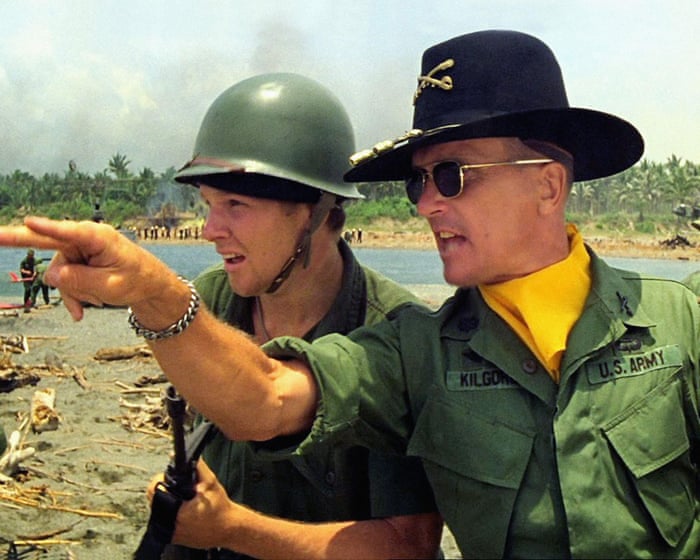
Duvall enjoyed a long and rich career, beginning with memorable roles in To Kill a Mockingbird, MASH, The Conversation, and Network. But he was destined to be best known for two sensational and very different roles given to him by Francis Ford Coppola at opposite ends of the 1970s. The first was Tom Hagen, the quiet, self-effacing consigliere to the Corleone crime family in The Godfather (1972), who navigates a complex relationship with Don Vito Corleone (Marlon Brando) and his youngest son, the coldly imperious Michael (Al Pacino). The second was his extraordinary turn as the surf-obsessed Wagner enthusiast Lieutenant Colonel Kilgore in Apocalypse Now (1979), who leads a massive helicopter assault on a Vietnamese village in broad daylight, blaring The Ride of the Valkyries* from speakers—ostensibly to escort Captain Willard (Martin Sheen) and his crew to a strategic river entry point, but clearly because he just wants an excuse for a whooping, hollering cavalry charge.
Duvall’s portrayal of Tom Hagen in The Godfather is one of his subtlest and most misunderstood performances. He is calm and reserved, the administrator and COO of the Corleone empire. Hagen endures insults from Vito’s hotheaded son Sonny (James Caan), who insists the family needs a “wartime” consigliere, not a milksop. When Michael later coldly excludes him from the inner circle, demoting him to a Las Vegas lawyer, Duvall masterfully conveys Hagen’s deep hurt.
Yet it is the mild-mannered Hagen who orchestrates the most macabre and legendary act of violence in the entire Godfather saga: the horse’s head in the bed. Vito sends him to Los Angeles to confront a movie producer refusing to cast Johnny Fontane, Vito’s godson and a Sinatra-esque singer. The producer entertains Hagen at his lavish Hollywood home, proudly showing off his prized racehorse, but still refuses to cooperate. Hagen leaves, seemingly accepting the decision. The next morning reveals the horrifying result: in the intervening hours, Hagen mobilized local muscle to silently break into the producer’s estate—leading the way himself, since he knew the layout—drug the horse, saw off its head, sneak into the producer’s bedroom, place the head between the sheets, and slip away. It’s an act of psychopathic ingenuity and daring. Back in New York, when Vito asks if he’s tired, Hagen simply shrugs and says he “slept on the plane.” Later, when Tessio is about to be executed for conspiring against Michael, he pleads with Hagen: “Tell Mike it was only business. I always liked him,” even asking for Hagen’s help. Duvall’s face in that moment is a mask of contemptuous amusement.
A similar steel runs through the outrageous Kilgore in Apocalypse Now, who booms shirtless while squatting athletically to address his men: “I love the smell of napalm in the morning.”“Charlie don’t surf!” he declares with contempt, dismissing the enemy for not understanding his passion. When a confused subordinate questions him, he snaps, “What do you know about surfing, Major? You’re from goddamned New Jersey!” Duvall delivers these unhinged arias with total conviction.
That same year, he delivered another intimidating performance in The Great Santini (1979) as “Bull” Meacham, a marine officer who bullies his teenage son, Ben, during driveway basketball games and cannot bear it when Ben finally wins. The father’s humiliation of his son makes for a painfully raw scene.
Duvall won his Best Actor Oscar for a role that channeled a quieter, more wistful loneliness: Mac Sledge in Bruce Beresford’s Tender Mercies (1983). Mac is a washed-up country singer who sobers up in a Texas motel run by a war widow, whom he eventually marries. Duvall gives a gentle, heartfelt performance, even singing two of his own compositions, “Fool’s Waltz” and “I’ve Decided to Leave Here Forever.” The film feels like a melancholy country song, with Duvall at its center.
My personal favorite, however, is Duvall’s own passion project, The Apostle (1997), which he wrote, produced, directed, and starred in. It shares with Tender Mercies a theme of spiritual redemption in America’s heartland. He plays Euliss “E.F.” Dewey, a disgraced preacher who, after a drunken, violent incident, rebuilds his life by founding a church in a Louisiana town. Duvall crafts an almost Hardyesque tale—a Mayor of Casterbridge for the Deep South. E.F. is portrayed without irony, and his final sermon, delivered as police wait outside, is profoundly moving. Duvall is glorious here, especially in his fiery, playful preaching, leaning into the microphone to bellow about “holy ghost power!”
Duvall always had power, and some of that power has left the movies today.
Frequently Asked Questions
Of course Here is a list of FAQs about the legendary actor Robert Duvall designed to be helpful for both new fans and longtime admirers
FAQs About Robert Duvall
Beginner General Questions
Q Who is Robert Duvall
A Robert Duvall is a highly acclaimed American actor known for his intense authentic and transformative performances across film and television for over six decades
Q What is Robert Duvall most famous for
A He is famous for iconic roles like the ruthless mafia consigliere Tom Hagen in The Godfather films the intimidating Lieutenant Colonel Bill Kilgore in Apocalypse Now and his Oscarwinning role as the washedup country singer Mac Sledge in Tender Mercies
Q Did Robert Duvall win an Oscar
A Yes he won the Academy Award for Best Actor for Tender Mercies He has been nominated a total of seven times
Q How old is Robert Duvall Is he still acting
A Robert Duvall was born on January 5 1931 While he has slowed down he continues to take on select roles with his most recent film being The Judge and 12 Mighty Orphans
Deeper Dive Career Questions
Q What makes his acting style so unique and respected
A Duvall is known for his incredible nuance and immersion He doesnt just play a character he seems to fully inhabit them capturing subtle mannerisms accents and a deep inner life He brings a quiet conviction and authenticity that makes even flawed or intimidating characters feel profoundly human
Q Besides The Godfather what are his other mustsee movies
A Essential viewing includes
The Great Santini
The Apostle
Lonesome Dove