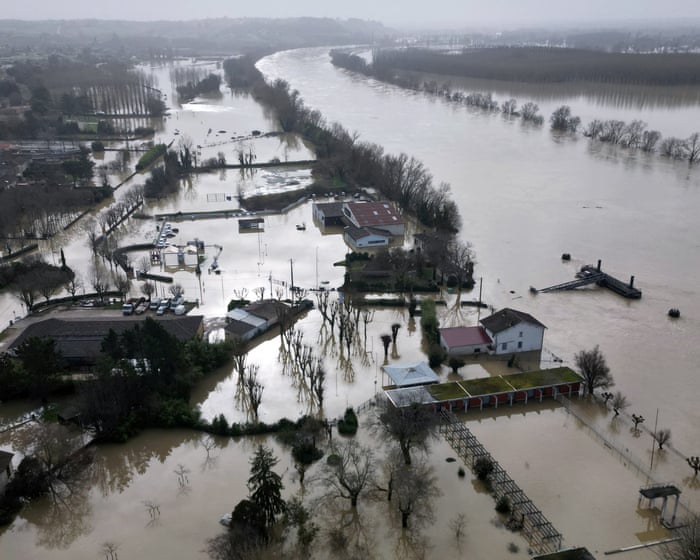
France has issued its highest flood warnings for three regions as the effects of Storm Nils continue to cause widespread disruption across the country.
Homes have been flooded and villages cut off after the Garonne River burst its banks. Hydrologists warn that rain is now falling on ground that has reached record levels of saturation.
Météo France stated that red flood alerts would stay in effect on Wednesday in Gironde, Lot-et-Garonne, and Maine-et-Loire, while the number of areas under orange alerts would drop from 14 to 12.
Monique Barbut, the minister for ecological transition, said a state of emergency—which speeds up insurance claims—would be declared once the flooding subsides. “Those who follow climate issues have long warned us that events like this will become more frequent,” she told TV news channel LCI on Tuesday, after visiting the affected Gironde region. “In fact, that future is already here.”
Lucie Chadourne-Facon, director of France’s flood monitoring service Vigicrues, described the repeated rainy disturbances as “exceptional,” noting that the soil is so saturated that even 20–30mm of rain could trigger flooding. “We are dealing with two parallel phenomena,” she explained to BFMTV over the weekend. “The widespread nature of the rainfall means all the smaller rivers are reacting, flowing into larger ones and causing water levels to rise through a chain effect. At the same time, ongoing rain is reactivating the flooding.”
Vigicrues reported “damaging flooding” along the Garonne River downstream from Agen, with significant impacts in the Marmande and Gironde areas. Although water levels had slowly receded after weekend peaks, they were rising again on the lower Garonne.
Officials anticipate major flooding on Tuesday afternoon along the Maine River—including the city of Angers—and overnight along the Loire River near Ponts-de-Cé, with levels expected to continue rising through Wednesday.
These floods in France follow a series of storms that have struck Portugal and Spain, killing at least 16 people and forcing thousands from their homes.
While scientists have not yet conducted specific studies to determine if global warming intensified these floods, they point to the established physical principle that warmer air holds more moisture.
On Tuesday, the EU’s scientific advisors urged Europe to prepare for a world that could be 3°C hotter by the end of the century—double the target set by world leaders in the 2015 Paris Agreement—and to stress-test even more extreme scenarios. France’s national adaptation strategy, released last year, aims to prepare the country for up to 4°C of global warming.
“We are now at a point where these events are happening with a speed and intensity we have never seen before,” Barbut told LCI. “Clearly, what we must do now is implement adaptation policies that will build resilience across our regions.”
Frequently Asked Questions
FAQs Red Flood Warnings in France
BeginnerLevel Questions
1 What is a red flood warning
A red warning is the highest level of alert in Frances weather and flood warning system It means the flooding is severe widespread and poses a significant danger to life People in affected areas must take immediate action to protect themselves
2 Which areas in France are affected
The specific affected regions can change rapidly Currently the most severe warnings are often for areas in northern and eastern France including parts of ledeFrance HautsdeFrance and Grand Est Always check the latest official maps from Vigicrues or MétéoFrance
3 What caused this heavy rainfall and flooding
The flooding is due to an unusual and persistent weather pattern that has brought continuous heavy rain over several days The ground is already saturated from previous rain so new rainfall has nowhere to go causing rivers to overflow rapidly
4 What should I do if Im in an area with a red warning
Immediately follow instructions from local authorities which may include evacuation orders
Avoid all travel Do not walk or drive through floodwater
Move to higher ground if it is safe to do so
Secure important documents and prepare an emergency kit
Stay informed via official sources like local prefecture alerts and radio
5 I have a trip planned to France Should I cancel
Not necessarily but you must check the situation for your specific destination Contact your airline train company and accommodation provider Avoid travel to the departments under red or orange alerts as transport is severely disrupted Monitor travel advice from your governments foreign office
Advanced Practical Questions
6 Whats the difference between Vigicrues and MétéoFrance alerts
MétéoFrance issues weather warnings using a colorcoded system
Vigicrues is the specific service that monitors river levels and issues flood warnings also using the same color system A red rain warning from MétéoFrance often leads to red flood warnings from Vigicrues