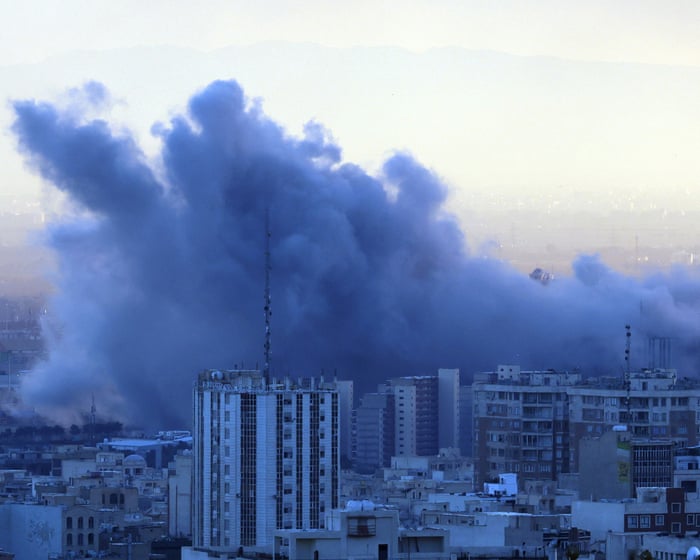
Israel has launched another wave of strikes on Tehran and Beirut, while Iranian missiles continue to target Israel and the Gulf, as the conflict enters its fifth day.
Explosions were heard across Tehran early Wednesday morning, following Israel’s announcement of “broad-scale strikes” on Iranian regime targets. Kurdish media also reported that police stations and Iranian Revolutionary Guards Corps (IRGC) headquarters in northwestern Iran’s Kurdish regions were destroyed in the attacks.
Iran’s death toll has risen sharply, with estimates now ranging from 800 to 1,500 people killed over the five days of war.
U.S. and Israeli officials stated that the war is progressing better than expected, though the ultimate goal of their campaign remains unclear due to contradictory aims. The Trump administration has at times cited objectives including regime change, destroying Iran’s ballistic missile capabilities and navy, preventing it from obtaining nuclear weapons, and ending its support for proxies across the region.
President Donald Trump mentioned that some individuals he considered as potential post-war leaders for Iran were killed in the initial days of the conflict. Regarding Reza Pahlavi, the exiled son of Iran’s late shah, Trump indicated a preference for “someone from within” Iran.
In Iran, funeral proceedings for the late Supreme Leader Ayatollah Ali Khamenei began in Tehran on Wednesday morning. Khamenei, who was killed in U.S.-Israeli airstrikes on Sunday, will lie in state for three days at a large compound in central Tehran for public viewing.
Meanwhile, Iran’s senior clerics convened to appoint a new supreme leader, a role that serves as both head of state and commander-in-chief of the military. The reported favored candidate is Mojtaba Khamenei, the 56-year-old son of Ali Khamenei, who is also the preferred choice of the IRGC.
Analysts suggest that Mojtaba Khamenei is a hardliner, and his selection would signal an increased role for the IRGC in Iran. His appointment would likely reinforce the regime’s authoritarian response to domestic calls for reform. Earlier this year, widespread protests against the government were brutally suppressed, resulting in at least 7,000 deaths.
Iran continued to target U.S. bases and installations across the Gulf, striking the U.S. embassy in Saudi Arabia and consulate in the United Arab Emirates. Iranian drones and missiles also hit U.S. military radars and early warning systems in Bahrain and Qatar—unprecedented attacks on U.S. bases in the region, which have maintained near-total dominance since the first Gulf War.
Israeli authorities reported that Iran launched missile barrages overnight and into the early morning, though most were intercepted without causing casualties.
Hezbollah also continued its attacks on Israel, firing rockets and suicide drones at military bases and troop gatherings in northern Israel. Hezbollah media claimed it struck three Israeli Merkava tanks that entered southern Lebanon and downed an Israeli drone in Lebanese airspace.
In response, Israel conducted extensive airstrikes across Lebanon, particularly in the southern suburbs of Beirut, with explosions shaking the capital into Wednesday morning. Israel also struck a hotel without warning in Hazmieh, southeast of Beirut, located about 700 meters from the presidential palace.Lebanon’s health ministry reported that six people were killed in the strikes, raising the total death toll since Monday to 46. The attacks have displaced at least 58,000 people across the country, creating widespread panic. Rumors of evacuation orders led many to flee certain areas and buildings in large numbers, sometimes unnecessarily.
People stand next to an Iranian missile after it fell near Qamishli international airport in Syria.
The U.S. and Israel offered a positive outlook on their military actions. Admiral Brad Cooper, head of U.S. Central Command, stated that the U.S. has hit around 2,000 targets in recent days, severely damaging Iran’s air defenses and destroying significant weapons stockpiles and ballistic missile launchers.
Israeli military spokesperson Brigadier General Effie Defrin said Israel targeted a building in the Iranian city of Qom, where religious authorities were reportedly meeting to choose a new supreme leader. Iranian media claimed the building was empty at the time of the strike, and Defrin said Israel is assessing potential casualties.
The Israeli military also stated it hit sites in Iran used to store ballistic missiles and destroyed a secret underground facility involved in developing “key components” for nuclear weapons. Iran has consistently denied seeking nuclear weapons, maintaining that its nuclear program is solely for civilian purposes.
Frequently Asked Questions
Of course Here is a list of FAQs about the reported escalation framed in a natural tone with direct answers
BeginnerLevel Questions
1 What exactly happened
In a significant escalation Israel reportedly launched military strikes against targets in Tehran Iran and Beirut Lebanon In response Iran launched missile and drone attacks against US military bases located in the Gulf region
2 Why did Israel attack Iran and Beirut
While official reasons are often complex such strikes are typically presented as preemptive or retaliatory actions Israel has stated goals of preventing Iran from developing nuclear weapons and countering Iranianbacked militias like Hezbollah in Lebanon which it sees as direct threats to its security
3 Why did Iran attack US bases
Iran views the United States as Israels primary ally and a major military presence in the region Striking US bases is a direct response to US support for Israel and a demonstration of Irans capability to retaliate against what it calls the axis of evil supporting its enemies
4 Is this the start of a fullscale regional war
It is a major escalation that significantly increases the risk of a wider war However all sides have historically aimed to avoid allout direct war The situation is extremely volatile and further cycles of retaliation could tip the balance
5 How is this different from previous conflicts
The direct strike on Iranian soil marks a major threshold crossed Previous conflicts often involved proxies or strikes on Iranian assets in other countries This represents a more direct stateonstate confrontation
Advanced Practical Questions
6 What are the immediate global implications
Expect a sharp spike in global oil prices increased volatility in financial markets and heightened security alerts for travelers and assets across the Middle East and for allied nations Major powers will be urgently engaged in diplomacy to prevent further escalation
7 What role do proxy groups play in this
Proxy groups are allied with Iran and can open additional fronts They may launch their own attacks against Israel or US interests complicating the conflict and making it harder to contain
8 Could this conflict draw in other major powers like Russia or China
Direct military involvement is unlikely initially However both Russia