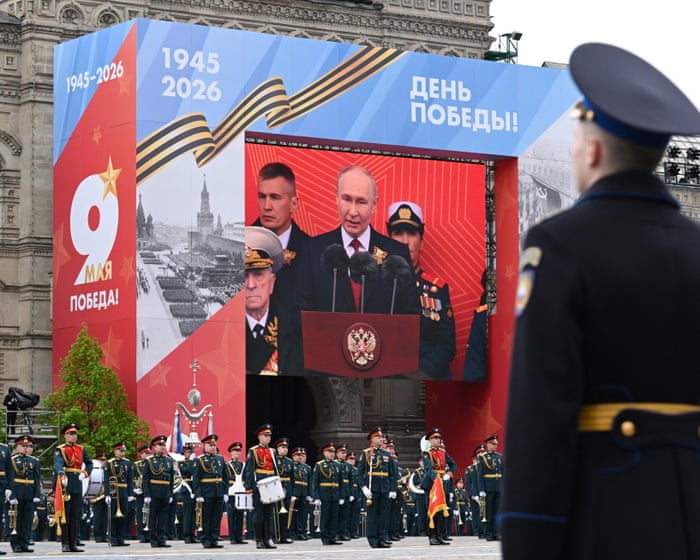
Vladimir Putin declared that Russia will always be victorious as he oversaw a scaled-back Victory Day parade on Red Square, held under heavy security amid growing fears of Ukrainian attacks and increasing public war fatigue.
Speaking to the crowd, the Russian leader invoked the sacrifices of World War II to rally support for his soldiers fighting in Ukraine. “The great feat of the generation of victors inspires the warriors carrying out the tasks of the special military operation today,” he said, using the Kremlin’s preferred term for his invasion of Ukraine. “They stand against an aggressive force armed and supported by the entire NATO bloc. And despite this, our heroes move forward. Victory has always been and will always be ours.”
Despite the confident words, this year’s parade highlighted a moment of serious weakness for the Russian president.
On Saturday, Moscow was blanketed with heavy security, and internet services were switched off across the city as Ukraine continued to unsettle the Kremlin with long-range drone and missile strikes, forcing organizers to strip the event of its usual spectacle.
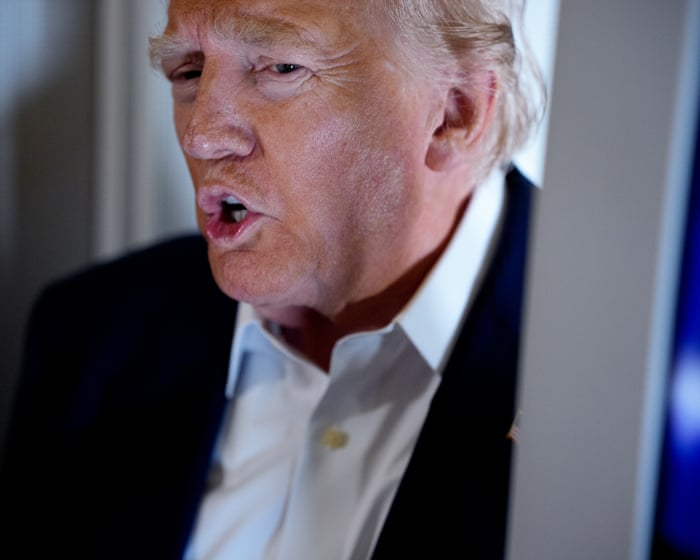
It wasn’t until the final hours that it became clear Ukraine would not disrupt the proceedings. On the eve of the parade, US President Donald Trump announced that Russia and Ukraine had agreed to a three-day ceasefire and prisoner exchange.
The usual display of missiles and armored vehicles, a regular feature of the parade since Putin introduced military hardware in 2017, was completely absent. Instead, guests were shown a video showcasing Russia’s drone capabilities and nuclear arsenal.
The audience, which included a small delegation of foreign leaders from Belarus, Kazakhstan, and Uzbekistan, also watched as a column of North Korean soldiers marched across the square. North Korea has become one of Russia’s closest allies in recent years, with its troops fighting alongside Russian forces in Ukraine.
The parade lasted about 45 minutes, roughly half the length of previous years.
“It was a modest parade,” wrote pro-Kremlin commentator Sergei Markov on Telegram, adding: “There are still enormous challenges ahead.”
Russian authorities openly acknowledged that the security measures were designed specifically to protect Putin, an admission that underscored just how dramatically the calculus of a war Russia once expected to win in weeks has since shifted.
Earlier in the week, Putin pressed Volodymyr Zelenskyy for a ceasefire to coincide with the parade. Ukraine initially dismissed the proposal as a cynical ploy to shield the celebrations from drone attacks.
Zelenskyy’s response came on Friday night in the form of a decree laced with sarcasm: Ukraine would, he announced, “permit” Russia to hold the event by choosing not to attack it, out of respect for a request from the US president. The ceasefire is set to last until May 11.
This year’s Victory Day parade was the first to be held since Russia’s war on Ukraine has lasted longer than the Soviet Union’s entire campaign against Nazi Germany. Putin has repeatedly tried to draw a direct line between the two wars, falsely portraying his invasion as a continuation of the struggle against Nazism.
Notably, on Saturday, he was seated not beside World War II veterans as in previous years, but flanked by soldiers who had fought in Ukraine.
With no victory in sight and no timeline for ending the current war, the mood inside Russia is souring. Mass internet blackouts in the weeks before the parade, imposed by security services and justified as necessary precautions, have fueled public anger and dragged down Putin’s approval ratings.In fullscreen, Russian soldiers who took part in the military campaign in Ukraine march in a Victory Day parade on Red Square in Moscow. Photograph: Dmitry Astakhov/Reuters
After years of growth fueled by war—largely driven by massive military spending—the Russian economy is now showing signs of strain. Growth has slowed sharply, and rising inflation is squeezing both ordinary Russians and businesses, while the budget deficit hits record highs.
On the battlefield, the situation is similarly grinding. Russian troops are nearly at a standstill, and neither side seems close to a breakthrough. Advances have slowed in recent months, with both armies showing signs of exhaustion and suffering heavy casualties, while continuing to strike each other’s energy infrastructure.
Yet there is little sign that any of this is pushing Putin toward compromise. Kremlin aide Yuri Ushakov told Russian media on Thursday that Moscow sees no basis for a new round of trilateral talks with Ukraine and the US until Ukrainian forces withdraw from the Donetsk region in eastern Ukraine—a condition Kyiv has flatly rejected. Ukraine continues to hold several key cities and fortified positions in Donetsk, defended at the cost of tens of thousands of lives.
Frequently Asked Questions
Here is a list of FAQs based on the statement Russia will always be victorious Putin said at a scaleddown Victory Day parade
BeginnerLevel Questions
1 What is Victory Day in Russia
Victory Day celebrated on May 9th marks the Soviet Unions victory over Nazi Germany in World War II It is a major national holiday featuring military parades and ceremonies
2 Why was the parade scaleddown this year
The parade was scaled down meaning fewer troops vehicles and aircraft participated than in previous years This is often due to security concerns ongoing military commitments or logistical issues
3 Did Putin really say Russia will always be victorious
Yes in his speech at the 2024 Victory Day parade President Putin stated that Russia will always be victorious and that no one can defeat it This is a common theme in his wartime rhetoric
4 What does Russia will always be victorious mean in this context
It is a declaration of national confidence and resilience Putin is asserting that despite current challenges Russia will ultimately prevail in its goals and defend its interests
IntermediateLevel Questions
5 Why did Putin emphasize victory at a smaller parade
By emphasizing victory at a smaller parade Putin aims to project strength and unity even when the display of military power is reduced Its a way to reassure the public and maintain morale suggesting that the outcome is certain regardless of the current scale of the event
6 Is this statement just about World War II or does it refer to the war in Ukraine
The statement is intentionally ambiguous While it honors the historical WWII victory it is widely interpreted as a message about the ongoing war in Ukraine It signals that Russia will not back down and believes it will achieve its military objectives there
7 What are some common problems or criticisms of this message
Critics argue that such statements are propaganda designed to silence dissent and avoid acknowledging military setbacks or casualties They also point out that declaring inevitable victory can discourage diplomatic solutions and prolong conflict
8 How do Russian citizens typically react to this kind of speech
Reactions are mixed Many patriotic citizens feel pride and reassurance Others especially those opposed to the war may see it as hollow or disconnected from the realities of the conflict such as economic hardships