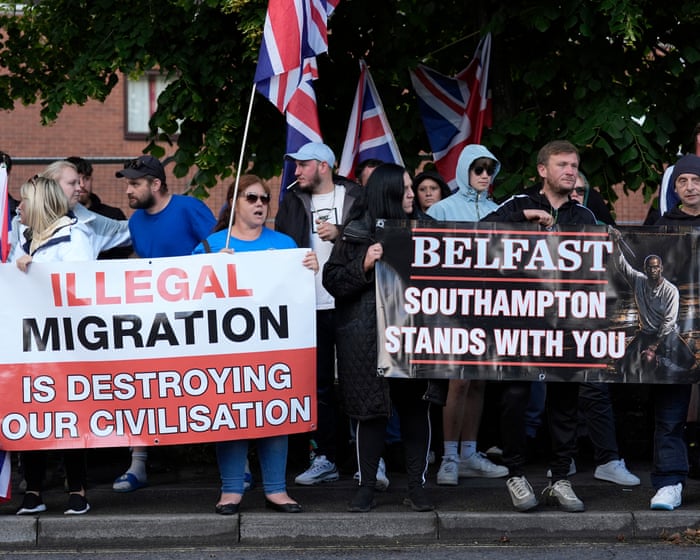
Around 10:30 PM on Monday night, bystanders on a Belfast street filmed a man—believed to be a Sudanese asylum seeker—holding a knife over another man he had pinned to the ground. By Tuesday, the clip had become the latest transnational “trigger event,” similar to the Southport killings and the murder of 18-year-old student Henry Nowak, as far-right activists from Britain and beyond quickly seized on it.
Key figures in spreading the footage on Elon Musk’s X platform included the far-right activist known as Tommy Robinson, who had just met with Musk’s father at a lavish Moscow hotel earlier that week. X eventually added age restrictions and a warning to the video Robinson shared, but by Tuesday afternoon it had over 52,000 views, and full, uncensored versions were still easy to find on the platform. Robinson also posted details of planned demonstrations across Britain and Northern Ireland on X, which Elon Musk shared with his 240 million followers.
As police and political leaders in Belfast urged calm and warned the public not to be misled by rumors before all facts were known, the incident once again highlighted the challenges social media poses to law enforcement and the opportunities it gives extremists looking to stir division. “It fits into the current trend of trigger events, where something horrifying happens and is then linked to an existing narrative pushed by the far right, with mass migration being promoted as the cause,” said Joe Mulhall, director of research at Hope Not Hate. “We saw this in Southport, Southampton with the Henry Nowak case, and in Epping with anti-asylum seeker protests. The even bigger danger is when several such events happen in quick succession.”
Some right-wing commentators have tried to do just that by baselessly suggesting that a stabbing in Manchester was also somehow tied to immigration. There has also been a rise in AI-generated images promoting protests. Telegram was once the preferred platform for organizing such actions, but activists are now openly discussing plans on X.
“Active Clubs”—far-right groups posing as sports clubs—have also used the Belfast events to push their message that young white men need to be “ready to fight.” It didn’t take long for the international far right to seize on the apparent opportunity either. Dominik Tarczyński, a Polish MEP who was banned by the British government from entering the UK earlier this year to attend a rally organized by Robinson, tried to link the Belfast attack and Nowak’s death. “Europe 2026 in two pictures. Mass deportations NOW!” Tarczyński tweeted, sharing an image of the knife attack in Northern Ireland and one of Nowak handcuffed.
Sid Venkataramakrishnan, an analyst and editorial manager at the Institute for Strategic Dialogue, an international think tank focused on extremism, polarization, and disinformation, said: “It’s no surprise that we’re seeing transnational far-right actors jumping in to exploit the attack, just as we saw with previous tragedies like the murder of Henry Nowak and the Southport stabbings. Boosting these signals across platforms from X to Telegram helps international accounts support their compatriots abroad and also fuels their own supporters.”
Right-wing MPs like Nigel Farage and Rupert Lowe haven’t held back either. Sharing a partly blurred image of the Belfast attacker, Farage repeated a message he and his party have used before, insisting that the public “are entitled to the truth.” As always these days, whatever position waFarage was outflanked by Lowe, his rival on the right. “Reform politicians let this monster into our country,” tweeted the Restore Britain leader, apparently referring to two of Farage’s recruits, former Tory ministers Suella Braverman and Robert Jenrick.
Frequently Asked Questions
Here is a list of frequently asked questions about the knife attack in Belfast and its use by farright groups written in a natural tone with clear direct answers
Frequently Asked Questions
1 What exactly happened in the knife attack in Belfast
A man was arrested after a knife attack in Belfast that left several people injured Police are treating it as a serious incident but the motive is still under investigation
2 Why are farright groups talking about this attack
Farright groups often try to use violent incidentsespecially if the suspect is from a minority backgroundto push their antiimmigrant or antiMuslim narratives even if the motive is unrelated to race or religion
3 Is this attack actually linked to terrorism or extremism
At this point police have not confirmed any terrorist or extremist motive Investigations are ongoing and its important not to jump to conclusions
4 How do farright groups spread their message after an event like this
They share false or exaggerated claims on social media post misleading videos and organize protests They often claim the attack is part of a larger invasion or threat to stir up fear
5 What can I do if I see someone sharing false information about the attack
Dont share or engage with it You can report the post to the social media platform and share only information from official sources like the police or trusted news outlets
6 Why do these groups target incidents like this so quickly
They exploit the shock and anger people feel right after a violent event By acting fast they hope to shape public opinion before the full facts come out
7 Has this happened before in the UK or Ireland
Yes After several highprofile attacks farright groups have tried to blame entire communities for the actions of one individual
8 How can I tell if a news story or social media post about the attack is accurate
Check the source Is it a major news outlet or the police Look for multiple reports saying the same thing Be wary of posts that use emotional language or call for immediate action without evidence
9 Whats the best way to respond if a friend or family member shares farright content about this
Stay calm Ask them where they