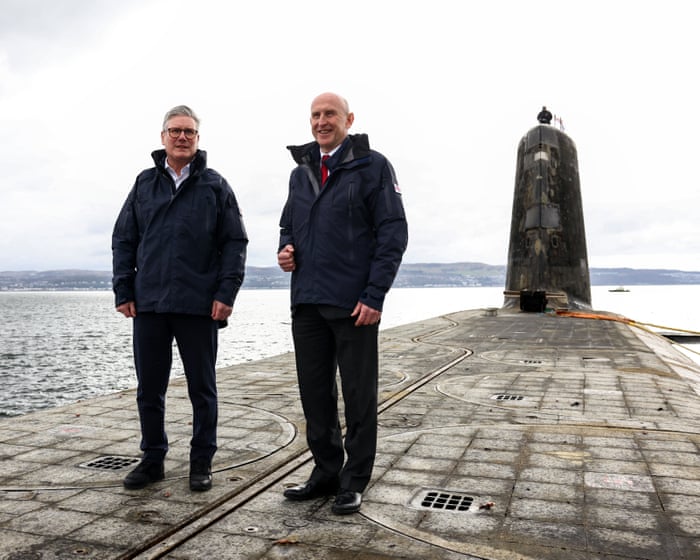
Defence Secretary John Healey has resigned over the government’s military spending plans, accusing Keir Starmer and Rachel Reeves of putting the country’s security at risk at a time when global threats are growing.
In a scathing resignation letter that further weakens the prime minister’s already shaky authority, Healey said the long-awaited Defence Investment Plan (Dip) fell far short of what was needed to protect the UK at such a dangerous moment.
Healey revealed that Starmer planned to increase defence spending by just 0.8% of GDP between next year and 2030 – from 2.6% to 2.68% – and argued it needed to reach 3% by 2030 to meet the challenge.
The government has committed to raising spending to 3.5% of GDP by 2035, in line with a Nato target. Starmer has also set out an ambition to increase funding to 3% of GDP in the next parliament. The Dip was due to be published today but has been delayed.
“You have been unable, and the Treasury unwilling, to commit the resources the nation needs to defend itself at this time of rising threats,” Healey wrote.
“I would not be able to accept a Dip settlement that does not give our forces the resources they need. I am now left with no other option than to submit my resignation as your defence secretary.”
He pointed to the prime minister’s explicit warning last week that UK intelligence had said Russia could attack a Nato country as early as 2030.
He also revealed that he only learned of Starmer and Reeves’ final military spending plans on Monday. The extra support was “backloaded” when “the pressure of operations and the need to speed up readiness to fight is in the first two years,” he wrote.
“Without a Dip that meets the moment in this way, I am being forced to make decisions that would reduce the readiness of our forces, increase the risk to personnel on operations, and could make the country less safe.”
Healey’s resignation comes at a particularly damaging time for Starmer. The prime minister is meeting G7 allies in France next week, and the Makerfield by-election is on Thursday. He then travels to Ankara for a Nato summit to discuss defence commitments in early July.
Cabinet relations have been badly damaged by the long-running row over the Dip, with the standoff leading to some of the worst infighting since Labour took power. Several departments agreed to cut their capital budgets by about 1% to pay for extra military spending.
In his letter, Healey wrote: “In funding the Dip, I fully recognise the strain this places on colleagues in other departments, both now as you have required spending to be switched into defence and in the future.
“I am very grateful to those colleagues who have supported this, and I appreciate how difficult their choices will have been.”
Healey was one of several cabinet ministers who privately urged Starmer last month to consider his position and do what was right for the country and the party to avoid a chaotic leadership contest. Although previously mentioned as a potential candidate, his allies ruled this out on Thursday.
The prime minister will want to appoint a new defence secretary as soon as possible. Security minister Dan Jarvis and armed forces minister Al Carns are both thought to be in the running. However, Carns has described the Dip as not fit for purpose and said Starmer should reopen it.
Starmer agreed in February last year to increase defence spending to 2.5% of GDP, believing it would be enough to fund the promises made in the strategic defence review, which was being worked on at the time.
That review was published last June alongside the cross-government spending review, which confirmed nearly £20bn extra for the MoD over five years. But within months, defence officials said they would need another £28bn over the same period.Over the next four years, the costs would be covered. Healey asked the Treasury for around £18 billion, but for weeks, Reeves wouldn’t approve anything over £12 billion. In the end, Starmer pushed the chancellor hard to agree to extra spending of about £15 billion. Part of the funding would come from other departments cutting their capital budgets by roughly 1%, with energy and transport hit hardest since their capital budgets are relatively large.
Frequently Asked Questions
Here is a list of FAQs regarding the resignation of the Defence Secretary over a disagreement with the Prime Minister on military spending
1 What happened
Healey quit his job as Defence Secretary He disagreed with Prime Minister Starmer over how much money to spend on the military
2 Why did they disagree
Healey wanted a bigger increase in the defence budget Starmer wanted a smaller increase to spend money on other things like health and education
3 Does this mean the government is in trouble
Its a serious blow to Starmers government It shows a major split at the top It could hurt public confidence but the government still has a majority in Parliament so it wont collapse immediately
4 Who will replace Healey as Defence Secretary
The Prime Minister will appoint a new Defence Secretary likely a loyal supporter of Starmer who agrees with his spending plan
5 What does this mean for the UKs military
It likely means defence spending will increase but not as much as Healey wanted Some military projects or upgrades might be delayed or scaled back
6 Is this about NATO or the war in Ukraine
Yes indirectly Healey argued that due to threats from Russia and the need to meet NATOs spending target the UK needed to spend more faster Starmer argued the economy couldnt handle that right now
7 Was this a surprise
Yes it was a sudden resignation It suggests the disagreement was very strong and could not be resolved privately
8 What is military spending exactly
Its the money the government spends on the armed forces salaries equipment training bases and operations overseas
9 What is the 2 GDP target
NATO members agreed to spend at least 2 of their total national income on defence The UK currently meets this but Healey wanted to go significantly higher
10 Could this lead to an election
No For an election to happen the government would have to lose a vote of no confidence or the Prime Minister would have to call one A single resignation even a big one doesnt trigger an election