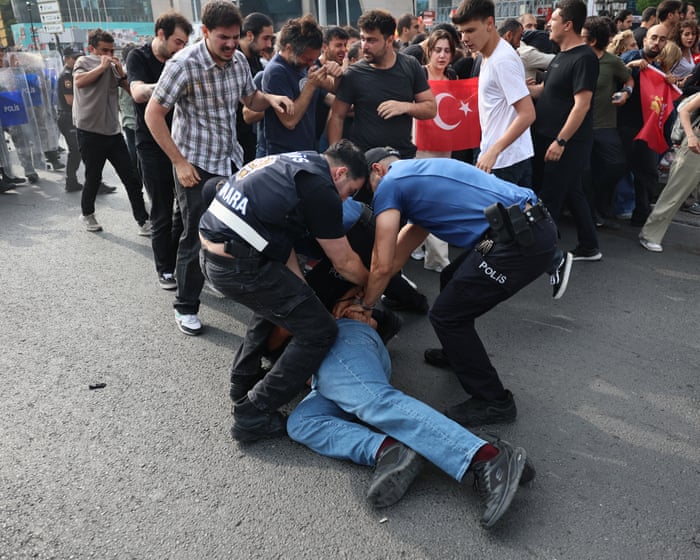
Authorities in Turkey have expanded their crackdown on public life, arresting over 200 people during raids across Ankara last month, jailing a comedian, and blocking a cruise ship carrying LGBTQ+ passengers from docking, all just before the NATO summit in the capital. The arrests followed a ban on demonstrations in Ankara that was in place until July 10. Human Rights Watch (HRW) said this shows Turkey’s “ruthless intolerance of freedom of speech and assembly.” The watchdog noted that the NATO summit, starting Tuesday, is happening amid growing violations of basic rights, “including far-reaching restrictions on the main political opposition party, the media, and freedom of expression in general.”
Last week, stand-up comedian Deniz Göktaş was arrested and placed in pre-trial detention after arriving at Istanbul airport from a holiday. He was charged with “insulting the president” and “denigrating religious values” for a show where he called Turkish President Recep Tayyip Erdoğan a dictator and made jokes about suicide bombers. The performance took place in Istanbul on June 1, and a recording was posted on YouTube on June 24. The video has been viewed nearly 9 million times.
According to Turkish news outlet Bianet, Göktaş tried to explain his jokes in his testimony to prosecutors, saying: “The word ‘dictator’ is a political term, a topic often discussed in public, and I have no intention of insulting or belittling anyone with this statement.”
In another recent incident, authorities in the coastal town of Aydın blocked a cruise ship operated by Atlantis, a company that specializes in gay-friendly holidays, from docking, claiming the passengers were “known for behaviors” that “do not align with the structure of our society and our moral values.” US actor and singer Patti LuPone, who was scheduled to perform on the cruise, wrote on social media: “The Atlantis cruise I am performing on next week has been banned from entering Turkey … simply because of who is onboard.”
This year, Reporters Without Borders accused Turkey of using “all possible means… to undermine critics,” as the country dropped to 163rd place out of 180 countries on the NGO’s press freedom index.
Rights groups and opposition parties have long accused Turkish authorities of silencing free speech, with prosecutions for criticizing Erdoğan rising sharply in recent years. On Sunday, two journalists were arrested: Buse Söğütlü, international news editor at online newspaper T24, and Ceren Erdoğdu, a journalist at OdaTV. Söğütlü’s lawyer, Erman Öztürk, told Agence France-Presse: “We believe it is linked to the NATO summit.” Ezgi Onalan, head of the Istanbul branch of the Association of Contemporary Lawyers, was also detained, the rights group announced on X.
Ankara’s prosecutor’s office said the arrests in late June, which happened during dawn raids, would “decipher the action and activities of terrorist organizations,” and accused those held of links to several socialist and Marxist groups, as well as the Islamic State. HRW said authorities had provided no evidence of any crimes committed by people accused of terrorism. Among those detained on suspicion of membership in terrorist groups were journalist and LGBTQ+ activist Yıldız Tar, two lawyers, an academic, and 14 members of an environmental organization focused on reforestation.Europe
A daily digest of the top morning headlines from the Europe edition, delivered straight to your inbox every weekday.
Preview the latest
Enter your email
Sign up
[after newsletter promotion]
Western leaders have mostly avoided publicly criticizing Turkey’s record on rights and freedoms, choosing instead to focus on strengthening security ties with the regional military power and major arms exporter.
Some critics of President Erdoğan’s government believe this relative silence from the West encourages his authoritarian drift, isolates Turkey’s opposition, and goes against NATO’s founding principles of democracy and the rule of law. “It remains important for the West to keep commenting on the decline of democratic institutions in Turkey, because the path isn’t set in stone—Turkey isn’t beyond hope,” David Satterfield, a former US ambassador to Ankara, told Reuters last week.
[Image: A view of Atakule, one of Ankara’s landmarks, lit up ahead of the NATO summit starting Tuesday. Photograph: Anadolu/Getty Images]
“It’s important for Turks to hear others talking about their system this way,” said Satterfield, who now directs the Baker Institute for Public Policy, a think tank based at Rice University in Houston, Texas.
Over the past year, Turkey’s main opposition party, the Republican People’s Party (CHP), has faced a sustained crackdown. Istanbul’s mayor, Ekrem İmamoğlu, has been arrested and put on trial, along with hundreds of other opposition municipal politicians. In late May, a court removed the CHP’s leader, a move critics feared was meant to weaken the party’s ability to challenge Erdoğan.
İmamoğlu is on trial for various corruption charges. The CHP says he is their chosen presidential candidate, even if that means he runs from prison. The 56-year-old was thrown out of court during a hearing last week after arguing with the judge, who said he would enforce a July 9 deadline for hearing the defense’s statements.
Frequently Asked Questions
Here is a list of FAQs about Turkeys increased crackdown on public life ahead of the NATO summit in Ankara written in a natural tone with clear simple answers
BeginnerLevel Questions
1 What exactly is happening in Turkey right now
The Turkish government is increasing restrictions on public activities like protests gatherings and certain media reporting They are doing this just before a big NATO summit in Ankara
2 Why is this crackdown happening now
The main reason is security The government wants to ensure the NATO summit goes smoothly without any protests or disruptions that could embarrass Turkey or pose a security risk to visiting world leaders
3 What kinds of things are being banned or restricted
Common restrictions include banning public protests and demonstrations limiting where people can gather increasing police presence and strictly controlling what can be reported in the news about the summit or security issues
4 Is this just about the NATO summit or is it permanent
For now its directly tied to the NATO summit However critics worry that the government will use the heightened security as a reason to keep these restrictions in place after the summit ends
5 How does this affect an ordinary person in Ankara
You might see more police checkpoints have your ID checked more often find certain streets closed or be unable to join a planned protest It can feel like a city under tighter control for a few weeks
AdvancedLevel Questions
6 What specific laws or legal mechanisms is the government using to justify this crackdown
The government often uses broad antiterrorism laws and a state of emergency decree or a specific law on meetings and demonstrations to ban gatherings They argue that any protest could be a security threat or provocation during the summit
7 Is this crackdown targeting any specific groups or political opponents
Yes Historically the government has targeted Kurdish political groups leftist activists and journalists critical of the government During highprofile events these groups are often the first to face restrictions or arrests
8 How does this compare to previous crackdowns before major events in Turkey
Its very similar to what happened before the 2015 G20 summit in Antalya and the 2017 constitutional referendum The pattern is always the same announce a major event then rapidly