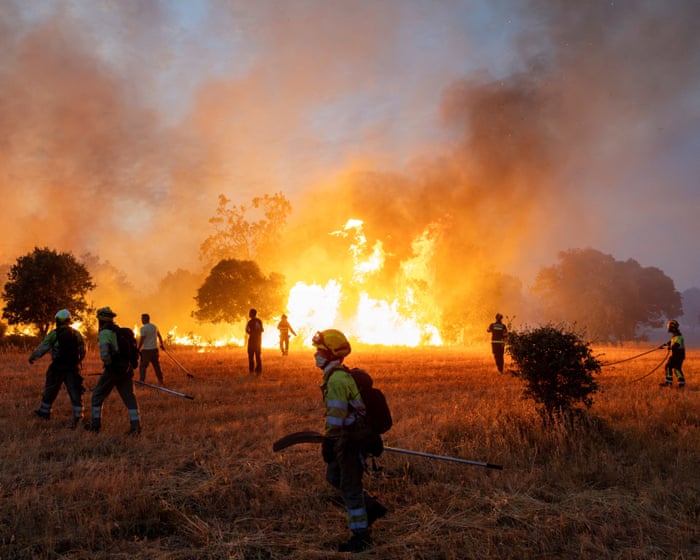
Fire weather across the EU has reached record severity for this time of year, according to new data, as firefighters work to contain blazes across the Mediterranean.
Driven by carbon pollution, the hot, dry, and windy conditions in the EU since the start of the year have been 43% more severe than the end-of-July average over the last two decades, according to data from the European Forest Fire Information Service (Effis).
Three firefighters died in Greece on Tuesday, officials said, while firefighters in France and Spain made progress overnight in tackling massive fires that have burned dangerously close to major cities.
The figures, released on Thursday but subject to revision, show that 435,000 hectares (1,075,000 acres) have burned so far this year—roughly three times the recent historical average. This devastation comes from 1,400 fires, more than double the usual number.
In France, a fire in the dense pine forests near Bordeaux grew so large it created a rare thunderstorm that could spark more fires. According to Effis, 91,000 hectares have burned, breaking the country’s record for a full year of fires—with one month of summer still to go.
Regional authorities in Gironde said the fire remained under control after a quiet night, with crews continuing to work around its edges and in active hotspots. They expected Thursday’s temperatures to be “fairly favourable” after Wednesday’s 38°C heat and strong winds hampered firefighting efforts.
On Thursday, another 84,000 people were allowed to return home, following 60,000 who were given the green light on Tuesday.
In Spain, which saw its largest wildfire on record west of Madrid, a total of 207,000 hectares have burned across the country, according to Effis. That’s nearly five times the average for this time of year, but still less than the devastation seen by late July during the 2022 fires.
Regional authorities in Madrid said the fire situation had been declared “stable,” but residents of seven housing estates were still unable to return home. Spanish Prime Minister Pedro Sánchez announced the end of the national emergency in the regions of Ávila and Madrid on Thursday morning.
However, a new fire near the Portuguese border forced 600 people to evacuate, officials said. Aemet, the Spanish meteorological agency, forecast temperatures above 35°C on Thursday across large parts of the country’s interior, with some regions bracing for highs of 40–42°C.
Wildfires in France and Spain have forced more than 300,000 people from their homes and tourist accommodation this month, prompting both countries to request EU support in the form of firefighters, fire engines, and water-dropping planes and helicopters.
Ursula von der Leyen, president of the European Commission, thanked firefighters for their “courage and commitment” on Wednesday, as crews sent by Romania and Greece extended their stays. “As the fires in France and Spain continue to ravage, European solidarity knows no limit.”
Officials at the EU’s crisis management centre said on Wednesday morning that difficult weeks lie ahead as fires worsen in Italy and Greece. Later that day, the Greek fire department announced the deaths of two firefighters battling a blaze on the island of Crete, and another in the south of the mainland.
Greece has had a relatively calm fire season so far, according to Effis data up to 29 July, with slightly fewer fires than usual and a burned area well below the average.
Meanwhile, Italy and Portugal have seen near-record numbers of fires, with burned areas well above average. So far, these countries have been spared the same scale of destruction.Wildfires have caused destruction in France and Spain, but in Italy last week, a firefighter died while battling intense blazes in Sicily.
View image in fullscreen
Wildfires on the Greek island of Crete have killed two firefighters, and another died fighting fires in the south of the mainland. Photograph: Reuters
Climate breakdown is fueling wildfires across Europe this summer. A series of nearly consecutive heatwaves have dried out vegetation, creating a huge surplus of fuel that has turned small fires into massive infernos.
During a visit to a command post on Wednesday, Spanish Prime Minister Sánchez repeated his call for a “national pact” to tackle the climate emergency.
“These fires may or may not be started by humans, but in any case, they grow exponentially due to high temperatures, low humidity, and the atmospheric conditions these large fires create in our forests,” he said.
View image in fullscreen
Firefighters in Cercosa, Portugal, battle a wildfire earlier this month. Photograph: Paulo Cunha/EPA
Rapid analyses have shown that western Europe’s June heatwave would have been “virtually impossible” without climate breakdown. The level of soil dryness—a key factor in larger fires—was made five times more likely. These heatwaves are estimated to have killed at least 10,000 people and cost grain farmers €2 billion (£1.7 billion) in lost crops.
The rise in temperatures from fossil fuel pollution has coincided with the decline of rural areas in southern Europe. Farms are being abandoned as populations age and young people move to cities. The resulting overgrowth of vegetation has created challenges for firefighters and wildfire researchers across the Mediterranean.
Frequently Asked Questions
Here is a list of FAQs about the recordbreaking fire weather and firefighter response across the EU organized by topic
General Beginner Questions
1 Why are there so many fires in the EU right now
The EU is experiencing a recordbreaking heatwave and drought This creates fire weatherhot dry and windy conditions that make vegetation extremely flammable and fires spread very quickly
2 What exactly is recordbreaking fire weather
It means the combination of high temperatures low humidity and strong winds is more extreme than anything weve seen in history for that time of year These are the perfect conditions for wildfires to start and grow out of control
3 Is this happening all over Europe
Its hitting hardest in Southern Europe but heatwaves and fires are also breaking out in Central and even Northern Europe due to the unusual weather
4 How do firefighters put out such huge fires
They use a mix of tactics water bombers ground crews with hoses and tools and creating firebreaks They also use specialized trucks designed for rough terrain
Advanced Technical Questions
5 Why cant they just drop all the water from planes on a single fire
Water bombing is used to slow the fire down not fully extinguish it A single drop cools the flames and wets the fuel allowing ground crews to get closer Its a support tool not a solution The fire is often too large to drown from the air
6 What is the EU doing to help countries that are overwhelmed
The EU has a system called the RescEU program It prepositions firefighting planes and helicopters in highrisk areas When a country is overwhelmed it can request help and the EU coordinates sending planes crews and equipment from other member states
7 What is fire weather and how is it measured
Its a scientific index that combines temperature humidity wind speed and recent rainfall A higher FWI means a fire is more likely to start and harder to control Right now these indices are at alltime highs