The chips are quite small—some can fit in the palm of your hand. But they’re essential for building artificial intelligence models, and the world’s biggest tech companies need huge numbers of them to stay ahead.
Microsoft is one of those companies. And on paper, it seems to have a problem. A Guardian investigation has found an apparent mismatch between what Microsoft has said about its AI capacity and the number of advanced AI chips it actually has in use.
This isn’t a small gap either. Microsoft reportedly aimed to have 1.8 million AI chips installed in its data centers worldwide by the end of 2024. Nearly two years later, in the middle of a $280 billion expansion, the company has 2.2 million AI chips installed, according to internal documents seen by the Guardian. That’s less than half the number some experts had expected.
In simple terms, the global AI race requires building massive data centers that run on extremely expensive chips. The apparent discrepancy suggests Microsoft’s newest data centers may not be fully operational—or, if they are, they don’t have the chips they need.
This also points to a bigger issue: it’s hard to track how AI technology is actually progressing. The chips that power AI are made by Nvidia, one of the two most valuable companies in the world. Its supply chain is one of the most closely guarded secrets in the industry.
With almost no exceptions, Nvidia doesn’t report how many of these chips it sells or to whom. Its clients—the world’s biggest tech companies—also don’t reveal how many they have. Without this information, it’s very difficult for anyone to know whether AI is really booming or not.
Microsoft: A Power Vacuum?
Over the past two years, Microsoft says it has built AI infrastructure at breakneck speed. Its CEO, Satya Nadella, said last year it would double its global data center footprint by mid-2027. Since 2022, it has invested roughly $280 billion in land, buildings, and computing infrastructure to build AI. That includes more than $41 billion in the last quarter alone.
But it’s hard to estimate how many data centers Microsoft has built with this money.
One way to gauge the company’s progress is to look at its public announcements, especially regarding power needs. Data centers require electricity, so a way to estimate how many are operational is to add up the energy Microsoft has available—its AI capacity.
Microsoft’s own claims, in annual reports and quarterly earnings, suggest it has added 5 gigawatts (GW) of data center capacity over the past two years as part of its AI build-out. It says it now has hundreds of data centers across five continents.
Five gigawatts is a huge amount of energy—four times the size of the largest data center park in Europe. But Microsoft’s total capacity should be even larger than this; it has been building AI infrastructure since 2022. How much larger is an open question.
In an internal presentation from 2024, Microsoft reportedly claimed to have 5GW of data center capacity already installed. That would suggest it could now have a total of 10GW. It’s unclear if all of these are AI data centers—some could be for other cloud services. But Microsoft’s own statements indicate that the overwhelming focus of its recent spending has been on building AI infrastructure.
Ten gigawatts of AI data centers would suggest Microsoft should have roughly 6.4 million graphics processing units (GPUs). Shaolei Ren, a professor at the University of California, Riverside, said Microsoft’s sustainability reports—which include electricity usage figures and are published separately from its financials—paint a different picture.He said these reports suggest Microsoft’s AI capacity in 2024 was probably closer to 1.2GW. But even this lower figure would mean Microsoft would need roughly 4 million AI chips – if it added 5GW of AI data centres over the past two years.
“According to their own metrics, Microsoft could be correct. But it isn’t clear what they mean when they say they have added data centre capacity. They are giving insufficient context,” Ren said. “The sustainability reports are audited by a third party. They have more credibility than announcements.”
An analyst who specialises in Nvidia said they thought Microsoft would have more chips, given its public statements. “They’re low to me. They’re less than I expected Microsoft would have,” they said.
Microsoft insisted the Guardian’s calculations were based on incorrect information. It did not offer any insight into which of the Guardian’s numbers were incorrect or why. What is clear is that Microsoft’s build-out of AI capacity appears to be going far more slowly than its annual reports may suggest.
Ren said: “It may be plausible to secure or announce 1GW of power capacity within a single quarter on paper. But bringing that capacity online and actually using it for computing within the same quarter would be far more difficult.”
Sources within Microsoft say the company’s total number of AI chips has “barely moved” over the past year.
Some of the apparent discrepancy may be explained by Microsoft’s tie-up with OpenAI. The exact terms of their commercial partnership are not public, but this unit may account for some of Microsoft’s data centre deployments, which would not be in the documents the Guardian has seen.
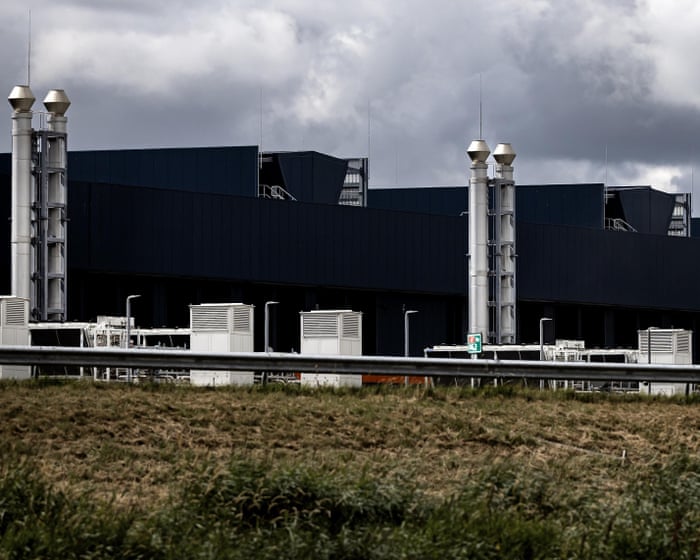
View image in fullscreen
A Microsoft data centre in Middenmeer, the Netherlands. Photograph: ANP/Shutterstock
‘You may have a bunch of chips … you can’t plug in’
There is another factor: some of Microsoft’s big projects appear to be far from operational.
Take Microsoft’s largest AI development in the US, a pair of data centres in Wisconsin and Georgia called Fairwater. In April, Nadella, Microsoft’s chief executive, said the Fairwater project in Wisconsin “is going live”.
Satellite footage of the building from Epoch AI, however, appears to indicate only part of it is operational. In May, Microsoft admitted to a Wisconsin newspaper that Fairwater was not yet online.
This is very common, said Ren. Initially it was a multi-gigawatt, multibillion-dollar investment. Three years later, only 300MW has been built.
View image in fullscreen
Satya Nadella said last year Microsoft would double its global data centre footprint by mid-2027. Photograph: Jeff Chiu/AP
The internal document also indicates Microsoft has fewer of Nvidia’s newest model of chip, the Blackwell, than one might expect given Nvidia’s public announcements. Last March, Nvidia’s chief executive, Jensen Huang, said orders for Blackwells from Nvidia’s top four customers – widely thought to be Amazon, Oracle, Microsoft and Google – amounted to 3.6 million.
There was no breakdown given for this figure, but Microsoft has historically been one of Nvidia’s largest customers. If this was still the case, that should put Microsoft’s total Blackwell holdings at somewhere close to 1 million chips. In fact, it has less than half of this amount installed.
Where are the chips, if not in the data centres?
Nvidia’s balance sheets appear to indicate that it has sold a great many chips; it posted a revenue of $215.9bn in February. Has Microsoft bought these but not installed them? How many, and are all of them in its possession?
Nadella appeared to gesture at this question on a podcast late last year called All Things AI, where he talked about Microsoft’s data centre build-out. The biggest problem, he said, was electrical power and building data centres close enough to where power was located.
“If you can’t do that, you may actually have a bunch of chips sitting in inventory that I cI can’t plug in. In fact, that’s my problem today. It’s not a chip supply issue. It’s actually that I don’t have warm shells to plug into.
A Microsoft spokesperson said: “Over several decades, Microsoft has built a global infrastructure to meet rapidly growing customer demand for cloud and AI services. Our datacentres combine custom silicon, AMD, Intel, and Nvidia chips across multiple generations, along with the networking, storage, and systems infrastructure needed to operate at scale. Microsoft does not report on the volume of specific chips in its AI infrastructure. The estimates the Guardian has shared with us are inaccurate, drawing the wrong conclusions from incorrect assumptions.”
Nvidia did not respond to a request for comment.
How to calculate the number of chips from a company’s ‘AI capacity’
The world’s biggest technology companies measure their AI capacity in terms of power: gigawatts. One gigawatt powers between 700,000 and 1 million homes. Meta says its controversial Hyperion datacentre in Louisiana will have 5GW of capacity. The UK company DataVita is planning a 1GW datacentre in Lanarkshire.
To convert these figures into chips, you need to calculate how many chips can run with that amount of power. The Guardian used the following method, checking these calculations with Abdeltawab Hendawi, a professor at the University of Rhode Island, and Ren.
The first anti-AI protester to be jailed has a message for OpenAI, Anthropic, and Meta: ‘Regain your humanity’ – read more.
To get a rough idea of how many chips are in a datacentre, you could divide the datacentre’s power usage by the power usage of an AI chip, such as an H100. A single H100 uses 700W. If Microsoft has 10GW of capacity, dividing this by 700 watts suggests it should have about 12 million chips.
H100s make up most of the chips mentioned in the internal document. It also indicates that Microsoft has A100s, which use less power, and Blackwells, which use more.
But this rough estimate doesn’t account for several factors. First, datacentres have cooling systems and other equipment that also use electricity. Ren estimates that in a typical AI datacentre, 80% of the electricity goes to computer chips. This is roughly in line with figures from the International Energy Agency, though the exact number depends on how efficient the datacentre is. Eighty per cent of 10GW would suggest that about 8GW is actually in use.
This is slightly lower than Microsoft’s own figures for datacentre efficiency, which appear in a 2024 sustainability report. That report suggests that 89% of the electricity in its new datacentres powers the IT systems, with an 11% overhead.
Second, not all chips in a datacentre are AI chips. AI chips are fitted onto server racks along with other computer chips, like memory chips, that help them run calculations. A server with eight H100 GPUs uses a maximum of about 10kW of power.
Dividing 8GW by 10kW gives 800,000 servers, or 6.4 million chips.
This is a conservative estimate, because in practice companies like Microsoft oversubscribe their power capacity to some extent – putting more chips in a datacentre than their IT capacity can fully support, said Ren.
Frequently Asked Questions
Here is a list of FAQs about Microsofts AI strategy and the chip shortage written in a natural userfriendly tone
BeginnerLevel Questions
1 Is Microsoft actually slowing down its AI plans because of chips
Answer Not really Microsoft is still moving very fast but they have to be smarter about where they put their AI features They are prioritizing big highvalue customers and their own core products over rolling out features to everyone at once They are also designing their software to use chips more efficiently
2 What does chip shortage mean for a normal person using Microsoft products
Answer For you it might mean that a new AI feature arrives a little later than expected or it might be rolled out to a smaller group of users first before being released to everyone It rarely means features are canceled just delayed or staggered
3 Why does Microsoft need so many chips for AI anyway
Answer AI models are like massive complex calculators They need to process billions of calculations to answer a single question Specialized chips are the only way to do this fast enough to make the AI feel instant Microsoft needs millions of these chips to power AI for all its customers at the same time
4 Is this shortage just about making more chips or is it something else
Answer Its a bit of both The factories cant make them fast enough but its also about which chips they can make The specific highend chips used for AI are the hardest to make and there are only a few companies in the world that can produce them
Advanced Technical Questions
5 Which specific chips is Microsoft struggling to get
Answer The main bottleneck is highbandwidth memory and advanced GPUs specifically NVIDIAs H100 and H200 series These GPUs are the industry standard for training and running AI models and supply hasnt kept up with the massive demand from Microsoft Google and Amazon all at once
6 Is Microsoft doing anything to fix this Are they building their own chips