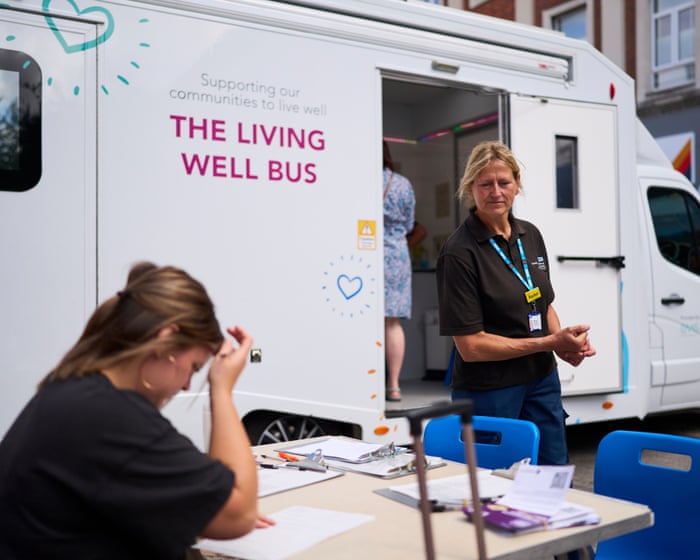
It’s 10am on one of the main shopping streets in Warrington, and already a line of women has formed outside a small bus, about the size of a supermarket delivery van. Some look calm, but others are clearly nervous. This isn’t a mobile library, post office, or coffee truck—it’s something far more personal: cervical screening.
Inside, the bus feels surprisingly roomy. There’s a consultation area where nurses, patients, and anyone accompanying them can sit and talk. Behind that, a separate room has a bed, space to change, and storage for all the medical equipment. Purple lighting, stylish decor, and spa music add to the calm, minimalist feel.
Catherine, 26, is first in line. She’s never had cervical screening before. She says the fact that it’s a bus, with people she doesn’t know, made her decide to go through with it. “I didn’t go before because there’s only one nurse at my doctor’s, and she’s my asthma nurse,” Catherine explains. “So it felt too personal.”
Cervical cancer is the fourth most common cancer in women, according to the World Health Organization. Its strategy aims for all countries to screen 70% of women and vaccinate 90% of girls by age 15 by 2030.
But NHS figures show that just over 4 million women in England are behind on their cervical screening, and that number is growing. OECD data reveals that since 2014, screening rates in England have dropped by eight percentage points to 69%, the fourth steepest decline after Luxembourg, the Netherlands, and Turkey.
According to the Royal College of Obstetricians and Gynaecologists, women from ethnic minority backgrounds, disabled women, LGBTQ+ people with a cervix, and those in deprived areas are less likely to be up to date with screening.
In 2024, to boost uptake, Living Well buses began offering walk-in cervical screening clinics in Cheshire and Merseyside. Funded by NHS England North West, the service was so popular that it expanded to nearby regions this summer. Now, two buses run 10 screening sessions a week across Lancashire, South Cumbria, Cheshire, and Merseyside. From October, they’ll also start visiting Greater Manchester.
Jill West, one of the nurses running the clinic, says mobile screening is a game-changer. “The bus is fantastic. Women sometimes forget about their own health—they’ve got kids to think about, work to think about, they can’t get a convenient GP appointment, or fit it in with their menstrual cycle. So the bus is perfect because it’s advertised, and women can just come along and get screened without booking an appointment.”
This morning’s session is clearly working. Peggy, 57, works in the NHS but admits she had to sneak out of her shift to come to the bus, and she’s very overdue for screening. “I’ve had smears before, but I can’t remember when the last one was,” she says. “I’m on HRT now, and I had a little bleeding the other week, so when this came up, I thought that’s my sign to get checked.”
Imogen, 35, a pharmacy technician, says the only appointment at her GP surgery would have been at 7am. “I’ve got two kids, I can’t get there that early,” she says. “It’s tough because you know it’s so important, and it’s so hard to get an appointment at the GP’s, but this is just brilliant.”
Despite that, Imogen is extremely anxious and nearly in tears at one point. “I don’t know why I’m so nervous,” she says. “It’s just uncomfortable, isn’t it? But I know it needs to be done.” Less than 10 minutes later, she’s done.Later, she steps off the bus. “I feel so relieved,” she tells me. “It went well, and now it’s over. The nurses were so kind and made me feel comfortable.”
By 4pm, 18 women have been screened—five of them had never been screened before, and eight were overdue. In total, the buses have screened more than 2,700 women across the north-west.
View image in fullscreen
The NHS England North West bus screening service has been so successful that this summer it expanded into nearby regions. Photograph: Christopher Thomond/The Guardian
Dr Sue Mann, NHS England’s national clinical director for women’s health, says: “Screening saves lives—and thousands more women have now had cervical screening that they likely wouldn’t have had otherwise, thanks to these excellent mobile clinics on wheels.”
For some, even a friendly mobile bus isn’t enough. Later this year, NHS England will start rolling out self-sampling, inviting women who are overdue for screening to order home kits.
HPV vaccination rates in UK graphic
Caroline Berchet, a health economist at the OECD, says this could boost rates without reducing the accuracy of results. “Allowing women to collect samples at home and send them by mail helps tackle common barriers like limited access to providers, travel difficulties, time constraints, and discomfort with clinician-based screening.”
Melanie Tipples, a consultant gynaecologist and vice-president for education at RCOG, says introducing home HPV testing kits is a positive step. “We now need ongoing investment in raising awareness of screening, and a clear, funded, accountable plan to eliminate cervical cancer by 2040.”
View image in fullscreen
Nurses say it’s crucial not to rush women during screening, and drop-in appointments make this possible. Photograph: Christopher Thomond/The Guardian
Elimination will require joint efforts to increase vaccination rates as well as screening by addressing barriers like stigma, misinformation, and logistical challenges, says Helen Hyndman, lead nurse at The Eve Appeal.
At 75.5% for girls and 70% for boys, HPV vaccination uptake in England is far below the 90% target set by the World Health Organization, and it’s falling—in 2017, the rate for girls was 85%. According to the OECD, reaching 90% could prevent 89% of all premature deaths from cervical cancer in the UK.
Back on the bus, West says the key is not rushing women. “One of the things we can do on the bus is give them time. Since there are no appointments, if it takes half an hour, it takes half an hour.”
“It’s the best job in the world—I’ve retired three times, but then I think I don’t really want to; I want to keep doing this.”
Names of the women have been changed.
Frequently Asked Questions
Here is a list of FAQs about the NHSs mobile cervical screening clinic based on the article All aboard the cervical screening bus how the NHSs mobile clinic is saving lives
General Questions
Q What is a cervical screening bus
A Its a mobile clinic that travels to different communities to offer cervical screening tests to people who might not otherwise go to a doctors office or clinic
Q Why is the NHS using a bus for this
A Many people skip their cervical screening because they cant get to a GP are too busy or feel anxious about going to a medical setting The bus goes directly to themparking in supermarket car parks workplaces and community centersto make it as easy and convenient as possible
Q Who can get a test on the bus
A The bus is for anyone who is eligible for cervical screening on the NHS This usually includes women and people with a cervix aged 25 to 64 You dont have to be registered with a specific GP to use it
Q Is the test the same as one done at a GP surgery
A Yes completely Its the same test done by a trained nurse in a private secure room inside the bus The only difference is the location
Practical Logistics Questions
Q How do I book an appointment on the bus
A You usually book in advance either online through the NHS or local health board website or by scanning a QR code on the buss schedule You can also sometimes just walk up if they have a spare slot but booking is safer
Q Does the bus visit my area
A The bus travels to different towns and cities based on where the need is highest You can check your local NHS trust or health boards website and social media for a schedule of where the bus will be and when
Q How long does the whole appointment take
A The actual test takes less than five minutes Your whole visit including checkin chatting with the nurse and getting ready usually takes about 15 to 20 minutes
Q Is it completely private