One is a 15-year-old boy who threw a lit cigarette into a wood near Bordeaux. Another is a 36-year-old man who set fire to a paper bag of rubbish in bushes near Perpignan. A third is a 50-year-old woman accused of starting 17 fires south of La Rochelle.
According to the French interior ministry, since the start of a summer in which a record 115,000 hectares of forest, scrub and heathland have burned, 514 people – including 198 minors – have been arrested on suspicion of starting wildfires.
Who are they, and what motivates them? Experts say arson is an under-studied field in France. According to Thierry Toutin, a criminology researcher with the national police, it remains “a mysterious crime, often hard for people to understand”.
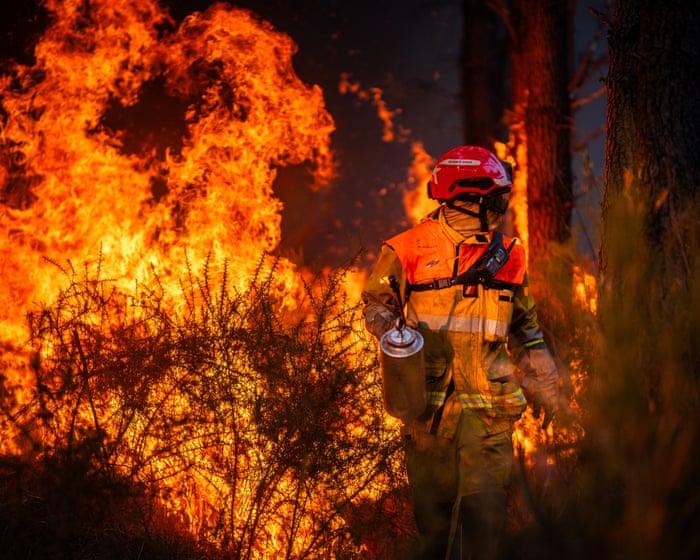
The summer of wildfires has turned the spotlight in France on the question of what – and who – is causing them. Photograph: Steph Picture/VHP/AFP/Getty Images
Two hundred years ago, under Napoleon, deliberately starting a wildfire in France was such a serious crime that it carried an automatic death penalty by guillotine. These days, sentences start at 10 years in jail and a €150,000 fine, rising to 15 years if protected forests or reserves burn, and life if someone is killed.
Arsonists have “many different profiles”, Toutin said in an essay for The Conversation. Several French departments have set up dedicated arson groups uniting police, forestry board experts and local services to help identify, find and prosecute them, he said, but still: “These are often crimes that are unsolved, or don’t lead to convictions, because the fire has destroyed the evidence.”
France’s official statistics classify wildfires by their cause: natural, such as lightning; accidental (say, a vehicle fire or electrical fault); involuntary professional (sparks from a machine); involuntary individual (a cigarette or barbecue) – and voluntary.
In practice, as a government PSA has repeated all summer on radio, TV and online, nine out of 10 fires are caused by human activity, with roughly two-thirds classed as involuntary (which, if negligence is proven, carries a jail term of one to five years).
That means fully one-third of wildfires in France each year are set deliberately, with the intention of doing harm. In 2025, the last year for which full figures are available, deliberate acts of arson were the biggest single cause of forest fires in France, accounting for 29.4% of blazes.
Graph of the area of land burnt by wildfires in France
Among those convicted this summer are a 27-year-old man diagnosed with autism and schizophrenia who set fire to a letter to his late daughter in tinder-dry vegetation near Béziers. He was sentenced to four years of detention and treatment.
Perpignan court last week sentenced a 51-year-old man to five years in prison for lighting four fires in July and August. In Les Sables d’Olonnes, a volunteer firefighter – reported to police by his superiors – was handed a three-year suspended sentence.
In Lyon, a 29-year-old man with a police record for theft, trafficking and domestic violence was convicted of setting a fire that destroyed more than a hectare of land, took 71 firefighters to extinguish and forced the evacuation of 150 people.
Among those convicted of arson this summer is a volunteer firefighter. Photograph: Emma Da Silva/AP
Those convicted of negligence include a motorist who lit a fire to alert emergency services after he broke down (six months, suspended) and two restaurant owners in the south-west who defied a red fire alert to light a charcoal grill and set off fireworks.
An early analysis based on police reports and obtained by Le Figaro showed 97.5% of arson suspects arrested this year have been men, aged on average 32.5, with 28.7% under 18. More than 95% were French citizens. Of a relatively small sample of 80 suspects, 37 were unemployed.
Exactly what drove them to act is often much harder to establish. In principle, criminologists identify four main categories of motivation. Some arson attacks are carried out inIn a conflict, there might be a dispute with a neighbour, rivalry between criminal gangs, or revenge against a person or thing.
Other arsonists may act for financial gain, like making a false insurance claim, or because of ideological or political beliefs. The rest show some kind of pathology, often psychological—including a small number of true pyromaniacs.
“Arsonists may be after money, revenge, or trying to cover up a crime. They may be under the influence of alcohol or other substances,” said Laurent Layet, a psychiatrist. “A pyromaniac’s only goal is to set fire to something.”
Pyromaniacs “have trouble organising their personalities,” Layet told France Inter radio. “They are often impulsive and struggle to control their emotions. They are often quite socially isolated.”
Classified as an impulse-control disorder, pyromania involves “a fascination with fire, rising tension before the act, and then a feeling of pleasure or relief right afterwards,” he said. But pyromaniacs are usually organised, aware of what their actions could cause, and considered criminally responsible.
In total, a record 115,000 hectares of forest, heath, and scrubland have burned so far this year.
They also make up barely 5% of people who deliberately set fires. Another equally small group are firefighters—mostly volunteers, very rarely professionals—who deliberately start fires for the glory of putting them out.
Over the years, France’s departmental fire services have set up screening measures, including psychological tests, to detect such personalities during recruitment. They admit that some still slip through each year.
But the reasons most people deliberately light wildfires are rarely so clear-cut. For many, it comes down to a vague “act of defiance—to confront the system and get pleasure from destroying other people’s property,” said Johanna Rozenblum, a clinical psychologist who works with the fire service.
A strikingly large share of the arsonists she has dealt with had “marked antisocial profiles,” Rozenblum said. In the case of minors, adolescent impulsiveness and frustration combine with “immaturity and internal revolt,” stopping them from fully grasping the devastating scale of the damage they risk causing.
Frequently Asked Questions
Here is a list of frequently asked questions about the 514 people accused of starting wildfires in France and their motives
1 Who are the 514 people accused of starting wildfires in France
They are a mix of individuals identified by French authorities over a specific period This group includes arsonists people acting recklessly and those who accidentally started fires while working
2 What are the main motives behind these wildfires
Motives vary widely Common reasons include pyromania financial gain revenge or simple carelessness Some fires are also started to cover up other crimes
3 What is the difference between an arsonist and someone who starts a fire accidentally
An arsonist intentionally sets a fire Someone who starts a fire accidentally does so without intending to cause harm often through negligence like leaving a campfire unattended
4 Why is the number 514 significant
It represents the total number of suspects or accused individuals identified by French police in a specific year or operation It is not a single group but a statistic showing the scale of the problem
5 Are most of these people caught and punished
Not all While many are identified only a portion are arrested and convicted The legal process can be slow and proving intent is difficult
6 What is pyromania and how common is it among these suspects
Pyromania is a rare psychiatric condition where a person feels a strong urge to set fires for pleasure or relief It is a motive for a small minority of the 514 but it gets a lot of media attention
7 Can a person be accused of starting a wildfire just for throwing a cigarette butt
Yes In France discarding a lit cigarette in a dry area is illegal and can lead to accusations of starting a wildfire if it causes a blaze It is considered criminal negligence
8 What are the common problems in prosecuting these cases
The main problems are lack of evidence difficulty proving intent and the fact that many fires are started in remote areas with no witnesses This makes it hard to link a specific person to a specific fire
9 What practical tips can help prevent wildfires in France
Never throw cigarettes on the ground Avoid lighting fires or barbecues in