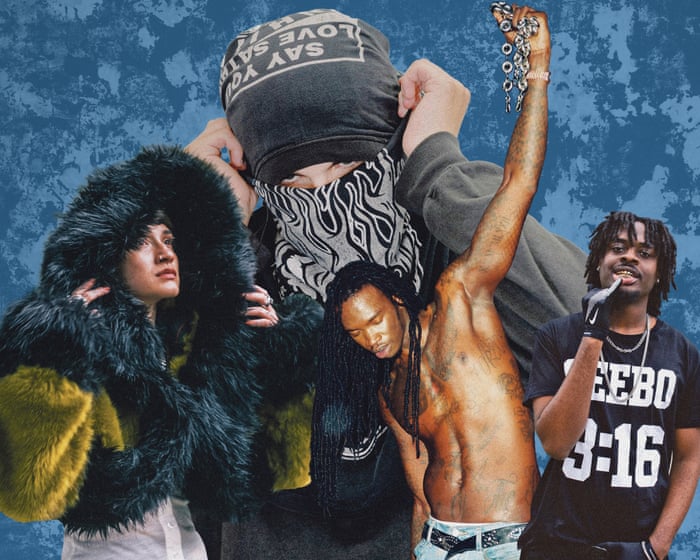
It’s early November, and London’s Electric Ballroom is packed. The warm-up DJ plays Fetty Wap’s 2014 hit “Trap Queen,” and the young crowd—many of whom were in primary school when the song first came out—shouts every word. They’re dressed in baggy skatewear, with worn, black-and-white Union Jacks plastered across hats and jackets. A coat flies across the room: someone will be going home cold tonight, but that will be the last thing on their mind as Liverpool rapper EsDeeKid, one of the fastest-rising musicians in the world, bursts onto the stage.
Wrapped in a hooded cloak and spinning like a twig in a hurricane, he grabs the mic and snarls, “Are you ready for rebellion?”—his distinctive Scouse accent cutting through a storm of apocalyptic bass and John Carpenter-esque horror synths. Behind him, stark black-and-red projections flash: tower blocks, eyeballs, dot-matrix geometries, more reminiscent of the gritty photocopy aesthetic of ’80s post-punk than any luxury rap branding. The teenagers in the room are ecstatic, swept up by the palpable energy thrumming from the stage to the pit, convinced this is A Moment.
They’re right. Two weeks after the show, EsDeeKid’s breakthrough single “Phantom”—one minute and fifty seconds of gothic inner-city intensity—crashes into the UK Top 20. Despite only starting to release music in 2024, the masked, anonymous rapper already has over 10 million monthly Spotify listeners. By the end of November, his debut album Rebel was Spotify’s most-streamed hip-hop album worldwide; his latest single, “Century,” reached the UK Top 10. While he remains silent in the press, wild conspiracy theories have spread, including one suggesting he is US actor Timothée Chalamet moonlighting as a self-proclaimed “council house rat” from Liverpool. EsDeeKid has neither confirmed nor denied it.
To the outside world, his rise seemed overnight. But EsDeeKid is part of a new movement that has been gradually emerging—with recent momentum—from all corners of the UK. After grime shifted to road rap in the mid-2000s, and the rise of UK drill and Afroswing in the mid-2010s, this is the latest evolution of homegrown rap culture. And while UK rappers like Dave, Stormzy, and Central Cee still sell out arenas, and Aitch charms the masses on I’m a Celebrity, these new artists are starting to rival them in popularity while carrying considerably more edge.
The kids at Electric Ballroom are friendly and eager to talk, and they all refer to the new sound as “underground” rap. I chat with Billy, one of three lads who have come down from Birmingham, and he reels off a list of artists pushing the scene forward: “Lancey Foux, Fimiguerrero, Len, EsDeeKid, Rico Ace, Fakemink, Jim Legxacy. Underground is exciting—it keeps getting more and more experimental.”
Pinning down the underground sound is tricky. Upcoming rapper Ceebo describes it as capturing the zeitgeist: “Constant stimulation—dopamine overload.” Fizzing, lo-fi tracks come and go in under two minutes, with everything cranked into the red. Crucially, Britishness is foregrounded, with older UK tracks sampled, regional accents flourishing, and lyrics as likely to describe getting messy in small market towns as they are to imitate US gangster rap.
The scene has spread through TikTok, Discord groups, Instagram, and, most importantly, live shows of increasing size—something police forces often made impossible for earlier generations of drill and grime artists. (Many would argue the reason the underground scene hasn’t been similarly policed is because it involves a higher proportion of white and/or middle-class kids, both as artists and fans.) Promoters like Aux (who also runs EsDeeKid’s label) have become serious players in the live space, packing out regular showcases with hordes of young fans who, numbed by the overwhelming flood…Tired of the polished world of social media, they crave the chaotic, tangible joy of mosh pits and massive speakers. Now, with US rap in a slump—October saw no rap songs on the US Hot 100 for the first time since 1990—fans across the Atlantic are starting to pay attention to this high-energy music. We may be witnessing the start of a new British Invasion: another star of the UK underground, Fakemink, was pictured with Clipse and Andre 3000 in Los Angeles in November and performed at Tyler, the Creator’s festival there.
“I’m a huge advocate of what’s going on in the underground,” says Kenny Allstar, the BBC’s chief rap DJ and arguably the foremost authority on British rap. “The next generation is here.”
While the scene’s biggest shows have taken place in London, the sound has spread rapidly across the country, drawing in kids from suburban towns much like punk did in the 1970s. Ledbyher, one of the few rising female artists in the scene, grew up in a council house in Norfolk. She listened to US rap until a school friend introduced her to UK drill, and she learned you could rap convincingly in an English accent.
“Where drill might have been a very niche aspect of London life, the underground is commenting on a life that more of us find ourselves in,” she says while on tour around the UK. “The underground now, its lyrics relate to people growing up in High Wycombe or wherever—it’s a commentary on British life.” Originally coining the term “bedroom drill” for her sound, her tracks deal with relationships, dreams, and depression. “Step into my wreck of a ship / I don’t even know whose wreckage it is,” she raps on her Bad News freestyle, a hazy, rainy cut that nods as much to trip-hop as trap.
“The producers might be from Scotland, Ireland; you have people from Canterbury,” she says, pointing out that YT, another of the scene’s leading lights, attended an institution not generally known as an engine room for British rap: the University of Oxford. “There’s not one place the scene is from.”
But everyone acknowledges one artist who has been fundamental to its growth. “Lancey Foux is a trailblazer,” says Allstar. “He started in 2015 and couldn’t be boxed in: not drill, or Afroswing, or trap. He was more outlandish with his approach to the music, using heavy melodic vibes with distorted beats. It created a new wave.”
He points to Foux’s skittering, chiming 2015 track About It. “It was like nothing we’d seen before. At that stage it didn’t have its own genre—you just knew which artists fit the sound because they didn’t fit into any other mold. But if you went up to these artists and said, ‘Are you underground?’ they’d probably say no.”
Raised in Stratford, London by Ugandan parents, Foux, who turned 30 this week, agrees. He has consistently worked with the kind of woozy, Day-Glo rap beats used by US megastars like Playboi Carti and Travis Scott, injecting UK slang, rhythms, and bass to create a druggy-sounding, nocturnal music that contrasts with much of UK rap’s social realism. In 2024, he started collaborating with a raft of new talent on singles like the 15-million-stream Black & Tan with YT, and the Conglomerate mixtape with Fimiguerrero and Len, which reached the UK Top 30. These projects signaled a shift away from the nihilism of drill to a weirder space, but like most trailblazers, Foux is not keen on being boxed in by genre.
“The term ‘underground,’ it’s very restrictive!” Foux says, calling from LA where he’s shooting videos for his forthcoming album. “EsDeeKid is one of the biggest UK artists, so why would you call him underground? This stuff is big! YT, Fimi, and EsDeeKid have bigger songs than other rappers in the UK. Not to say ‘underground’ is a bad word—but this…”
Frequently Asked Questions
FAQs Constant Stimulation Dopamine Overload The Rise of EsDeeKid UK Rap
Beginner Definition Questions
1 What does constant stimulation dopamine overload mean in this context
It refers to the fastpaced highenergy style of modern UK rap music and its online culture The tracks are often short packed with catchy flows viral samples and aggressive beats designed to grab and hold your attention immediatelymuch like scrolling through TikTok or playing a video game
2 Who or what is EsDeeKid
EsDeeKid is a pioneering UK drill and rap artist from South London Hes famous for his raw energetic style viral hits like Robbery Remix and for being one of the first UK drill artists to gain massive global attention helping to open the door for the scene
3 What is UK underground rap and how is drill different
UK underground rap is an umbrella term for rap scenes that developed outside the mainstream like grime road rap and drill UK drill is a darker slowertempo subgenre that originated in Chicago but was adopted in London Its known for its menacing beats stark lyrics about street life and a unique cold flow
4 How did this go global
Through the internet Platforms like YouTube TikTok and Spotify allowed raw UK tracks to bypass traditional media Viral dances memes and international cosigns from artists like Drake brought UK accents and slang to audiences worldwide making it a dominant force in global hiphop
Benefits Cultural Impact
5 Whats the appeal of this music Why is it so popular
Its authentic unfiltered and matches the pace of internet culture The beats are gripping the lyrics are often a direct window into a specific reality and the sheer energy provides an instant adrenaline rush or a relatable outlet for listeners
6 What positive impact has this global rise had
It has given a powerful voice to marginalized communities in the UK created new career paths for young artists and influenced fashion slang and production styles worldwide It proved that a hyperlocal sound could become an international language
Common Problems Criticisms