I’m at the airport gate, waiting to board, watching passengers rush by with rolling suitcases and paper cups of coffee. A small boy sits very still next to his mother. He holds an iPad close to his chest, almost curled around it, clutching the screen as if it might run away. I hear loud clapping and the squeaky voices of children. I lean over and see a cartoon character in green snatch a toy from a character in pink. The pink character starts to cry, tears spraying like sprinkles from its huge eyes. The green character shouts “sorry.” Instantly the tears stop and a wide smile appears before I can blink. And before I’ve even figured out whether the characters are speaking English or Arabic (as the mother does with the boy), the scene has changed and the two characters are rowing a boat with some random song in the background. The boy’s eyes dart across the screen from right to left, center, down. His body is still, but his attention is being rushed from one cue to the next. This is the problem I’ve come to think of as the pace of children’s media.
Children’s media is usually judged by its content and quality: how many minutes watched, and whether it was educational, age-appropriate, diverse, prosocial, commercial, and safe. These questions matter, and with my colleagues I’ve studied them through experiments and contributed to guidelines, regulations, and toolkits for designers. But we’ve been missing a bigger design feature that may be just as consequential: the time a medium gives a child to make meaning. A program or app can contain good lessons and still move too quickly for those lessons to settle. For instance, in the US animated educational series Ask the StoryBots, the subject matter may be genuinely rich—why the sky is blue, how eyes work, where planets come from—but the explanation unfolds through rapid jokes, songs, visual shifts, and sudden changes in style. Before a child has time to sit with one image or idea, the scene has moved on to the next, with a burst of information.
Different media have different temporal demands: a digital picture book, a game, a TV episode, and an app each ask a child to pay attention differently. But across these media, the important question is whether the pace suits the experience the narrative claims to support. Does it give children time to follow a story, grasp a concept, identify with a character, regulate emotion, or share attention with another person? Or does it continually hurry them toward the next cue, the next reward, the next burst of stimulation?
When media moves too quickly, layers of experience collapse into one another. A child may laugh at someone slipping on a banana peel but imitate only the visible silliness, missing the anticipation and reversal that make the joke work. A character may comfort a friend, but if the scene moves on too quickly, the child has little time to recognize the repair or imagine doing the same in the kindergarten room. To develop empathy in the early years, a child must notice that another person feels something different. That small act of crossing over takes time.
In this sense, pace is not a minor stylistic feature of children’s media. It is one of the ways media imagines the child. Is the child a consumer to be retained, a nervous system to be stimulated, a vessel to be filled with educational content—or a person whose attention is still forming, and who therefore needs time to arrive?
People who worry about children and screens tend to worry about violent content, advertising, or whether a phonics app calling itself “educational” truly supports phonics. These are reasonable worries and I share them. But spend five minutes watching what many young children watch, and you’ll see how fast, loud, and bright everything on the screen has become. It doesn’t matter whether the child is watching on a smartphone in the car or on a TV at home. The screen has inherited the adult logic of media design.
That logic is, for the most part, the logic of attention.The attention economy overwhelms and drowns out everything else, making it easier for screens to steer the viewer. It has introduced many small design features that shorten time. The “like” button is faster than writing a comment to show appreciation. A progress bar tells us how many minutes are left in an article before we’ve even decided whether to read to the end. Increasingly, AI appears next to long documents with an offer that sounds helpful but carries a message: this text is long; would you like a quick summary?
Of course, some features work in the opposite direction. The delay-email function and the pop-up asking “Are you sure you want to delete this?” are two examples. These features interrupt automatic action and give the user back a bit of judgment. A nature documentary with a linear structure and the interpretive voice of an adult is a great model for children’s media. In the TV show Prehistoric Planet, for example, David Attenborough’s voiceover and the camera’s zoom-ins encourage children to look closely and wonder about unfamiliar life. But these are exceptions within a larger system where speed is the default.
When learning is crowded with content that keeps jumping ahead—a crisis appears, a mission begins, a spaceship launches, a door opens—the child’s attention is restarted as each problem is introduced and immediately solved. Such media may gesture at teamwork or perseverance, but the speed of the format leaves little time for those lessons to sink in. In the animated TV series Paw Patrol, for instance, a rescue is clear and reassuring: someone is in trouble, the pups assemble, each uses a skill, and order is restored. Yet the movement from problem to rescue to resolution is often so efficient that the child is swept along by urgency rather than invited to dwell on responsibility or care for others. Similarly, in the app-based game Hot Wheels Unlimited, building tracks and racing cars may suggest creativity and problem-solving, but the dominant rhythm is acceleration: boost, race, crash, win, unlock, repeat.
View image in fullscreenSesame Street … a great example of TV that supports learning. Photograph: Zach Hyman/Netflix
Research has taught us many useful things about children’s media. We know that some educational television (such as Sesame Street) can support learning. We know that some apps are better designed than others. We know that interactive features in digital books can help when they serve the story, and distract when they don’t. We know that characters and narratives shape children’s ideas about identity, gender and social life. Pace cuts across all of these questions as the condition under which content becomes experience.
Screen time can run fast or slow. This is partly why merely clocking “screen time” is too crude a measure. Two children may each watch 20 minutes of media and have entirely different experiences of time. In one case, the child is moved through a coherent story with pauses, repetitions and recognisable emotional beats. In another, she is pulled through 10 clips, 30 characters, flashing colours, sudden songs and rewards that arrive before thought has had time to form. The clock records the same duration, but the child does not live the same time.
And parents are rightly worried: a four-year-old does not come to media with adult reserves of self-regulation. She is still learning how to stay with a feeling, how to wait for a story to unfold, how to connect one event to another, how to notice that a character’s sadness matters before the joke wipes it away. If a programme moves too quickly, it may encourage a child to expect information to arrive in rapid, constantly shifting bursts, making slower, more sustained forms of attention harder to tolerate. Stopping this vicious cycle starts by asking what exactly makes children’s media fast or slow.
Don’t get me wrong, I am not saying that slow is always good or better than fast media. Some lively children’s mGood children’s media can be excellent; slow media can be dull, lifeless, or poorly made. The key point is that good children’s media gives a child enough time to complete an act of attention. Bad media keeps interrupting that act before it can become a memory or turn into play.
When my research group compared children’s shows, apps, and digital stories, we found that pace can be a set of design choices. A story can move in a way that helps a child anticipate what comes next, or it can jump so quickly between scenes that cause and effect become blurred. A screen can guide the eye toward one important object, or fill the frame with competing movement.
This is why the familiar adult language of “engagement” is so inadequate for children. A child can look intensely engaged while being given very little time to think. In the Kids’ Slow Media Project, we have therefore tried to make these differences visible. We evaluate children’s media by looking at how it organizes time. We ask whether the narrative is coherent enough to follow; whether the sensory field overwhelms meaning-making at specific age points; whether the design builds in stopping points where the story can be digested before it continues. Does a piece of media allow learning to develop through meaningful repetition? And does a story or piece create openings for a child and adult, or two children, to notice something together?
When in March 2026 the UK Department for Education advised parents of children under five to choose “slow-paced, age-appropriate” content, without saying what slow-paced actually means, our group sought to make the term concrete.
What makes a show slow or fast for a given child? It depends. Children differ by age, temperament, language, sensory sensitivity, and circumstance; so without testing their responses, it is impossible to give a firm recommendation: a show that suits one four-year-old may overwhelm another. We therefore give ratings only to provide a map for adult judgment. The ratings are illustrations, inviting parents to check whether their child is being given enough time to complete an act of attention.
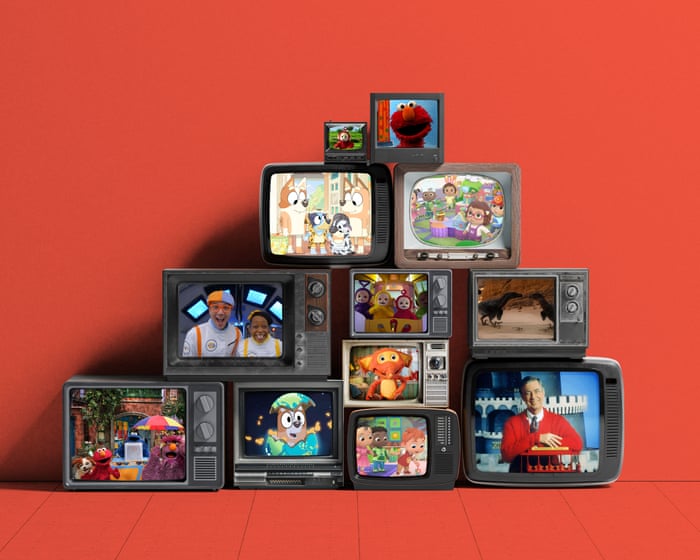
The shows scoring highest on the slow rubric are those that leave room around the characters’ actions and allow the child to recognize the actions. Often there is a face, a puppet, a song, a greeting, a familiar body on screen that treats attention as a relationship. Indeed, the power of programmes such as the US show Mister Rogers’ Neighborhood, the Norwegian series Fantorangen, and the British shows In the Night Garden … and Teletubbies lies in their ability to build a rapport with the child and then repeat a theme or a segment, almost like a ritual. Here, small acts and greetings or songs provide a familiar frame, like a safety net, within which new concepts can be introduced. In the Australian animated series Bluey, an episode often begins with an ordinary family situation that develops into imaginative games involving parents, siblings, and friends; the pace can be lively, but it tends to return the child to pretend play, negotiation, and emotional understanding. In the animated TV series The Adventures of Paddington – a British-French co-production – gentle mishaps are usually held inside a world of curiosity, politeness, family, and repair, so comedy becomes a route into perseverance or social understanding. Such programmes are slow because they leave openings through which the story can travel back into meaning and play.
Conversations between characters are another way in which higher-ranked shows convey new concepts at an appropriate pace. When introduced with context, a new word or idea might not be immediately clear, but the child can notice and infer. Over time, the child arrives at understanding, and this slow, even arduous process helps the concept stick. For exFor example, in one episode of Daniel Tiger’s Neighborhood – based on Mister Rogers’ Neighborhood – Daniel is nervous about trying the swing. The scene lets that feeling be acknowledged, sung through, and gradually transformed into confidence, with support from Daniel’s friend Jodi Platypus and her grandmother. Similarly, in the Sesame Street-based game app Elmo Loves ABCs, a letter is traced, sounded out, repeated, connected to words, and encountered through touch and play.
View image in fullscreen Photograph: Robert Nickelsberg/Getty Images
The lowest-scoring media keeps a child’s attention in constant motion through a manipulative rhythm that continually restarts attention with the next tune, the next bright image, the next comic beat, the next loop of familiarity or personalized nudge. Instead of letting the child settle into the story, these shows repeatedly pull attention back. The same is true of many preschool game apps built around loops of reward and progression.
Evaluating popular children’s media taught me that pace is a revealing measure of quality, but it also stands in for a deeper question about the child’s agency – their own sense of self. The real distinction is whether a medium leaves room for the child’s own attention or continually redirects it. When every pause is filled, every uncertainty immediately resolved, and every wandering thought pulled back by a brighter cue, waiting and reflection can start to feel unbearable. The child learns to reach for the next stimulus before the previous one has had time to settle. Giving space for a child’s attention to drift inward, to reflect, is therefore giving space for the child’s inner life. Slow media changes the relationship between screen and child by saying: you may arrive at your own pace.
Some critics may dismiss slow media as nostalgia: a longing for the children’s television of the previous generation, or a privilege available only to parents with time, large bookshelves, and big houses with quiet rooms. But we should reject that idea. The attention economy has trained us to treat a child’s pause as a problem, a wandering gaze as lost engagement, and an unfilled moment as wasted time. The opposite is true: slow time gives children the space to perceive, process, respond, and make meaning – and it can be designed into children’s media.
Unboxing, bad baby and evil Santa: how YouTube got swamped with creepy content for kids
Read more
Like energy drinks, fast media promises more capacity than the child actually has: more attention is supposed to lead to better performance. Fast media feels like an extension of the child’s energy, but the bargain is unsustainable and unhealthy. What looks like support can become dependency, and what promises engagement and learning is actually compulsion.
Children need media that doesn’t merely occupy them, instruct them, or keep them quiet. They benefit and grow from stories and shows that preserve their capacity for inwardness and their connection to others. In fast media, the child’s attention is continually propped up by the next stimulus. Slow media insists on the opposite. In the end, the goal is not to withdraw children from the digital world, but to make that world more worthy of them. Listen to our podcasts here and sign up to the long read weekly email here.
Frequently Asked Questions
FAQs Faster Louder Brighter How the Attention Economy Took Over Childrens TV
1 What does attention economy mean
Its the idea that attention is a scarce resource and media companies compete to capture as much of it as possiblebecause attention can be sold to advertisers or turned into profit
2 What is the book about
It explores how childrens television shifted toward fastpaced highly stimulating content designed to grab and hold kids attentionand what that shift means for children parents and society
3 Who wrote it
Its by Tim Kasser a psychology professor known for research on materialism and wellbeing
4 What counts as faster louder brighter TV
Shows with rapid cuts constant sound effects loud music saturated colors and nonstop actioncontent engineered to keep kids from looking away
5 Is this a new problem
The trend built up over decades from the 1980s onward as cable TV merchandising and later streaming made attentiongrabbing content more profitable
6 Why do companies make shows this way
Because attention drives ratings ad revenue toy sales and subscriptions Calmer shows can struggle to compete
7 Does fastpaced TV actually harm kids
Research links heavy exposure to short attention spans poorer impulse control and sleep problemsbut effects depend on age content and how much kids watch
8 Is all fastpaced childrens TV bad
Not necessarily Some energetic shows are educational and wellmade The concern is with content designed purely to hook attention not to teach or enrich
9 What are the benefits of stimulating shows
They can be engaging teach quick facts build excitement for learning and hold attention for kids who struggle with slower content
10 What are the common problems
Overstimulation shortened attention spans less imaginative play tantrums when screens go off and pressure on parents to keep up with kids demands
11 How is this different from older kids TV
Older shows often had slower pacing longer scenes and more dialogue Modern shows use faster cuts and louder sound to compete with apps games and YouTube