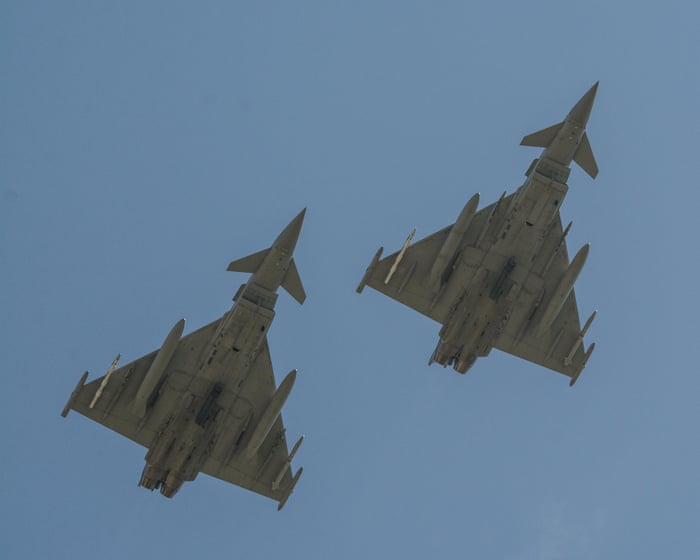
Two RAF Typhoon jets were launched from a Romanian air base to respond to Russian drones near NATO airspace, but they did not fire any shots. British defense sources confirmed that the fighter jets did not enter Ukrainian airspace, contradicting reports that the RAF had shot down Russian drones there—an event that would have marked a major escalation in tensions between the Western alliance and Moscow.
Romanian officials reported that the Typhoons took off at 2 a.m. on Saturday in response to the drone threat. They established radar contact with the targets and had permission to engage if needed. Shooting down Russian drones inside Ukraine would be significant because Ukraine is not a NATO member, and the West has consistently refused to patrol its skies to avoid a direct confrontation with Russia.
The Typhoons are stationed in Romania as part of a rotating multinational NATO air mission to protect Eastern European countries from Russian drone incursions that could spill over from the war in Ukraine. Officials said the RAF Eurofighter Typhoon aircraft operated strictly within Romanian airspace, following national and allied rules of engagement, and never entered Ukrainian airspace during the mission.
A spokesperson for the Romanian defense ministry said the pilots had authorization to engage the drones if they entered Romanian airspace, which they did not. The mission remained focused on surveillance, deterrence, and readiness to respond if necessary. The spokesperson added: “Ground-based radar systems tracked multiple aerial targets approaching the area near Reni, Ukraine, where explosions were later reported. After that, contact with the drones was lost. Half an hour later, residents of Galați, Romania, reported through the emergency service 112 that an object had fallen in an area on the outskirts of the town. Allied aircraft maintained a defensive posture, helping to improve situational awareness and protect NATO airspace.”
The UK Ministry of Defence has been asked for comment.
Frequently Asked Questions
Here is a list of FAQs about the RAF Typhoon jets intercepting a Russian drone near NATO airspace written in a natural tone with clear concise answers
BeginnerLevel Questions
1 Why did the RAF scramble Typhoon jets for a drone
To protect NATO airspace The drone was approaching without permission or communication so the RAF launched jets to identify it monitor it and make sure it didnt enter allied territory
2 Was the drone a threat
Yes a potential one Even if unarmed an unidentified drone can spy disrupt air traffic or cause confusion The RAFs job is to intercept anything that might be a risk
3 What happens when Typhoons intercept a drone
The Typhoons fly close to visually identify the drone sometimes communicate with it and escort it away from NATO airspace They dont usually shoot it down unless it poses a direct danger
4 Is this a common thing
Yes its routine NATO jets regularly intercept Russian aircraft near the alliances borders Drones are becoming more common in these incidents so this is the new normal
5 What is NATO airspace
Its the sovereign airspace of any NATO member country For this incident it likely meant airspace near a Baltic state which borders Russia
IntermediateLevel Questions
6 How do the Typhoons know where the drone is
They get realtime tracking data from ground radar AWACS surveillance planes and sometimes from NATOs integrated air defense network The drones flight path is monitored long before the jets take off
7 Can a Typhoon actually shoot down a drone
Yes they are armed with cannons and missiles But shooting is a last resort Usually the goal is to shadow the drone until it leaves or force it to turn around
8 Why dont they just shoot it down immediately
Because international rules require proportional response Shooting down an unarmed drone over international waters could escalate tensions unnecessarily Interception and escort are the standard procedures
9 How fast do the Typhoons get scrambled
Very fast The Quick Reaction Alert crews are on standby 247 From the alarm