Millions of children across the Middle East have been thrown into crisis by the ongoing war, with reports of child recruitment in Iran, mass forced displacements in Lebanon, and the deaths of hundreds of minors.
According to UNICEF, more than 340 children have been killed and thousands injured since the conflict began with attacks by the US and Israel on Iran, which has retaliated with bombings throughout the region. The deadliest single event for children occurred on the first day of the war, when a US missile strike on a school in Iran killed at least 160 children and teachers.
Israel’s invasion of Lebanon, along with its continued attacks in the occupied West Bank and Gaza, has intensified the bloodshed. Across the region, more than 1.2 million children have been displaced.
“Children in the region are being exposed to horrific violence, while the very systems and services meant to keep them safe are coming under attack,” said UNICEF’s executive director, Catherine Russell.
Here are some of the ways the war has affected children.
Forced Displacement in Lebanon
A UNICEF assessment reports that over 1.1 million people, including nearly 400,000 children, have been forced from their homes in Lebanon due to Israeli bombing and evacuation orders. Nearly 90% are living outside of shelters, with many sleeping on the streets.
Nidal Ahmed, 52, is living in a tent with two of his children in a makeshift camp with hundreds of other families in Beirut’s Biel district. This is his second displacement. His home in Tyre was destroyed in an airstrike on the second day of the Israel-Hezbollah war, and his brother’s home in southern Beirut, where he had fled, was later ordered evacuated by Israel.
“It’s 5 p.m. and we haven’t had anything to eat today,” Ahmed said, as his eight-month-old daughter Zahraa sat before him in a stained onesie. “We’ve only been able to give the kids tea and some bread. It’s not suitable for a child this young to eat bread, but what can we do?” he said, gesturing to crumbs of old flatbread Zahraa had been chewing.
After a month of displacement, Ahmed has run out of money to feed his children. He relies on local organizations that distribute one meal on most days, but not all.
He described their living conditions as “humiliating,” pointing to the blue tarpaulin hastily thrown over a wooden frame and pinned down with rocks. “I tried to cover it to protect us from the rain, but we wake up every morning with our mattresses soaked.”
As his three-year-old son, Ahmad, plays in a vacant lot, Ahmed explains they shower only once a week, on Fridays, when a friend allows them to use a bathroom 30 minutes away. For daily needs, there is one bathroom for hundreds of families, with a half-hour wait to use a toilet that has no running water.
UNICEF’s representative to Lebanon, Marcoluigi Corsi, warned last month that displacement would have lasting effects on children. “This relentless cycle of bombardment and displacement is severely compounding their psychological scars, embedding deep-seated fear and threatening profound, long-term emotional harm,” said Corsi.
Ahmed says he has already seen these effects in his own children. When Israeli jets break the sound barrier or bomb Beirut, his son starts to run, trying to hide from a bomb he believes is about to land on him.Ahmed is exhausted. He had to leave his wife and 17-year-old daughter in a hospital in Tyre after they were injured when their house was bombed. He shows a picture of his comatose wife in a hospital bed, listing her injuries: her skull fractured in 33 places, internal bleeding, and spinal injuries.
“They say she won’t survive,” Ahmed said, looking at his children. “The children are distracted for now, they’re playing. But when they come home and their mother isn’t there, it will be a disaster.”
Deaths, Injuries, and Mourning in Palestine
Despite a ceasefire that has held for over five months, health officials in Gaza say at least 50 Palestinians have been killed by Israeli forces since the conflict with Iran began more than a month ago. The number of child deaths is unclear, but on March 29th, Israeli airstrikes on checkpoints killed at least six Palestinians, including a girl, according to local rescue services.
The Gaza Strip has not recovered from 23 months of Israeli bombardment, which killed tens of thousands of people and destroyed hospitals and schools—acts a UN investigation found to constitute genocide. Until October of last year, an average of at least one Palestinian child was killed every hour. According to Save the Children, the number of children killed by Israeli forces in the war on Gaza surpassed 20,000 late last year.
While the war with Iran did not open a new front in Gaza, it has increased insecurity and led to an intensification of ongoing Israeli military operations.
Displaced Palestinian children wait to refill canisters with water at the Nuseirat refugee camp in the central Gaza Strip.
Closures and movement restrictions in Gaza triggered by the recent escalation have disrupted access to basic services and forced some schools to close. Crossings into Gaza were shut for the first few days of the war, blocking humanitarian aid and commercial goods.
In the occupied West Bank, Israeli settlers and security forces have escalated their violence against Palestinians since the start of the Iran war, killing at least three children. On March 15th, Israeli police shot dead two young Palestinian brothers and their parents in Tamoun, firing at the family’s car as they returned from a Ramadan shopping trip.
Mohammed, 5, and Othman, 7—who was blind and had special needs—were killed alongside their mother, Waad Bani Odeh, 35, and father, Ali Bani Odeh, 37. Two other brothers survived. Khaled, 11, later said he heard his mother crying and his father praying before they died. After the shooting, he said Israeli border police dragged him from the wreckage, taunted him, and beat him. One officer told him, “We killed dogs,” Khaled said.
In Israel, at least four children have been killed by retaliatory Iranian missiles. One of the worst attacks occurred on March 1st, when an Iranian missile struck the central Israeli city of Beit Shemesh.
‘No Excuse’: Children as Young as 12 Guard Checkpoints in Iran
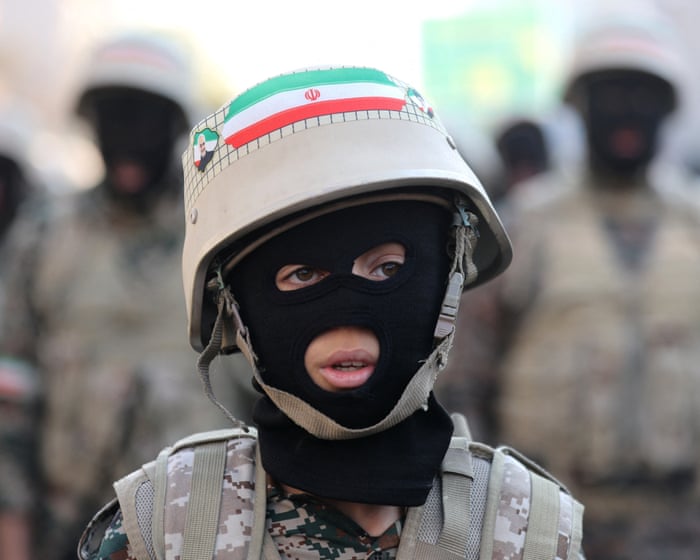
Reports of children as young as 12 being used by Iran’s Islamic Revolutionary Guard Corps (IRGC) to guard security checkpoints have raised alarms about the use of child soldiers.
Human Rights Watch (HRW) released a report at the end of March stating the IRGC was conducting a campaign to recruit children to volunteer as “homeland defending combatants.”
On March 26th, an IRGC official in Tehran said a campaign to enlist civilians, called “Homeland Defending Combatants for Iran,” had set the minimum age at 12.
The poster for the recruitment drive features a boy and a girl alongside two adults, including a man in a military uniform.
The New York-based HRW said the military recruitment and use of children is a grave violation of children’s rights and a war crime when the children are under 15.
A young member of Iranian militia forces attending an anti-Israeli march in Tehran in January.
Bill Van Esveld, the associate children’sThe rights director at Human Rights Watch stated, “There is no excuse for a military recruitment drive that targets children, especially 12-year-olds. This shows that Iranian authorities are willing to risk children’s lives for additional manpower.”
An 11-year-old Iranian boy was reportedly killed in an Israeli airstrike while at a security checkpoint. His mother told a municipal newspaper that he had been assisting patrols and checkpoints run by the Basij, a volunteer militia under the command of the IRGC.
Van Esveld added, “Officials involved in this reprehensible policy are endangering children and risking criminal liability themselves. Senior leaders who fail to stop this cannot claim to care for Iran’s children.”
Attacks on Schools and Loss of Education
A U.S. bombing of a primary school in Minab on February 28 killed many people, most of them girls aged seven to twelve. This strike, described by UNESCO as a “grave violation” of international law, is the deadliest single incident in the U.S.-Israeli war against Iran so far.
Ongoing attacks across the region are destroying critical infrastructure for children, including hospitals, schools, and water systems.
The Iranian Red Crescent Society reported that 316 medical centers and 763 schools have been severely damaged or destroyed by U.S.-backed Israeli attacks.
This violence has disrupted education for millions. Save the Children estimates at least 52 million school-age children across the region have had their education interrupted, shifting to online learning or having none at all.
In Lebanon, 364 of the 669 collective shelters are public schools, according to UNICEF. In Israel, schools have been repeatedly closed in many areas.
Ahmad Alhendawi of Save the Children said, “In every conflict, classrooms are often the first to close and among the last to reopen. Every missed lesson deepens the scars of war. The most vulnerable children, once out of school, may never return.” He emphasized, “Schools are protected sites, and attacks on them could constitute grave breaches of international humanitarian law.”
The Psychological Toll
The violence has exposed children to traumatic events. Prolonged exposure to such instability is known to have lasting effects on brain development, emotional regulation, and long-term mental health.
While Iran faces a near-total internet blackout, satellite TV channels remain accessible. Iran International, based in London, now broadcasts segments offering advice on managing children’s fears and anxieties.
“Every war is a war on children,” said Alhendawi. “Children are living in fear, caught in the crossfire of this adult war. Wars have laws, and children must be off-limits in every conflict.”
Frequently Asked Questions
FAQ The Crisis for Children in the Middle East Due to War
Understanding the Basics
Whats happening to children in the Middle East right now
Due to ongoing and past conflicts in several countries children are facing a severe humanitarian crisis They are being killed and injured forced to flee their homes as refugees or internally displaced persons and in some cases recruited or used by armed groups
Which countries are most affected
While conflict impacts the region broadly some of the most severe situations for children have been in Yemen Syria Gaza Sudan and parts of Iraq and Afghanistan
What does displacement mean for a child
It means a child has been forced to leave their home often suddenly They might become an internally displaced person within their own country or a refugee in another country This leads to loss of community schooling and stability often living in overcrowded camps or shelters
Are children really being used in wars
Tragically yes This is called the recruitment and use of children by armed forces or groups Children might be used as fighters messengers spies or for forced labor It is a grave violation of international law
The Impacts and Dangers
What are the main immediate dangers for these children
The immediate threats are death and injury from bombs bullets and explosives They also face acute malnutrition disease outbreaks due to destroyed healthcare and water systems and separation from their families
How does war affect a childs mind and emotions
Children experience profound psychological trauma They may have nightmares severe anxiety depression or posttraumatic stress disorder This is often called toxic stress which can harm their brain development and emotional wellbeing longterm
What happens to their education
Schools are often destroyed used as shelters or too dangerous to reach This creates a lost generation without formal education limiting their future opportunities and making them more vulnerable to exploitation
Why are children especially vulnerable in a conflict
Their bodies and minds are still developing They are more susceptible to disease and malnutrition less able to protect themselves and depend entirely on adults for care and safetysystems that often collapse during war
How the Situation is Addressed
What is being done to help these children
International organizations like UNICEF UNH