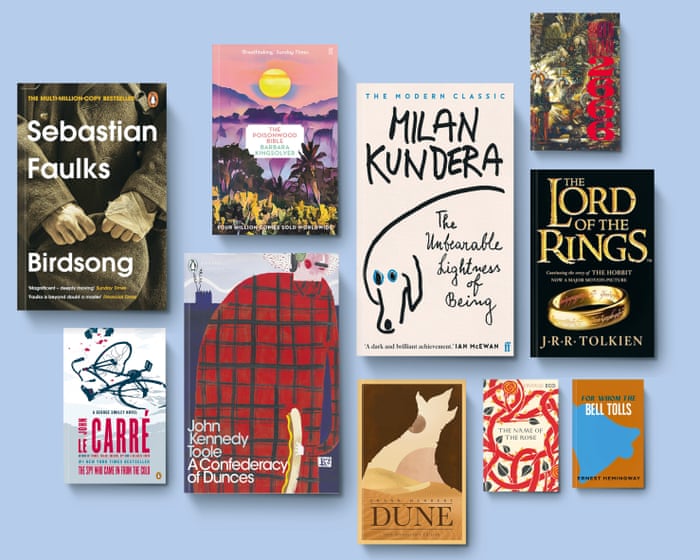
Here are the top 100 novels, as chosen by readers.

Here are the top 100 novels, as chosen by readers.

@font-face {
font-family: ‘Guardian Headline Full’;
src: url(‘https://assets.guim.co.uk/static/frontend/fonts/guardian-headline/full-not-hinted/GHGuardianHeadline-Light.woff2’) format(‘woff2’),
url(‘https://assets.guim.co.uk/static/frontend/fonts/guardian-headline/full-not-hinted/GHGuardianHeadline-Light.woff’) format(‘woff’),
url(‘https://assets.guim.co.uk/static/frontend/fonts/guardian-headline/full-not-hinted/GHGuardianHeadline-Light.ttf’) format(‘truetype’);
font-weight: 300;
font-style: normal;
}

@font-face {
font-family: ‘Guardian Headline Full’;
src: url(‘https://assets.guim.co.uk/static/frontend/fonts/guardian-headline/full-not-hinted/GHGuardianHeadline-LightItalic.woff2’) format(‘woff2’),
url(‘https://assets.guim.co.uk/static/frontend/fonts/guardian-headline/full-not-hinted/GHGuardianHeadline-LightItalic.woff’) format(‘woff’),
url(‘https://assets.guim.co.uk/static/frontend/fonts/guardian-headline/full-not-hinted/GHGuardianHeadline-LightItalic.ttf’) format(‘truetype’);
font-weight: 300;
font-style: italic;
}

@font-face {
font-family: ‘Guardian Headline Full’;
src: url(‘https://assets.guim.co.uk/static/frontend/fonts/guardian-headline/full-not-hinted/GHGuardianHeadline-Regular.woff2’) format(‘woff2’),
url(‘https://assets.guim.co.uk/static/frontend/fonts/guardian-headline/full-not-hinted/GHGuardianHeadline-Regular.woff’) format(‘woff’),
url(‘https://assets.guim.co.uk/static/frontend/fonts/guardian-headline/full-not-hinted/GHGuardianHeadline-Regular.ttf’) format(‘truetype’);
font-weight: 400;
font-style: normal;
}

@font-face {
font-family: ‘Guardian Headline Full’;
src: url(‘https://assets.guim.co.uk/static/frontend/fonts/guardian-headline/full-not-hinted/GHGuardianHeadline-RegularItalic.woff2’) format(‘woff2’),
url(‘https://assets.guim.co.uk/static/frontend/fonts/guardian-headline/full-not-hinted/GHGuardianHeadline-RegularItalic.woff’) format(‘woff’),
url(‘https://assets.guim.co.uk/static/frontend/fonts/guardian-headline/full-not-hinted/GHGuardianHeadline-RegularItalic.ttf’) format(‘truetype’);
font-weight: 400;
font-style: italic;
}

@font-face {
font-family: ‘Guardian Headline Full’;
src: url(‘https://assets.guim.co.uk/static/frontend/fonts/guardian-headline/full-not-hinted/GHGuardianHeadline-Medium.woff2’) format(‘woff2’),
url(‘https://assets.guim.co.uk/static/frontend/fonts/guardian-headline/full-not-hinted/GHGuardianHeadline-Medium.woff’) format(‘woff’),
url(‘https://assets.guim.co.uk/static/frontend/fonts/guardian-headline/full-not-hinted/GHGuardianHeadline-Medium.ttf’) format(‘truetype’);
font-weight: 500;
font-style: normal;
}

@font-face {
font-family: ‘Guardian Headline Full’;
src: url(‘https://assets.guim.co.uk/static/frontend/fonts/guardian-headline/full-not-hinted/GHGuardianHeadline-MediumItalic.woff2’) format(‘woff2’),
url(‘https://assets.guim.co.uk/static/frontend/fonts/guardian-headline/full-not-hinted/GHGuardianHeadline-MediumItalic.woff’) format(‘woff’),
url(‘https://assets.guim.co.uk/static/frontend/fonts/guardian-headline/full-not-hinted/GHGuardianHeadline-MediumItalic.ttf’) format(‘truetype’);
font-weight: 500;
font-style: italic;
}

@font-face {
font-family: ‘Guardian Headline Full’;
src: url(‘https://assets.guim.co.uk/static/frontend/fonts/guardian-headline/full-not-hinted/GHGuardianHeadline-Semibold.woff2’) format(‘woff2’),
url(‘https://assets.guim.co.uk/static/frontend/fonts/guardian-headline/full-not-hinted/GHGuardianHeadline-Semibold.woff’) format(‘woff’),
url(‘https://assets.guim.co.uk/static/frontend/fonts/guardian-headline/full-not-hinted/GHGuardianHeadline-Semibold.ttf’) format(‘truetype’);
font-weight: 600;
font-style: normal;
}

@font-face {
font-family: ‘Guardian Headline Full’;
src: url(‘https://assets.guim.co.uk/static/frontend/fonts/guardian-headline/full-not-hinted/GHGuardianHeadline-SemiboldItalic.woff2’) format(‘woff2’),
url(‘https://assets.guim.co.uk/static/frontend/fonts/guardian-headline/full-not-hinted/GHGuardianHeadline-SemiboldItalic.woff’) format(‘woff’),
url(‘https://assets.guim.co.uk/static/frontend/fonts/guardian-headline/full-not-hinted/GHGuardianHeadline-SemiboldItalic.ttf’) format(‘truetype’);
font-weight: 600;
font-style: italic;
}Here’s the rewritten text in fluent, natural English:

“`css
@font-face {
font-family: Guardian Headline Full;
src: url(https://assets.guim.co.uk/static/frontend/fonts/guardian-headline/full-not-hinted/GHGuardianHeadline-Bold.woff2) format(“woff2”),
url(https://assets.guim.co.uk/static/frontend/fonts/guardian-headline/full-not-hinted/GHGuardianHeadline-Bold.woff) format(“woff”),
url(https://assets.guim.co.uk/static/frontend/fonts/guardian-headline/full-not-hinted/GHGuardianHeadline-Bold.ttf) format(“truetype”);
font-weight: 700;
font-style: normal;
}

@font-face {
font-family: Guardian Headline Full;
src: url(https://assets.guim.co.uk/static/frontend/fonts/guardian-headline/full-not-hinted/GHGuardianHeadline-BoldItalic.woff2) format(“woff2”),
url(https://assets.guim.co.uk/static/frontend/fonts/guardian-headline/full-not-hinted/GHGuardianHeadline-BoldItalic.woff) format(“woff”),
url(https://assets.guim.co.uk/static/frontend/fonts/guardian-headline/full-not-hinted/GHGuardianHeadline-BoldItalic.ttf) format(“truetype”);
font-weight: 700;
font-style: italic;
}

@font-face {
font-family: Guardian Headline Full;
src: url(https://assets.guim.co.uk/static/frontend/fonts/guardian-headline/full-not-hinted/GHGuardianHeadline-Black.woff2) format(“woff2”),
url(https://assets.guim.co.uk/static/frontend/fonts/guardian-headline/full-not-hinted/GHGuardianHeadline-Black.woff) format(“woff”),
url(https://assets.guim.co.uk/static/frontend/fonts/guardian-headline/full-not-hinted/GHGuardianHeadline-Black.ttf) format(“truetype”);
font-weight: 900;
font-style: normal;
}

@font-face {
font-family: Guardian Headline Full;
src: url(https://assets.guim.co.uk/static/frontend/fonts/guardian-headline/full-not-hinted/GHGuardianHeadline-BlackItalic.woff2) format(“woff2”),
url(https://assets.guim.co.uk/static/frontend/fonts/guardian-headline/full-not-hinted/GHGuardianHeadline-BlackItalic.woff) format(“woff”),
url(https://assets.guim.co.uk/static/frontend/fonts/guardian-headline/full-not-hinted/GHGuardianHeadline-BlackItalic.ttf) format(“truetype”);
font-weight: 900;
font-style: italic;
}

@font-face {
font-family: Guardian Titlepiece;
src: url(https://interactive.guim.co.uk/fonts/garnett/GTGuardianTitlepiece-Bold.woff2) format(“woff2”),
url(https://interactive.guim.co.uk/fonts/garnett/GTGuardianTitlepiece-Bold.woff) format(“woff”),
url(https://interactive.guim.co.uk/fonts/garnett/GTGuardianTitlepiece-Bold.ttf) format(“truetype”);
font-weight: 700;
font-style: normal;
}

@media (scripting: enabled) {
:root article.content–interactive > div,
:root .article {
opacity: 0;
}
:root.interactive-loaded article.content–interactive > div,
:root.interactive-loaded .article {
opacity: 1;
transition: opacity 0.25s ease 0.25s;
}
}

@media (scripting: enabled) and (prefers-reduced-motion) {
:root.interactive-loaded article.content–interactive > div,
:root.interactive-loaded .article {
transition: opacity 0.25s ease 0.1s;
}
}

@media (min-width: 71.25em) {
.content__main-column–interactive {
margin-left: 160px;
}
}

@media (min-width: 81.25em) {
.content__main-column–interactive {
margin-left: 240px;
}
}

.content__main-column–interactive .element-atom {
max-width: 620px;
}

@media (max-width: 46.24em) {
.content__main-column–interactive .element-atom {
max-width: 100%;
}
}

.content__main-column–interactive .element-showcase {
margin-left: 0;
}

@media (min-width: 46.25em) {
.content__main-column–interactive .element-showcase {
max-width: 620px;
}
}

@media (min-width: 71.25em) {
.content__main-column–interactive .element-showcase {
max-width: 860px;
}
}

.content__main-column–interactive .element-immersive {
max-width: 1100px;
}

@media (max-width: 46.24em) {
.content__main-column–interactive .element-immersive {
width: calc(100vw – var(–scrollbar-width, 0px));
position: relative;
left: 50%;
right: 50%;
margin-left: calc(-50vw + var(–half-scrollbar-width, 0px)) !important;
margin-right: calc(-50vw + var(–half-scrollbar-width, 0px)) !important;
}
}

@media (min-width: 46.25em) {
.content__main-column–interactive .element-immersive {
transform: translate(-20px);
width: calc(100% + 60px);
}
}

@media (max-width: 71.24em) {
.content__main-column–interactive .element-immersive {
margin-left: 0;
margin-right: 0;
}
}

@media (min-width: 71.25em) {
.content__main-column–interactive .element-immersive {
transform: translate(0);
width: auto;
}
}

@media (min-width: 81.25em) {
.content__main-column–interactive .element-immersive {
max-width: 1260px;
}
}

.content__main-column-
“`Here is the rewritten text in fluent, natural English:

– For interactive content, the main column uses a maximum width of 620 pixels for lists. A vertical line appears on the left side of the main column on wider screens, starting from the top and extending slightly beyond the content. On screens 71.25em wide and above, this line is positioned 10 pixels to the left, and on screens 81.25em and above, it shifts to 11 pixels left.

– Interactive elements like atoms have no top or bottom margin but include 12 pixels of padding above and below. If a paragraph is followed by an atom, the padding is removed and replaced with a 12-pixel margin on both sides. Inline elements are also limited to 620 pixels in width.

– For media sections containing a looping video, the caption sits above other elements with a z-index of 6. The loop button is 32 pixels wide, aligned to the bottom right of the video, with 40 pixels of bottom margin and 3 pixels of right margin. The caption button has a z-index of 100.

– Self-hosted videos in the body section are displayed as block elements, up to 620 pixels wide, with 12 pixels of margin above and below. If the video is looping, both the figure and video take full width and auto height, centered with no margin. For immersive looping videos, the width is unrestricted, and margins are removed entirely. On screens 71.25em and above, these immersive videos expand to 1140 pixels wide and shift 180 pixels to the left, with captions indented 20 pixels. On screens 81.25em and above, they grow to 1300 pixels wide and shift 260 pixels left.

– The design uses several color variables: dateline is a medium gray, header borders are light gray, captions are a lighter gray with a dark semi-transparent background, and the feature color is red. The new pillar color defaults to the primary pillar or the feature color.

– Subheading and pullquote text colors match the secondary pillar, while blockquote text uses the article text color. Blockquote fills also follow the secondary pillar. In dark mode (unless overridden), subheadings, pullquotes, and pullquote icons use the dark mode pillar color, and blockquote fills adjust accordingly.

– Interactive elements and atoms have no padding. When an atom appears right before a paragraph (or after a sign-in gate or horizontal rule), the paragraph’s top margin is removed to keep the layout clean. This applies across various content sections like the article body, interactive content, and comment sections.Here’s the rewritten text in fluent, natural English:

The first paragraph after a horizontal rule (unless it’s the last one) or after the first element in a feature body gets a 14-pixel top padding.

The first letter of the first paragraph after certain elements—like the first element atom, a sign-in gate, or a non-last horizontal rule—is styled as a large drop cap. This drop cap uses the Guardian Headline font, is bold, 111 pixels tall, and 92 pixels in line height. It floats to the left, is uppercase, has an 8-pixel right margin, and uses a color defined by the drop-cap variable (or the pillar color as a fallback).

Paragraphs that come right after a horizontal rule have no top padding.

Pull quotes are limited to a maximum width of 620 pixels.

For showcase images in main content, feature articles, standard articles, and comment articles, the caption is positioned statically and takes up the full width, up to 620 pixels. On screens wider than 71.25em, the caption becomes absolutely positioned with a max width of 140 pixels. On screens wider than 81.25em, the max width increases to 220 pixels.

Immersive elements span the full viewport width (minus the scrollbar). On screens narrower than 71.24em, they are capped at 978 pixels wide, and their captions have 10 pixels of padding on each side. On screens between 30em and 71.24em, the caption padding remains the same.Here’s the rewritten version in fluent, natural English:

Add 20 pixels of padding on the left and right sides.
For screens between 46.25em and 61.24em wide, immersive elements should have a maximum width of 738 pixels.
On screens narrower than 46.24em, immersive elements should have a left margin of -10 pixels (with !important), no right margin, and be aligned to the left.
For screens between 30em and 46.24em, immersive elements should have a left margin of -20 pixels (with !important), and their captions should have 20 pixels of padding on each side.
For screens wider than 71.25em, showcase images should have a left margin of -160 pixels (with !important).
For screens wider than 81.25em, showcase images should have a left margin of -240 pixels (with !important).

The furniture wrapper should be positioned relatively.
On screens wider than 61.25em, the furniture wrapper should use a CSS grid with a 20-pixel gap between columns, no gap between rows, and a specific layout for titles, headlines, metadata, standfirsts, and portrait sections.
In this layout, the first child of the headline section should have a 1-pixel solid top border using the header border color.
The metadata section should be positioned relatively, with 2 pixels of top padding and no right margin.
The standfirst section should have a bottom margin of 4 pixels, and its list items should use a font size of 20 pixels.
Links in the standfirst should not have a bottom border or background image, but should be underlined with a 6-pixel offset, using the header border color (or #dcdcdc as a fallback).
When hovered, these links should change their underline color to the new pillar color.
The first paragraph in the standfirst should have a 1-pixel solid top border using the header border color, and no bottom padding.

For screens wider than 71.25em (and at least 61.25em), the first paragraph in the standfirst should not have a top border.
On screens wider than 61.25em, figures in the furniture wrapper should have no margin on top or bottom, and a left margin of -10 pixels.
Figures with the inline role should have a maximum width of 630 pixels.

For screens wider than 71.25em, the furniture wrapper grid should change to have different column and row definitions.
The metadata section should have a 540-pixel-wide, 1-pixel-high line above it, using the header border color.
Paragraphs in the standfirst should not have a top border.
The standfirst section should not have a top border either..furniture-wrapper [data-gu-name=”standfirst”]::before {
content: “”;
width: 1px;
background-color: var(–headerBorder);
height: 100%;
position: absolute;
top: 0;
left: 0.5px;
}

@media (min-width: 81.25em) {
.furniture-wrapper {
grid-template-columns: [title-start headline-start meta-start] repeat(3, 1fr) [meta-end standfirst-start] repeat(5, 1fr) [title-end headline-end standfirst-end portrait-start] repeat(8, 1fr) [portrait-end];
grid-template-rows: [title-start portrait-start] 0.25fr [title-end headline-start] 1fr [headline-end standfirst-start meta-start] 0.75fr [standfirst-end meta-end portrait-end];
}

.furniture-wrapper #meta::before,
.furniture-wrapper [data-gu-name=”meta”]::before {
width: 620px;
}

.furniture-wrapper .standfirst::before,
.furniture-wrapper #standfirst::before,
.furniture-wrapper [data-gu-name=”standfirst”]::before {
left: -0.5px;
}
}

.furniture-wrapper .article-header .content__labels > div,
.furniture-wrapper [data-gu-name=”title”] .content__labels > div {
padding-top: 2px;
}

.furniture-wrapper #headline h1,
.furniture-wrapper [data-gu-name=”headline”] h1,
.furniture-wrapper .headline h1 {
font-weight: 600;
max-width: 620px;
font-size: 32px;
}

@media (min-width: 71.25em) {
.furniture-wrapper #headline h1,
.furniture-wrapper [data-gu-name=”headline”] h1,
.furniture-wrapper .headline h1 {
max-width: 540px;
font-size: 50px;
}
}

@media (min-width: 46.25em) {
.furniture-wrapper .keyline-4,
.furniture-wrapper [data-gu-name=”lines”] {
margin-right: 0;
}
}

@media (min-width: 61.25em) {
.furniture-wrapper .keyline-4,
.furniture-wrapper [data-gu-name=”lines”] {
display: none;
}
}

.furniture-wrapper .keyline-4 svg,
.furniture-wrapper [data-gu-name=”lines”] svg {
stroke: var(–headerBorder);
}

@media (min-width: 46.25em) {
.furniture-wrapper #meta,
.furniture-wrapper [data-gu-name=”meta”] {
margin-right: 0;
}
}

.furniture-wrapper #meta .meta__social,
.furniture-wrapper #meta .meta__social ul li a span,
.furniture-wrapper #meta .meta__comment,
.furniture-wrapper [data-gu-name=”meta”] .meta__social,
.furniture-wrapper [data-gu-name=”meta”] .meta__social ul li a span,
.furniture-wrapper [data-gu-name=”meta”] .meta__comment {
border-color: var(–headerBorder);
}

.furniture-wrapper #meta .content__meta-container_dcr > div > gu-island,
.furniture-wrapper [data-gu-name=”meta”] .content__meta-container_dcr > div > gu-island {
display: none;
}

.furniture-wrapper .standfirst,
.furniture-wrapper #standfirst,
.furniture-wrapper [data-gu-name=”standfirst”] {
margin-left: -10px;
padding-left: 10px;
position: relative;
}

@media (min-width: 46.25em) {
.furniture-wrapper .standfirst,
.furniture-wrapper #standfirst,
.furniture-wrapper [data-gu-name=”standfirst”] {
padding-top: 2px;
}
}

.furniture-wrapper .standfirst p,
.furniture-wrapper #standfirst p,
.furniture-wrapper [data-gu-name=”standfirst”] p {
font-weight: 400;
font-size: 20px;
padding-bottom: 14px;
}

.furniture-wrapper #main-media,
.furniture-wrapper [data-gu-name=”media”] {
position: relative;
margin-top: 0;
margin-bottom: 2px;
grid-area: portrait;
}

.furniture-wrapper #main-media div div,
.furniture-wrapper [data-gu-name=”media”] div div {
width: 100%;
margin-inline: 0;
}

@media (min-width: 61.25em) {
.furniture-wrapper #main-media,
.furniture-wrapper [data-gu-name=”media”] {
margin-bottom: 0;
}
}

@media (max-width: 46.24em) {
.furniture-wrapper #main-media,
.furniture-wrapper [data-gu-name=”media”] {
width: calc(100vw – var(–scrollbar-width, 0px));
margin-left: -10px;
}
}

@media (max-width: 46.24em) and (min-width: 30em) {
.furniture-wrapper #main-media,
.furniture-wrapper [data-gu-name=”media”] {
margin-left: -20px;
}
}

.furniture-wrapper figcaption {
position: absolute;
bottom: 0;
padding: 4px 10px 12px;
background-color: var(–captionBackground);
color: var(–captionText);
max-width: unset;
width: 100%;
margin-bottom: 0;
min-height: 46px;
}

.furniture-wrapper figcaption span {
color: var(–headerBorder);
}

.furniture-wrapper figcaption span svg {
fill: var(–headerBorder);
}

.furniture-wrapper figcaption span:nth-of-type(1) {
display: none;
}

.furniture-wrapper figcaption span:nth-of-type(2) {
display: block;
max-width: 90%;
}

@media (min-width: 30em) {
.furniture-wrapper figcaption {
padding: 4px 20px 12px;
}
}

.furniture-wrapper figcaption.hidden {
opacity: 0;
}

.furniture-wrapper #caption-button {
display: block;
position: absolute;
bottom: 10px;
right: 8px;
z-index: 30;
background-color: var(–captionBackground);
}Here’s the rewritten version in fluent, natural English:

Remove the border, set the border radius to 50%, and add padding of 6px on top and bottom, and 5px on the sides. Inside `.furniture-wrapper #caption-button`, scale the SVG down to 85% of its original size.

On screens wider than 30em, move the caption button 10px from the right. On screens wider than 71.25em, adjust the pseudo-element before `.content__main-column–interactive` so it starts 12px higher and is 24px taller.

For headings inside `.content__main-column–interactive`, set a maximum width of 620px. The pseudo-element before this column should have a z-index of 1. For the first paragraph after the heading, remove any special styling for the first letter—use the same font, size, weight, line height, and color as the rest of the text, and don’t float or change its vertical alignment.

Inside `#maincontent`, hide the desktop figure caption by default and remove its top padding. On screens wider than 71.25em, show it as a block element, positioned absolutely, with a max width of 140px. On screens wider than 81.25em, increase that max width to 220px.

For `.furniture-wrapper`, add a pseudo-element before it. This element should be positioned absolutely at the top left, starting 10px to the left of the wrapper. It should span the full viewport width and have a height set by the CSS variable `–furniture-bg-height` (or 100% if not set). Its z-index should be -1, and its background color should be `#fbf6ef`. On screens wider than 30em, shift it 20px to the left. On screens wider than 46.25em, calculate the left offset based on the viewport width minus 720px, divided by -2, minus 10px. On screens wider than 61.25em, use a similar calculation with 980px and subtract 20px, and set the height to 100%. On screens wider than 71.25em, use 1140px, and on screens wider than 81.25em, use 1300px.

On screens narrower than 46.24em, make figures inside `.furniture-wrapper` span the full viewport width and add a left margin of 10px. On screens narrower than 61.24em, add 10px of bottom padding to the social media meta section. On screens narrower than 46.24em, remove the left margin from figures inside the media section.

On screens between 61.25em and 71.24em, make the standfirst section a flex container with a column layout and space between its items.

For list items inside the standfirst, remove left padding. Before each list item, add a small bullet (4px by 4px) with a left margin of 10px and a bottom margin of 3px, colored `#866d50`. Paragraphs, links, and spans inside list items should also use this color. Links inside list items should have a left margin of -3px, and when hovered, add a bottom border of 1px solid `#866d50`. For spans with the data attribute `data-dcr-style=bullet`, add a left margin of 10px and set the background to `#866d50`. The first link or span in a paragraph should have a top margin of 18px.

For mobile figure captions inside the standfirst, display them as block elements, positioned relatively, with a transparent background, no left padding, and a text color of `#707070`. Any spans inside these captions should also be `#707070` and displayed as inline-block. SVG icons inside these spans should have a fill of `#707070`. If the caption has two lines, remove any minimum height and set the height to fit its content. The span inside should take full width with no max width, and its SVG should be 15px wide and 14px tall, positioned relatively with a right margin of 3px. On screens wider than 71.25em, hide these mobile captions.

For dark mode (when the user’s system preference is dark and the app is not in an end-of-year state), change the background of the `.furniture-wrapper` pseudo-element to `#121212`. Also, update the text color of paragraphs, links, and spans inside the standfirst list items to match this dark theme.(.is-eoy) .furniture-wrapper [data-gu-name=standfirst] p>a {
color: #a1845c !important;
}

[data-rendering-target=apps]:not(.is-eoy) .furniture-wrapper [data-gu-name=standfirst] p {
color: #dcdcdc;
}

[data-rendering-target=apps]:not(.is-eoy) .furniture-wrapper [data-gu-name=standfirst] p>span[data-dcr-style=bullet] {
background-color: #a1845c !important;
}

[data-rendering-target=apps]:not(.is-eoy) .furniture-wrapper [data-gu-name=standfirst] .figure-caption–mobile {
color: #999;
}

[data-rendering-target=apps]:not(.is-eoy) .furniture-wrapper [data-gu-name=standfirst] .figure-caption–mobile span {
color: #999;
}

[data-rendering-target=apps]:not(.is-eoy) .furniture-wrapper [data-gu-name=standfirst] .figure-caption–mobile span svg {
fill: #999;
}

.list-wrapper {
margin-left: -10px;
width: calc(100% + 20px);
}

.list-wrapper h2 {
color: #574835;
font-weight: 700;
}

.list-wrapper>h2 {
font-size: 34px;
padding: 10px 0;
margin: 0 0 4px 10px;
scroll-margin-top: 51px;
}

.list-wrapper .list-item {
padding: 0px 10px 3rem;
scroll-margin-top: 51px;
position: relative;
transform: translateY(100px);
opacity: 0;
transition: all 0.5s ease;
}

.list-wrapper .list-item.fade-in {
transform: translateY(0);
opacity: 1;
}

@media (prefers-reduced-motion: reduce) {
.list-wrapper .list-item {
transform: none;
opacity: 1;
transition: none !important;
}
}

.list-wrapper .list-item__number-paragraph {
font-family: Guardian Headline Full, Guardian Egyptian Web, Georgia, serif;
font-variant-numeric: lining-nums;
color: #574835;
font-size: 80px;
font-style: normal;
font-weight: 300;
line-height: 100%;
letter-spacing: -0.8px;
margin: 0;
padding: 0;
display: block;
}

.list-wrapper .list-item h2:has(em) {
color: #000;
font-size: 1rem;
padding: 0;
}

.list-wrapper .list-item h2:has(em) em {
font-style: normal;
}

.list-wrapper .list-item figure.element–immersive {
position: relative;
z-index: 1;
}

.list-wrapper .list-item figure figcaption {
line-height: 130%;
}

.list-wrapper .list-item:nth-of-type(2n):before {
content: “”;
position: absolute;
top: 0;
left: 0;
width: 100vw;
height: 100%;
z-index: -1;
background-color: #fbf6ef;
}

@media (min-width: 30em) {
.list-wrapper .list-item:nth-of-type(2n):before {
left: -10px;
}
}

@media (min-width: 46.25em) {
.list-wrapper .list-item:nth-of-type(2n):before {
width: 738px;
}
}

@media (min-width: 61.25em) {
.list-wrapper .list-item:nth-of-type(2n):before {
width: 978px;
}
}

@media (min-width: 71.25em) {
.list-wrapper .list-item:nth-of-type(2n):before {
width: 1138px;
left: -170px;
}
}

@media (min-width: 81.25em) {
.list-wrapper .list-item:nth-of-type(2n):before {
width: 1298px;
left: -250px;
}
}

[data-rendering-target=apps] .list-wrapper .list-item__number-paragraph {
font-family: Guardian Headline Full, Guardian Egyptian Web, Georgia, serif;
font-variant-numeric: lining-nums;
color: #574835 !important;
font-size: 80px;
font-style: normal;
font-weight: 300;
line-height: 100%;
letter-spacing: -0.8px;
margin: 0;
padding: 0;
display: block;
}

[data-rendering-target=apps] .list-wrapper .list-item .ad-portal-placeholder:has(>aside) {
padding-bottom: 100px;
}

[data-rendering-target=apps] .list-wrapper .list-item .ad-portal-placeholder:has(>aside) aside div:last-of-type {
margin-top: -100px;
}

@media (prefers-reduced-motion: reduce) {
[data-rendering-target=apps] .list-wrapper .list-item .ad-portal-placeholder:has(>aside) {
padding-bottom: 0;
}
[data-rendering-target=apps] .list-wrapper .list-item .ad-portal-placeholder:has(>aside) aside div:last-of-type {
margin-top: 0;
}
}

@media (prefers-color-scheme: dark) {
[data-rendering-target=apps] .list-wrapper h2 {
color: #a1845c;
}
[data-rendering-target=apps] .list-wrapper .list-item:nth-of-type(2n):before {
background-color: #574835;
}
[data-rendering-target=apps] .list-wrapper .list-item__number-paragraph {
color: #a1845c !important;
}
[data-rendering-target=apps] .list-wrapper .list-item h2:has(em) {
color: #dcdcdc;
}
}

html.is-eoy {
–headerBorder: #4f6280;
–comment-count-fill: #eacca0;
}

html.is-eoy article.content–interactive>div {
border: none;
}

html.is-eoy [data-gu-name=title]:before {
content: “”;
position: absolute;
top: 0;
left: -20px;
width: 1px;
height: var(–furniture-bg-height, 100%);
background-color: var(–headerBorder, #4f6280);
display: none;
}

html.is-eoy [data-gu-name=title]:after {
content: “”;
position: absolute;
top: 0;
right: -20px;
width: 1px;
height: var(–furniture-bg-height, 100%);
background-color: var(–heHere is the rewritten text in fluent, natural English:

“`css
aderBorder, #4f6280);
display: none;
}

@media (min-width: 46.3125em) and (max-width: 61.24em) {
html.is-eoy [data-gu-name=title]:before,
html.is-eoy [data-gu-name=title]:after {
display: block;
}
}

@media (min-width: 61.3125em) and (max-width: 71.24em) {
html.is-eoy [data-gu-name=title]:before,
html.is-eoy [data-gu-name=title]:after {
display: block;
}
}

@media (min-width: 71.3125em) and (max-width: 81.24em) {
html.is-eoy [data-gu-name=title]:before,
html.is-eoy [data-gu-name=title]:after {
display: block;
}
}

@media (min-width: 81.3125em) {
html.is-eoy [data-gu-name=title]:before,
html.is-eoy [data-gu-name=title]:after {
display: block;
}
}

@media (min-width: 61.25em) {
html.is-eoy [data-gu-name=title]:before,
html.is-eoy [data-gu-name=title]:after {
height: 100%;
}
}

html.is-eoy [data-gu-name=meta] .meta__social,
html.is-eoy [data-gu-name=meta] .meta__comment {
border-color: var(–article-border, #dcdcdc);
}

@media (min-width: 61.25em) {
html.is-eoy [data-gu-name=meta] .meta__social,
html.is-eoy [data-gu-name=meta] .meta__comment {
border-color: var(–headerBorder, #4f6280);
}
}

@media (min-width: 46.25em) and (max-width: 61.24em) {
html.is-eoy [data-gu-name=meta]:before {
content: “”;
position: absolute;
top: 0;
left: -20px;
width: 1px;
height: calc(100% + 6px);
background-color: var(–article-border, #dcdcdc);
}
html.is-eoy [data-gu-name=meta]:after {
content: “”;
position: absolute;
top: 0;
right: -20px;
width: 1px;
height: calc(100% + 6px);
background-color: var(–article-border, #dcdcdc);
}
}

html.is-eoy [data-gu-name=body] {
position: relative;
}

html.is-eoy [data-gu-name=body]:before {
content: “”;
position: absolute;
top: 0;
left: -20px;
width: 1px;
height: 100%;
z-index: 1;
background-color: var(–article-border, #dcdcdc);
display: none;
}

html.is-eoy [data-gu-name=body]:after {
content: “”;
position: absolute;
top: 0;
right: -20px;
width: 1px;
height: 100%;
background-color: var(–article-border, #dcdcdc);
display: none;
}

@media (min-width: 46.3125em) and (max-width: 61.24em) {
html.is-eoy [data-gu-name=body]:before,
html.is-eoy [data-gu-name=body]:after {
display: block;
}
}

@media (min-width: 61.3125em) and (max-width: 71.24em) {
html.is-eoy [data-gu-name=body]:before,
html.is-eoy [data-gu-name=body]:after {
display: block;
}
}

@media (min-width: 71.3125em) and (max-width: 81.24em) {
html.is-eoy [data-gu-name=body]:before,
html.is-eoy [data-gu-name=body]:after {
display: block;
}
}

@media (min-width: 81.3125em) {
html.is-eoy [data-gu-name=body]:before,
html.is-eoy [data-gu-name=body]:after {
display: block;
}
}

@media (min-width: 61.25em) {
html.is-eoy [data-gu-name=body]:before,
html.is-eoy [data-gu-name=body]:after {
height: 100%;
}
}

html.is-eoy [data-gu-name=lines] svg {
stroke: var(–article-border, #dcdcdc);
}

html.is-eoy .furniture-wrapper:before {
background-color: #001536;
}

html.is-eoy .furniture-wrapper [data-gu-name=title] a,
html.is-eoy .furniture-wrapper [data-gu-name=title] span {
color: #eacca0;
}

html.is-eoy .furniture-wrapper [data-gu-name=title] div > span > a {
display: none;
}

html.is-eoy .furniture-wrapper [data-gu-name=headline] h1 {
color: #fbf6ef;
font-weight: 300;
}

html.is-eoy .furniture-wrapper [data-gu-name=headline] h1 strong {
font-weight: 600;
}

html.is-eoy .furniture-wrapper [data-gu-name=standfirst] ul > li > p,
html.is-eoy .furniture-wrapper [data-gu-name=standfirst] ul > li > a,
html.is-eoy .furniture-wrapper [data-gu-name=standfirst] p > a {
color: #eacca0;
}

html.is-eoy .furniture-wrapper [data-gu-name=standfirst] p {
color: #fbf6ef;
}

html.is-eoy .furniture-wrapper [data-gu-name=standfirst] p > span[data-dcr-style=bullet] {
background-color: #eacca0;
}

html.is-eoy .furniture-wrapper [data-gu-name=standfirst] .figure-caption–mobile,
html.is-eoy .furniture-wrapper [data-gu-name=standfirst] .figure-caption–mobile span {
color: #999;
}

html.is-eoy .furniture-wrapper [data-gu-name=standfirst] .figure-caption–mobile span svg {
fill: #999;
}

@media (min-width: 61.25em) {
html.is-eoy .furniture-wrapper .meta__social *,
html.is-eoy .furniture-wrapper .byline * {
color: #e7d4b9;
}
html.is-eoy .furniture-wrapper .meta__social a,
html.is-eoy .furniture-wrapper .byline a {
color: #eacca0;
}
html.is-eoy .furniture-wrapper .meta__social svg,
html.is-eoy
“`.furniture-wrapper .byline svg { fill: #eacca0; }

html.is-eoy .furniture-wrapper .meta__social a,
html.is-eoy .furniture-wrapper .meta__social [data-gu-name=”share-button”] {
border-color: var(–headerBorder, #4f6280) !important;
}

html.is-eoy .furniture-wrapper [data-gu-name=”dateline”] {
color: #fbf6ef;
}

@media (prefers-color-scheme: dark) {
[data-rendering-target=”apps”].is-eoy .furniture-wrapper:before {
z-index: 0;
}
}

html.is-best-paperbacks [data-gu-name=”headline”] h1 strong {
font-weight: 300;
}

html.is-best-paperbacks .list-wrapper .list-section-heading {
height: 0;
opacity: 0;
margin: 0;
padding: 0;
}

html.is-best-paperbacks .list-wrapper h2:has(strong) {
font-size: 15px;
font-family: Guardian Text Sans Web, Helvetica Neue, Helvetica, Arial, Lucida Grande, sans-serif;
font-weight: 400;
}

html.is-best-paperbacks .list-wrapper h2:has(em) {
font-size: 20px !important;
}

html.is-best-paperbacks .list-wrapper h2 {
padding-top: 0;
padding-bottom: 0;
}

html.is-best-paperbacks .list-wrapper h2:has(strong) {
padding-top: 4px;
}

html.is-best-paperbacks .list-wrapper figure.element–showcase {
max-width: 60%;
margin: 36px auto 30px;
box-shadow: 0 4px 15px 5px #0000001a;
}

@media (min-width: 46.25em) {
html.is-best-paperbacks .list-wrapper figure.element–showcase {
width: 248px;
margin: 20px 0;
}
}

html.is-best-paperbacks [data-rendering-target=”apps”] .content__meta-container_dcr svg {
display: none;
}

html.is-best-paperbacks [data-rendering-target=”apps”] .list-wrapper figure.element–showcase img {
margin-bottom: -3px;
}

gu-island[name=”UnsafeEmbedBlockComponent”],
iframe.js-embed__iframe {
display: block;
height: 0px !important;
}

@media (min-width: 71.25em) {
#maincontent .list-item figure.element.element–showcase.element-showcase,
.content__main-column–interactive .list-item figure.element.element–showcase.element-showcase {
margin-left: 0 !important;
}

#maincontent .list-item figure.element.element–showcase.element-showcase figcaption,
.content__main-column–interactive .list-item figure.element.element–showcase.element-showcase figcaption {
max-width: 620px;
position: static !important;
}
}

@media (min-width: 81.25em) {
#maincontent .list-item figure.element.element–showcase.element-showcase,
.content__main-column–interactive .list-item figure.element.element–showcase.element-showcase {
margin-left: 0 !important;
}
}

100
A Dance to the Music of Time by Anthony Powell
William Wood, Alberta, Canada, 68, retired art historian: “A series of novels that looks at several specific levels of English society in the first three-quarters of the 20th century – upper class, bohemian, military, political – with comic energy, sadness, and sharp social insight.”

=93
A Little Life by Hanya Yanagihara
Heather, Sydney, Australia, 40, engineer: “Devastating. I never want to read this again, but I’ll never forget it.”

All the Light We Cannot See by Anthony Doerr
Roger Paine, Boulder, Colorado, US, 84, retired: “History comes fully alive in the lives of Marie-Laure and Werner. The storytelling is vivid, and the tears are real.”

Animal Farm by George Orwell
Jenny Lundy, London, UK, 47: “Reading this as a teen was my first step into socialism. It opened my eyes to injustice, oppression, and abuse of power. My parents always blamed my ‘communist’ English teachers for introducing me to Orwell!”

Love in the Time of Cholera by Gabriel GarcĂ­a MĂĄrquez
Adam Glasser, London, UK, 70, musician: “An unmatched literary achievement that captures the psychological and emotional reality of passionate love. A wildly original story with fantastical yet completely believable characters, set against the detailed backdrop of Colombian history and culture at the turn of the century. A tale so poetically enchanting that the reader is forced to admit the ending isn’t a fairytale – it’s one hundred percent real.”

Mrs Dalloway by Virginia Woolf
Natasha Walker, Heidelberg, Germany, 55, consultant: “I wish I’d written it! All the emotion and relationships of the world are packed into Mrs. Dalloway’s few hours of preparing for her party. Heartbreaking and beautifully observed.”

Of Human BondageHere is the rewritten text in fluent, natural English:

The Razor’s Edge
by William Somerset Maugham

Lee Anne Test, Columbus, Ohio, US, 57, former bookseller: “It’s a bit of a melodrama, and who doesn’t enjoy that? Maugham is incredibly readable, and this is his best work.”

The Magus
by John Fowles

Dominic Riordon, Gerringong, Australia, 61, retired lawyer: “Reading this as a young man, I was amazed by the depth of the story, the vivid setting, and how skillfully ancient Greek mythology was woven into the plot.”

Absalom, Absalom!
by William Faulkner

Brent Grisim, Seattle area, US, 60, scientist: “A powerful critique of the slaveholder’s mindset. It took me 20 hours to finish, and I came out of it feeling like I’d had a religious experience. Brutal and brilliant.”

Dune
by Frank Herbert

Chris Winter, the Netherlands: “This novel completely shaped how I think about so many things—religion, politics, AI, class, the Middle East, you name it. I’ve never found another book so packed with ideas.”

For Whom the Bell Tolls
by Ernest Hemingway

David, Chicago, high school literature teacher: “A powerful read in 2026: an idealistic left-wing American hero gives up his life for a greater cause while his country stays on the sidelines. Hemingway shows masterful storytelling and deep empathy for those bravely resisting the fascist war machine.”

Jonathan Strange & Mr Norrell
by Susanna Clarke

Natalie Clark, St Andrews, Scotland, 31, pediatrician: “Clarke really understands the English mindset. She challenges and twists it, using fantasy to reflect on Napoleonic-era society. She critiques the roles of people of color, women, and the working class by slowly revealing that magic never really left them. I truly believe this is the greatest novel of the 21st century.”

Memoirs of Hadrian
by Marguerite Yourcenar

Amy Lapierre, Wolcott, Connecticut, US, 56, local realtor: “Yourcenar spent 20 years researching this book carefully, and it reads as if she channeled Hadrian’s own voice.”

Tess of the d’Urbervilles
by Thomas Hardy

Lisa Reynolds, Norfolk, retired: “An A-level text that has stayed with me, making me rethink my views over time. It questions Victorian hypocrisy and once inspired a group of sixth formers to visit Hardy’s Dorset for five days back in 1979!”

The Life and Opinions of Tristram Shandy, Gentleman
by Laurence Sterne

Tony Dodd, Abingdon, Oxfordshire, 73, software engineer: “A one-of-a-kind gem, with nothing like it before or since. After 50 years, it still makes me laugh out loud.”

The Name of the Rose
by Umberto Eco

Deirdre Slater, Youlgreave, Derbyshire, 77, retired modern foreign languages teacher: “On one level, it’s a great historical mystery. On another, it’s a pretty accurate look at medieval church history. And on a deeper level, it’s a grim exploration of the darkest corners of the human mind, often hidden behind religious expression.”

The Picture of Dorian Gray
by Oscar Wilde

Catherine Healey, Chicago, US, office manager: “This list isn’t complete without Wilde’s masterpiece. It’s one of the most clever ideas ever put on paper, and Wilde handles it with his trademark ease. What does a corrupted soul look like when beauty and youth are valued above everything else?”

The Plague
by Albert Camus

Josh, Atlanta, Georgia, US, 53, ER doctor: “One of the most powerful books ever written. It tells the story of a doctor trying to do the right thing during an outbreak, despite obstacles from religion and politics. It’s also a metaphor for the rise of fascism. A perfect modern novel.”

The Red and the Black
by Stendhal

Julia Weiner, London, 60, art historian: “A flawed hero you can’t help but love, two very different heroines—one dramatic, the other passionate—and an unforgettable ending. What’s not to love? I’m going to find my copy and start reading it again.”

The Road
by Cormac McCarthy

Liam GHere’s the rewritten text in fluent, natural English:

The Road by Cormac McCarthy
Iven, MĂĄlaga, Spain, 56: “McCarthy’s writing is simple and beautiful. It pulls you through horrors and hells, and you really care about what happens to the father and the boy. I’ve read it many times. It’s a book that warns humanity what it’s in danger of losing.”

The Stand by Stephen King
Anita Pomerantz, Baltimore, US, 59: “Unforgettable. No one grabs the reader like Stephen King. It keeps you hooked for over 1,000 pages. Some might say King isn’t literary enough, but I think he just tricks you into thinking that because his writing is so fast-paced.”

Brave New World by Aldous Huxley
Anonymous, Australia: “It reflects our modern society almost more accurately than Nineteen Eighty-Four, and it’s a dystopia we never tried to avoid.”

Brideshead Revisited by Evelyn Waugh
Declan Durrant, South Australia, 28: “This is the great novel from possibly the best prose writer of the 20th century. It’s rich and full of excess, guilt, and moral decay in a lost England that maybe never existed—and if it did, perhaps it shouldn’t have.”

The Old Man and the Sea by Ernest Hemingway
Vince, Melbourne, Australia, 55: “Could a story be more perfectly put together? It’s short but deeply explores what makes us successful as humans and our fatal flaws.”

The Sun Also Rises by Ernest Hemingway
Matt, Seattle, US, 31: “I never really understood the hopelessness and aimlessness after World War I until I read this book. Being surrounded by beauty and passion but unable to connect with it in any real way is heartbreaking. The last line is one of my all-time favorites in literature.”

Tinker Tailor Soldier Spy by John le Carré
Fiona May, Glasgow: “It captures the essence of Cold War Britain—melancholy, sentimental, and exciting. George Smiley is one of the most amazing characters ever created.”

On the Road by Jack Kerouac
Ryan Hook, East Yorkshire, 34, lorry driver: “On the Road changed my life. I first read it in my early twenties when I’d lost interest in reading, and it brought me right back to loving words.”

The Unbearable Lightness of Being by Milan Kundera
Joshua Tanzer, Hoboken, New Jersey, US: “I’ve read it three times at three different ages, and felt differently about it each time. It gives you so much to think about love and relationships—you live through every page.”

Piranesi by Susanna Clarke
Alison, London: “It’s a beautiful, strange fable that’s really about the experience of losing time. You can read it as coming out of chronic illness or grief, but especially after the time warp of pandemic lockdowns, it hit me hard.”

The Dispossessed by Ursula K. Le Guin
Clare, Toronto, Canada, graduate student studying philosophy: “It’s the only book I’ve read that treats an anarchist society with humanity and realism. It’s about theoretical physics and political ideology, but at its heart, it’s a story about trying to find your home in a world where you own nothing. It’s beautiful, radical, and smart.”

To the Lighthouse by Virginia Woolf
Martin Ley, Chicago, US, 76, retired English teacher at a community college: “I read this in college, the year after I came back from serving in Vietnam. It was my first experience with stream-of-consciousness writing. That, along with the narrator’s deep uncertainty and the sense of grief on every page, changed the direction of my life.”

Demon Copperhead by Barbara Kingsolver
Belle Taylor, Edinburgh, 34, works in science and tech communications: “I loved spotting the parallels and characters from David Copperfield, but more importantly, I adored this story of a young man pushing through a traumatic life—marked by addiction, abandonment, and poverty—in Appalachia at the start of the opioid crisis.””Amazing characters and I learned a lot.”

Germinal by Émile Zola
Marcos Mariño, Geneva, Switzerland, 55, professor of physics and mathematics: “Émile Zola opened literature to the lives of working people and to parts of the mind and sexuality that had long been hidden by a mix of modesty and prejudice. At the same time, he turned ordinary people into modern heroes and their struggles into a new kind of tragedy.”

Madame Bovary by Gustave Flaubert
Judith Klau, Massachusetts, US, 91, retired high school literature teacher: “No writer I’ve ever read understands the desperation of feeling powerless and stuck like Flaubert does in this book—or the explosive energy of sexual passion.”

Neapolitan Quartet by Elena Ferrante
Lucia Benavides, Barcelona, Spain, Argentine-American writer and journalist: “This is the most realistic and complex friendship I’ve ever read in fiction. The characters are subtle and complicated. The world Ferrante built is extraordinary and a joy to get lost in. I often dream of the Naples and the people from this quartet.”

Rebecca by Daphne du Maurier
Hunter Mattacks, Leeds, 37, works in clinical trials research: “Reading this novel was the first time I saw a character’s inner life that felt like my own. Plus, it’s a well-crafted, atmospheric story—a great example of real-world gothic. I don’t think Du Maurier gets enough credit for how good her characters and dialogue are.”

The Outsider by Albert Camus
Dylan Moore, Cardiff, 46, English teacher: “A bookish neighbor gave this to me when I was 17 and she was in her seventies. It opened up a world—not just of ideas and philosophies, but of the pure joy of being carried away by reading. Before the famous killing on the beach, I was right there with Meursault: swimming, frying eggs, just existing under a Mediterranean sky. A true gift.”

The Tin Drum by GĂŒnter Grass
Clare Winstanley, London, 75, allotment gardener who worked in public housing: “Grass was the first novelist to make fun of the Nazis, through the brilliantly imagined main character, the dwarf Oskar. It’s a parade, a circus, a pilgrimage, a battle, and so much more. Oskar sees the world from a different level and lets the reader do the same.”

Midnight’s Children by Salman Rushdie
Alok Ranjan Jha, Lusaka, Zambia, 53, diplomat: “This novel—an astonishing, imaginative take on modern Indian history—changed the course of Indian writing in English!”

A Gentleman in Moscow by Amor Towles
Peter, Australia, 67: “For a book with just one setting and such a small group of characters, it held my attention from the very first paragraph. And it’s stayed with me all these years.”

Possession by AS Byatt
Kay, Sheffield, 69, retired librarian: “Reading this book during a hard time in my life felt like a true gift—a comfort for the heart and soul. It’s beautifully built: a mystery, a love story, with clues to find in books and libraries, and poetry. Such a rich mix that I was lost for days, reading whenever and wherever I could. When I finished the last few pages, I cried with joy and sadness. I’ll never forget it, and I’ve reread it at least five times.”

2666 by Roberto Bolaño
Ash, Edinburgh, literature student: “A sprawling, dark, fierce epic that still keeps a heartbeat of real empathy. A novel about how literature fails to capture and confront the evils of the 20th century, and about our stubborn drive to create anyway.”

Cloud Atlas by David Mitchell
Jane, Stockport, 60, doctor: “An unforgettable and unique novel that explores our cruelty and desire to control others. Starting way back in the 1700s and stretching into the future and back again, it tells six shocking stories. I can still remember them all 15 years after reading it, which is very rare for me with books!”Never Let Me Go by Kazuo Ishiguro
Sheila Knight, Skipton, North Yorkshire, 60, counsellor: “It still haunts me. Everyone sees something different in it – for me, it’s the tragic impact of children’s unmet needs: confusion, stoicism, trauma bonding. It’s our reality magnified: we’re born, shaped by our environment, some are luckier, some are exploited. But love rises above all that, making this game of chance worthwhile.”

Birdsong by Sebastian Faulks
Nicky, France, psychotherapist: “It describes emotions we all feel but rarely talk about – love, comradeship, fear, resignation, betrayal. The setting is broadly familiar, but it’s so carefully described that you feel like you’re living it. The structure is cleverly layered, bringing the past into the present.”

Emma by Jane Austen
Nicola Barrett, London, 69, retired English teacher: “The perfect love story. You know from the start that Emma and Mr Knightley belong together, but Austen leads us through a dazzling tangle of misunderstandings only to bring us back where we began. The plot is brilliantly crafted, alternating between comedy and satire, and deeply satisfying. Emma probably doesn’t deserve Mr Knightley, but her realisation of love is pure joy!”

Lonesome Dove by Larry McMurtry
Jim, Manchester, 55, local government worker: “Gripping from start to finish. It made me ugly cry several times, which I’m not usually prone to. A real treasure of a book.”

The God of Small Things by Arundhati Roy
Billkiss Bhatia, Manila, the Philippines, 44, wife, mother and, for now, non-practising lawyer: “This novel changed how I think about literature. It’s personal and political, showing how the personal is political. It’s written in the most beautiful prose – unpretentious and heartbreaking. A revolutionary love story.”

The Magic Mountain by Thomas Mann
Jeremy, Zagreb, Croatia, 48, anthropologist and historian: “A massive book set entirely in a Swiss tuberculosis clinic might not appeal to casual readers, but few novels explore modernity and mortality with more subtlety. The intellectual sparring between Settembrini and Naphta is exquisite.”

A Tale of Two Cities by Charles Dickens
Christine, Cairns, Australia, 64, retired teacher-librarian: “One of the greatest opening lines in literature, and one of the greatest closing lines too. And all the wonderful writing in between.”

Atonement by Ian McEwan
Sally, Derbyshire, 45, civil servant: “The writing is beautiful, the characters’ stories are told so effortlessly, and Ian’s words at the end of the novel broke me. I finished reading it on a long weekend in Paris (before kids, pets, and a mortgage) and had to hide it in my suitcase – because every time I saw that damn book, I started sobbing again.”

David Copperfield by Charles Dickens
Julian, California, USA, 59, college professor: “I love Great Expectations and Our Mutual Friend, but this most personal of his novels has a vulnerability in the main character that once made me cry non-stop on the train from Berlin to Amsterdam, despite a three-hour delay.”

Lolita by Vladimir Nabokov
Peter, France, 60: “Three reasons: the writing, the writing, and the writing. Oh, and the story – unforgettable. And Humbert, of course. But it’s the writing: every single sentence in the novel is perfect. Only Nabokov could have turned such a repulsive premise into such an astonishingly beautiful work of art.”

The Hitchhiker’s Guide to the Galaxy by Douglas Adams
Cathy, Cardiff, 60s, works supporting homeless families: “A delightfully funny and absurd look at us humans, as its main character, Arthur Dent, bumbles through space. We’d do well to reconnect with characters like Marvin the Paranoid Android as a reality check against the uncontrolled, ill-considered rush toward AI.”Here is the rewritten text in fluent, natural English:

We are currently being subjected to.

Watership Down
by Richard Adams
Ben, Shetland: “In one short book, Adams managed to tell a gripping story and a thoughtful allegory for the 20th century, while also creating an entire world with its own language, cultures, and history. I can’t think of any group of characters more deserving of the word ‘heroic’ than the little band of rabbits led by Hazel and Fiver.”

A Fine Balance
by Rohinton Mistry
Rahul, London, 40: “Rohinton Mistry captures the spirit of an entire country while focusing on the details of the lives of people we often overlook. Even in the dullness and small struggles of everyday life, he finds moments of beauty and brilliance.”

A Suitable Boy
by Vikram Seth
Lee Anne Test, Ohio, US, 57, former bookshop worker: “It’s romantic, yet practical. It’s big, yet intimate. It taught me about a culture and a time period I knew very little about. I’ve recommended it to many people, and it’s always a hit.”

Heart of Darkness
by Joseph Conrad
Victoria, New York, 79: “The brilliance is on many levels: the critique of colonialism, of course, but mostly the exploration of the darkness inside humans beneath a thin layer of civilization; madness that comes from being removed from society’s constraints and thrown into the depths of yourself. Conrad writes about these themes often, but most powerfully, in my opinion, in Heart of Darkness.”

The Handmaid’s Tale
by Margaret Atwood
Celia, London, 32, documentary director: “The Handmaid’s Tale never felt safely like fiction; it felt like history repeating itself in slow motion. Reading it, I could feel the past, present, and future collapsing into each other, which is what made it so terrifying. But alongside that fear, the novel gave women something lasting: a symbol of resistance that left the page and entered real life. Few books speak truth to power so completely that they become part of our shared language. If I’m ever lucky enough to have a daughter, I’ll name her June.”

The Secret History
by Donna Tartt
Gabrielle Ulubay, New York, 30, writer: “This is the ultimate dark academic thriller, full of emotional depth, angst, and beautiful writing. The Secret History is tense with suspense until the very last page, and its ending is unforgettable.”

Frankenstein
by Mary Shelley
Stella, Durham, 20, student: “Every time I read it, it affects me in a new way. It seems to stay relevant to every problem, and it should be read now in the context of AI. It’s also amazing that it was written by an 18-year-old.”

Stoner
by John Williams
Jordan, London, 27: “I never thought boredom and sadness could be this interesting and engaging. Watching a life slowly slip away just breaks your heart, right up to the final page.”

A Prayer for Owen Meany
by John Irving
Buster Christianson, academic archaeologist, 68, Denmark: “Nowhere in English literature is there a novel that deals so well and so successfully with the nature of friendship. Irving’s writing, his humor, and the importance of his theme make this an unforgettable reading experience.”

The Catcher in the Rye
by JD Salinger
Kevin, Delaware, US, 19, student: “Incredible writing, delightful storytelling. Salinger’s tone is crushingly sarcastic. Holden is in all of us, though not many can admit it. A touching look at grief and its effects.”

The Count of Monte Cristo
by Alexandre Dumas and Auguste Maquet
Emma, London, 39: “I read it about 20 years ago but still think about it most weeks. It took me to another level of life, and I haven’t fully come back since.”

A Confederacy of Dunces
by John Kennedy Toole
Tom, Brighton, 42: “Without a doubt, the funniest book I’ve ever read. I can’t think of many other novels that have made me laugh out loud as much as this one.”Infinite Jest by David Foster Wallace
Sebastián, Argentina, 34, bookseller: “You hope for a time when this novel won’t feel so painfully relevant in pointing out the flaws in our culture. Plus, it’s hilarious.”

The Master and Margarita by Mikhail Bulgakov
Jessica, London, 28: “A brilliant piece of writing that mocks the emptiness of political and religious beliefs. It’s beautifully written, beautifully imagined, and beautifully lasting.”

The Poisonwood Bible by Barbara Kingsolver
Cecilia JĂ€rdemar, Australia, 52: “This book has stayed with me. It brings together characters from different cultures with deep understanding and compassion for everyone. The author’s use of Kikongo proverbs helps us grasp a country and time that few in the West know much about, even though it matters to us all.”

The Remains of the Day by Kazuo Ishiguro
Alec, New Zealand, 35: “Ishiguro has a remarkable way of writing his characters’ voices that makes you want to keep turning pages. I think this is the most emotionally powerful novel, and it offers a serious reminder of how life should be lived.”

The Adventures of Huckleberry Finn by Mark Twain
Jane, Virginia, US, retired high school librarian: “Huckleberry is a realist who thinks for himself, is clever, and kind. He’s such a lovable character who defies the horror of slavery by treating Jim, a runaway enslaved man, as a fellow human. Twain’s satire of religion and social norms is excellent.”

Great Expectations by Charles Dickens
John O’Reilly, Glasgow, late 50s: “A work full of Dickens’ empathy, romance, and sense of justice. The unreturned love really hurts. If there’s a kinder, more humane man than Joe Gargery, I haven’t read about him.”

Blood Meridian by Cormac McCarthy
Gordon Webb, Australia, 48, geologist: “The horror and the beauty. The writing is both stunning and devastating. There’s a three-page paragraph made up of one sentence. Incredible.”

Bleak House by Charles Dickens
Michele Miller, Tunbridge Wells, Kent, 68, life coach: “This is Dickens at his best. Bleak House is like a cathedral of a novel—vast, intricate, alive. The fog that opens the book never fully lifts, and that’s the genius: the rot of Chancery seeps into every life it touches, and Dickens makes you feel the cold in your bones. Esther Summerson is one of fiction’s most quietly radical narrators, her goodness neither simple nor sentimental. The plot is dizzying, the social anger barely held back, the comedy harsh. Reading it makes you understand what the novel, as a form, can truly do.”

Jane Eyre by Charlotte Brontë
Sarah Owen, Cheshire, 54: “The first book I ever stayed up all night reading and went to work with no sleep the next day. The sun was rising when I finished. All the emotions: the anger at how she was treated as a child, the hope as she made her way in the world, the hidden longing, the romantic tension, the sting of betrayal—fantastic.”

Crime and Punishment by Fyodor Dostoevsky
Kevin Keating, Oregon, US, late middle age: “I first read it as a homeless 19-year-old punk rocker in Berkeley, California. It tackles all the big questions of life against the struggles of the urban poor. It’s the most sustained and accomplished psychological insight I’ve ever found in any story. It made me realize I had to become a novelist.”

Les Misérables by Victor Hugo
Kathy, Russia: “This book is etched into me. It made me feel deeply for Valjean and Fantine and others, sure, but also, unexpectedly, for Javert: a lost man destroyed by his own stubbornness, unable to let go of the only moral code he was given. Hugo made me care about the terrifying tragedy of someone watching his worldview fall apart.”

Don Quixote by Miguel de Cervantes
Paul, California, US, 63: “One”One of the funniest books I’ve ever read, and it also helped me understand people and our struggles better than anything else. If you only read one novel in your life, make it this one.” =21

Slaughterhouse-Five by Kurt Vonnegut
Thomas Keith, US, 38, real estate worker: “Pure magic. I can no more describe this novel in 100 words than I could describe what it means to be alive in 100 words.”

The Brothers Karamazov by Fyodor Dostoevsky
Kyle, California, US, 25: “This is where all the different sides of Dostoevsky’s brilliant, unsettling genius come together: rough and shocking writing, deep humanist philosophy, and psychological character studies that feel uncomfortably real. Plus, there’s a juicy murder trial.”

20

Beloved by Toni Morrison
Sikkaaka Sompo, the Gambia: “Beloved is that rare thing: an important subject done justice in the best possible language. It taught me more about slavery than any history book ever has.”

19

Gravity’s Rainbow by Thomas Pynchon
Nathan Cowie, Australia, 28, public servant economist: “This is fiction at its most self-indulgent and rambling. Any good book pulls you into its world, but Pynchon goes further than any author I’ve seen by trapping you in a cage of unease, paranoia, and delusion. And it’s so much fun.”

=16

East of Eden by John Steinbeck
John Watkin, California, US, 68: “Unforgettable characters trying to figure out the meaning of life while stumbling through family scandal and heartbreak. Powerful, in-your-face writing, with the occasional laugh just when you least expect it.”

Persuasion by Jane Austen
Verity Hancock, Leicestershire, 59, semi-retired college principal: “This perfect story is the best of Jane Austen’s books and the best novel ever written. Melancholic at first, comic in parts, daring in places, and triumphantly optimistic and satisfying in the end. Every detail is exquisite, and Anne is a quiet heroine for all time.”

The Great Gatsby by F. Scott Fitzgerald
Philip Rebbeck, Surrey, 50s, English teacher: “The Great Gatsby must be as close to perfect as a novel can get. The story of the doomed romance between Gatsby and Daisy is fairly slight, but Fitzgerald’s beautiful writing and his ability to capture the spirit of the 1920s lift it to greatness. An absolute masterpiece that I often return to.”

15

In Search of Lost Time by Marcel Proust
Mary, California, US, retired public defender: “In Search of Lost Time has so many layers that you can always find something new to enjoy. The author explores painting, music, politics, psychology, sexuality, love, and human nature. If I were stuck on a desert island, this is the book I’d want with me.”

=14

Wolf Hall by Hilary Mantel
George, London, 31: “I’ve never read a book like Wolf Hall, and I’m not sure there will ever be another like it. I’ll never forget the descriptions of smells and textures, like orange and cinnamon in the air or cobbled stones underfoot.”

Wuthering Heights by Emily Brontë
Élise Camilla, Oxford, bookshop worker: “Gothic. Shakespearean. Dramatic. Beautiful. I’ve never loved a novel as much as this one… It changed who I was at 15, and I’ve never looked back.”

12

Moby-Dick by Herman Melville
Aprille McKay, Michigan, US, retired archivist: “I didn’t read it until I was 55, and I was blown away by how creative the storytelling is. A chapter like a play, a chapter like a sermon, a chapter like a textbook—who knew anyone was writing like this in the 19th century?”

11

Anna Karenina by Leo Tolstoy
Olalla, London, 50, physics professor: “I love how Tolstoy makes every character human, even the ones you dislike. Anna is a fascinating woman you can’t help but identify with and fall in love with. But I’ve always loved Levin, who finds happiness andEnlightenment through physical work and being in nature. I’ve always wished I could one day find the kind of peace with the world that Levin seems to have.

Ulysses by James Joyce
Jeremy Yapp, Hertfordshire, 52: “The best books contain whole worlds. This is one of them. It deals with timeless themes like love and loss. It has one of the best female characters ever written by a man. It explores fatherhood and the complications between parents and children. The structure is brilliant. There’s so much richness, sadness, and even humor. It’s a very funny book. And yes, it’s difficult—but every line is worth the effort.”

Catch-22 by Joseph Heller
Hamilton, Amsterdam, 43, urban planner: “Reading Catch-22 as a teenager opened my eyes to how absurd life can be and how powerful art is. I was hooked. Reading it again in my 20s helped me understand people better—their contradictions and the theater of life. Now in my 40s, it feels even more true and essential. For me, it’s definitely number one.”

One Hundred Years of Solitude by Gabriel GarcĂ­a MĂĄrquez
Daniel Diffin, Westerly, Rhode Island, US, 69, retired physician: “This novel created magical realism and did it better than any other. It’s funny, sad, magical, and gives a great explanation of Latin American history and the Colombian character.”

Nineteen Eighty-Four by George Orwell
Dhaval Bhate, Singapore, 36, sociologist in training: “Few novels feel as frighteningly relevant as Nineteen Eighty-Four does today. The chills I got while reading it came not just from its brilliance, but from how closely its world mirrors the realities around us. Orwell pushes us to stay critical, aware, and questioning of power, surveillance, and control. At its heart, this novel reminds us that the ability to think freely, to disagree, and to protest is deeply tied to what makes us human.”

War and Peace by Leo Tolstoy
Maggie Walker, Devon, 78: “Besides war and peace, this book contains all of human life: longing, searching, loss, love, heartache, temptation, decadence, redemption, the joy of living, and the certainty of death. And Natasha is more alive than any other character in print.”

To Kill a Mockingbird by Harper Lee
Gwen Stephens Jones, LlĆ·n peninsula, Wales, 54, social media marketing manager: “Atticus Finch is the man all men and fathers should look up to. The children’s innocence creates a sharp contrast with the hate-filled Jim Crow South. Even today—maybe especially today—the book still stands as a condemnation of American racial inequality and ignorance.”

Paul Milne, Scotland, 69, retired civil servant: “It’s very readable, hilarious, and blends social history, social justice, great storytelling, an inspiring hero in Atticus Finch, and one of the most engaging voices in literature: the narrator, Scout.”

The Grapes of Wrath by John Steinbeck
Dylan Moore, Cardiff, 46, English teacher: “The ultimate road trip. It’s a novel that works as documentary history, biblical epic, and is written in language for everyday people. The story of the Joad family is about the 1930s Dust Bowl and a specific American time and place, but its mythic qualities make it a story about all of humanity.”

Martin Searle, Thailand/Cornwall, retired: “Painful, gut-wrenching, beautiful, thought-provoking, sometimes overly sentimental, and always remarkable—this is not an easy book to read. But everyone should. Its angry message about how humans exploit and fear one another is just as relevant today, in a world of economic migration, natural and man-made disasters, and refugee movements across continents.”

Pride and Prejudice by Jane Austen
Heather, Los Angeles, research analyst: “This is a perfect novel. It speaks with incredible precision and humor about class and gender. I reread it every ten years or so. In my teens and 20s, it felt like a fairytale. In my 30s, it was a cautionary tale. Now, I see it as a ho—””An error story where the unlikely happy ending is just a thin cover hiding the more realistic fate of girls in Lizzie and her sisters’ situation.”

David, Loanhead, Scotland, 68, retired: “A porcelain gem with a backbone of steel. A novel that speaks to anyone navigating adulthood and the pressure to find a partner to face the world with – one way or another.”

2. Middlemarch by George Eliot

Katrina Evans, Sydney, GP: “You can keep all your heavy Russian classics as long as I get to keep this one – warm, wise, witty, and so generous-hearted. Critically acclaimed books can sometimes feel cold and distant, but this one felt like an old friend. It perfectly captures human foolishness but forgives it too. And it’s really funny. If I believed in God, I’d want her to be like George Eliot.”

Carrie, Chester, 45: “This novel is like an old, comforting blanket. I wrap myself in it every few years. To me, no other writer shows such empathy and understanding of her characters. She never sneers or mocks. Somehow, even the most unlikeable characters, like Casaubon, are shown for who they really are, yet with surprising sympathy and clarity.”

1. The Lord of the Rings by JRR Tolkien

Grant Currie, Marlow, Buckinghamshire, 55, corporate communications: “I don’t think there’s much to add! It’s a masterpiece of storytelling and world-building. I think I first read it when I was 13 and just couldn’t put it down. I’d sit in my bedroom for hours, drawn into a different world. For someone growing up on a council estate, it was escapism at its very best!”

Kathleen Reeves, Somerset, 65: “I can’t tell you how many times I read this as a teenager, the dreams it planted in my head, the images, music, history, and the sense that a whole world could be explored if you just left your front door and took that first step. A mythology for our complex island, full of depth, darkness, light, resilience, love, and compassion.”

Frequently Asked Questions
Here is a list of frequently asked questions about the concept of the top 100 novels as chosen by readers covering various angles

Beginner Questions

1 What exactly is the top 100 novels as chosen by readers
Its a list of 100 books that were voted on by the general public often through a poll or survey to determine which novels are the most popular or most loved

2 Who made this list
There isnt just one list Many organizations have made them The most famous example is the The Big Read list from the BBC where over 140000 UK readers voted Other lists come from The Guardian Goodreads or the New York Times

3 How are the novels chosen
Usually people submit their favorite books online or by mail The organization then tallies up the votes and ranks the books from most to least popular

4 Is this the same as a best books list from critics
No not usually A readers choice list reflects what people actually love and enjoy reading A critics list might focus more on literary merit innovation or historical importance

5 What kind of books are on the list
Youll find a mix of everything classic literature fantasy epics modern bestsellers and beloved childrens books

6 Why are these lists so popular
Theyre a great starting point for finding your next book They give you a sense of what other people have loved and they often spark fun debates about which books should or shouldnt be included

Advanced Analytical Questions

7 Why is The Lord of the Rings almost always at the top of these lists
Its a perfect storm of factors its a genredefining epic it has incredibly devoted fans it was released at a time that gave it a huge head start and it was massively popularized by the movie adaptations

8 Are these lists biased toward Englishlanguage books
Yes very much so Most major reader polls are conducted in Englishspeaking countries Youll rarely see translated works from nonEnglish traditions