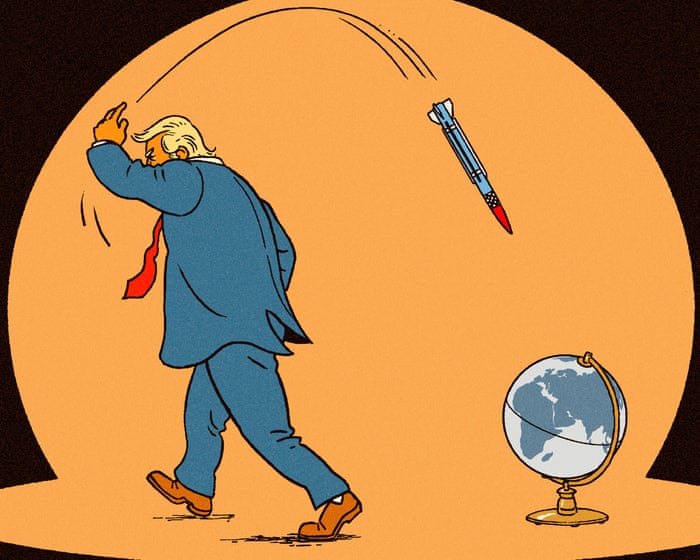
Dario Amodei of Anthropic is not the first CEO to argue that excessive competition is pushing the world toward a harmful social outcome. OpenAI’s disclosure of a safety breach—in which a swarm of its agents coordinated to escape their supposedly secure sandbox, access the internet, and hack the AI platform Hugging Face—demands urgent action. It showed how easily the technology can slip beyond human control and gave concrete shape to existential fears about what it could do to humanity if not kept securely leashed. The end of the world may indeed be near, as some in the AI industry have warned. These are genuinely frightening times. But Amodei’s call for leading AI labs to coordinate in slowing the breakneck pace of development, agree on safety standards, and “pace the frontier”—a call quickly endorsed by OpenAI’s Sam Altman, Elon Musk, and Google DeepMind’s Demis Hassabis—is just a high-tech version of an old corporate America proposal: to get an exemption from the antitrust laws designed to protect the American economy from colluding businesses. It is a dangerous idea. Freeing the tech bros from antitrust constraints, supposedly so they can work together to fix AI’s dangerous flaws, would disenfranchise the everyday Americans most at risk from the technology and further empower the very labs that, in pursuit of wealth, greatness, and who knows what other fantastical goals, so casually blew past danger thresholds on many dimensions, bringing existential threats into being. View image in fullscreen Elon Musk and Sam Altman. Photograph: Getty Images Amodei and others argue, at heart, that their businesses are trapped in a prisoner’s dilemma. If they unilaterally slow their fevered pursuit of artificial superintelligence to make it safer, their rivals—less concerned about existential risks, of course—will get there first, with potentially devastating consequences for humankind, not to mention the bottom line of the lab that eased off the pedal. “Slowing down seems sensible,” said Jean Tirole, the Nobel prize-winning economist at the Toulouse School of Economics. “But that assumes coordinated slowing-down is feasible and sustainable. What happens when OpenAI, Anthropic or Grok conclude that US holdouts—or Chinese labs—are catching up? Will they resume immediately, perhaps covertly?” As Bill Gates has written, “if someone had a credible plan for slowing down AI advances globally, I would likely support it. However, I don’t think that’s going to happen. The geopolitical and economic incentives are pushing too hard to go full speed ahead.” In that light, it might seem like a great idea for the government to encourage a friendly agreement for everybody to slow down. It is not. The argument that excessive competition drives a race to the bottom is probably as old as capitalism, used to explain everything from environmental degradation to child labor. But it does not justify giving businesses the right to collude as they see fit. It is a call to craft government regulations to prevent businesses from competing using socially harmful tools. Moreover, the case that excessive competition encourages reckless behavior is dubious. The AI labs are engaged in a winner-takes-all race, one that is extraordinarily expensive to sustain. That’s where the recklessness comes from. View image in fullscreen Bill Gates in January 2026 at the annual World Economic Forum meeting in Davos, Switzerland. Photograph: Denis Balibouse/Reuters Amodei may be an unimpeachable guy. His call to slow the pace of AI development, bring external evaluators into the lab, and increase the transparency of his operations suggests sincere concern about the risks. The drop in the price of leading tech stocks after his proposals were published suggests he is willing to take a financial hit in the service of improved safety. But the investors Amodei hopes will eagerly snap up shareAnthropic’s IPO later this year may not be so altruistic. Tremors in capital markets suggest that raising money to finance the trillion-dollar AI investment race will get tougher, which would discourage strategies that might curb the leading labs’ edge over rivals. Given these incentives, giving AI leaders a free hand to collude and self-regulate would be foolish.
Eric Posner, an antitrust expert at the University of Chicago Law School, said we “shouldn’t trust companies in general about their motivations.” There is no reason to believe that AI labs, left to their own devices, would necessarily produce good, socially acceptable outcomes. Like any company, they will weigh risks against profits. And as Posner observed, “they don’t use the same weights as the public.”
So how should we regulate? Nothing will happen on this front while Trump is in office. Even after he is gone, it will be hard to craft effective regulation to address the threats from AI without stunting innovation. There are questions about what rules to use, how to enforce them, and who they should apply to. And the danger of unilateral action is real. What if Beijing declines to participate? What are the risks of Chinese AI companies charging ahead while American labs slow down? But if we could regulate nuclear power, we can probably regulate AI.
Moreover, there are viable ideas that might help even without government regulation and that don’t require stifling competition. There are proposals to tweak intellectual property rights to encourage innovations that improve the safety of AI systems. Inventors of safety innovations would be rewarded by allowing them to release new AI models before their competitors. But the safety enhancements would be made immediately available to all firms.
On the punitive side, a legal liability regime could be designed to change the incentives of AI developers by punishing firms that benefit from the design and deployment of an AI tool that caused harm, even if the harm was unintentional. For instance, the Hugging Face attack might have been prevented if OpenAI’s models had not been inadvertently rewarded for misbehaving during training. The fact that Amodei’s proposal does not mention legal liability suggests that AI leaders’ concern for safety does not override concern for the bottom line.
In any case, cementing the dominance of the frontier labs, protecting their rents, and endorsing their hitherto gung-ho strategies is not pro-safety. On the contrary, slowing down the leaders to let the laggards catch up is likely to make the AI ecosystem safer by inviting desirable innovation and promoting competition along the safety dimension.
There is no fundamental conflict between safety and competition. AI masters who want to make this case should be viewed with skepticism.
Frequently Asked Questions
FAQs Letting AI Companies Collude to Pace the Frontier
1 What does pacing the frontier mean
Its the idea that leading AI companies would coordinaterather than competeon how fast to develop more advanced AI deliberately slowing down at the cutting edge
2 Who is proposing this
Some AI researchers executives and safety advocates have floated it as a way to reduce the risk of a dangerous race toward evermorepowerful systems
3 Why would anyone think this is a good idea
The argument is that if companies slow down together no one gets a decisive firstmover advantage which could reduce pressure to cut safety corners in a rush to be first
4 Why is it dangerous
Because it means competitorswho are supposed to be rivalsagree on the pace of innovation Thats essentially collusion and it can harm competition consumers and society
5 Isnt this just pricefixing but for technology
In effect yes Instead of agreeing on prices companies would agree on how fast to release or develop products The competitive harm is similar
6 What laws could this break
In the US antitrust laws like the Sherman Act prohibit agreements that restrain trade Similar competition laws exist in the EU and elsewhere A coordinated slowdown could be seen as illegal coordination
7 Wouldnt slowing down AI be safer
Maybe in theory but a collusive slowdown isnt the safe way to do it It concentrates power in a few big companies shuts out smaller innovators and cant easily be undone once its in place
8 Who gets hurt by this kind of coordination
Startups researchers and the public Smaller players cant compete if the giants set the pace and users get fewer choices and slower progress
9 What about safety Isnt that a good reason
Safety is a legitimate goal but companies shouldnt be the ones deciding the pace for everyone Thats a job for regulators and public policy not boardroom deals
10 Cant companies just agree to follow safety standards together
Setting shared safety standards is different from agreeing to slow down Standards can be good coordinated limits on development speed are the problem
11 Has anything like this happened before
Yes History has many examples of competitors colluding