This CSS code defines a custom font family called “Guardian Headline Full” with multiple font weights and styles. It includes light, regular, medium, and semibold weights, each with normal and italic variations. The fonts are loaded from the Guardian’s servers in WOFF2, WOFF, and TrueType formats to ensure compatibility across different browsers.@font-face {
font-family: Guardian Headline Full;
src: url(https://assets.guim.co.uk/static/frontend/fonts/guardian-headline/noalts-not-hinted/GHGuardianHeadline-Bold.woff2) format(“woff2”),
url(https://assets.guim.co.uk/static/frontend/fonts/guardian-headline/noalts-not-hinted/GHGuardianHeadline-Bold.woff) format(“woff”),
url(https://assets.guim.co.uk/static/frontend/fonts/guardian-headline/noalts-not-hinted/GHGuardianHeadline-Bold.ttf) format(“truetype”);
font-weight: 700;
font-style: normal;
}
@font-face {
font-family: Guardian Headline Full;
src: url(https://assets.guim.co.uk/static/frontend/fonts/guardian-headline/noalts-not-hinted/GHGuardianHeadline-BoldItalic.woff2) format(“woff2”),
url(https://assets.guim.co.uk/static/frontend/fonts/guardian-headline/noalts-not-hinted/GHGuardianHeadline-BoldItalic.woff) format(“woff”),
url(https://assets.guim.co.uk/static/frontend/fonts/guardian-headline/noalts-not-hinted/GHGuardianHeadline-BoldItalic.ttf) format(“truetype”);
font-weight: 700;
font-style: italic;
}
@font-face {
font-family: Guardian Headline Full;
src: url(https://assets.guim.co.uk/static/frontend/fonts/guardian-headline/noalts-not-hinted/GHGuardianHeadline-Black.woff2) format(“woff2”),
url(https://assets.guim.co.uk/static/frontend/fonts/guardian-headline/noalts-not-hinted/GHGuardianHeadline-Black.woff) format(“woff”),
url(https://assets.guim.co.uk/static/frontend/fonts/guardian-headline/noalts-not-hinted/GHGuardianHeadline-Black.ttf) format(“truetype”);
font-weight: 900;
font-style: normal;
}
@font-face {
font-family: Guardian Headline Full;
src: url(https://assets.guim.co.uk/static/frontend/fonts/guardian-headline/noalts-not-hinted/GHGuardianHeadline-BlackItalic.woff2) format(“woff2”),
url(https://assets.guim.co.uk/static/frontend/fonts/guardian-headline/noalts-not-hinted/GHGuardianHeadline-BlackItalic.woff) format(“woff”),
url(https://assets.guim.co.uk/static/frontend/fonts/guardian-headline/noalts-not-hinted/GHGuardianHeadline-BlackItalic.ttf) format(“truetype”);
font-weight: 900;
font-style: italic;
}
@font-face {
font-family: Guardian Titlepiece;
src: url(https://assets.guim.co.uk/static/frontend/fonts/guardian-titlepiece/noalts-not-hinted/GTGuardianTitlepiece-Bold.woff2) format(“woff2”),
url(https://assets.guim.co.uk/static/frontend/fonts/guardian-titlepiece/noalts-not-hinted/GTGuardianTitlepiece-Bold.woff) format(“woff”),
url(https://assets.guim.co.uk/static/frontend/fonts/guardian-titlepiece/noalts-not-hinted/GTGuardianTitlepiece-Bold.ttf) format(“truetype”);
font-weight: 700;
font-style: normal;
}
@media (min-width: 71.25em) {
.content__main-column–interactive {
margin-left: 160px;
}
}
@media (min-width: 81.25em) {
.content__main-column–interactive {
margin-left: 240px;
}
}
.content__main-column–interactive .element-atom {
max-width: 620px;
}
@media (max-width: 46.24em) {
.content__main-column–interactive .element-atom {
max-width: 100%;
}
}
.content__main-column–interactive .element-showcase {
margin-left: 0;
}
@media (min-width: 46.25em) {
.content__main-column–interactive .element-showcase {
max-width: 620px;
}
}
@media (min-width: 71.25em) {
.content__main-column–interactive .element-showcase {
max-width: 860px;
}
}
.content__main-column–interactive .element-immersive {
max-width: 1100px;
}
@media (max-width: 46.24em) {
.content__main-column–interactive .element-immersive {
width: calc(100vw – var(–scrollbar-width, 0px));
position: relative;
left: 50%;
right: 50%;
margin-left: calc(-50vw + var(–half-scrollbar-width, 0px)) !important;
margin-right: calc(-50vw + var(–half-scrollbar-width, 0px)) !important;
}
}
@media (min-width: 46.25em) {
.content__main-column–interactive .element-immersive {
transform: translate(-20px);
width: calc(100% + 60px);
}
}
@media (max-width: 71.24em) {
.content__main-column–interactive .element-immersive {
margin-left: 0;
margin-right: 0;
}
}
@media (min-width: 71.25em) {
.content__main-column–interactive .element-immersive {
transform: translate(0);
width: auto;
}
}
@media (min-width: 81.25em) {
.content__main-column–interactive .element-immersive {
max-width: 1260px;
}
}
.content__main-column–interactive p,
.content__main-column–interactive ul {
max-width: 620px;
}
.content__main-column–interactive:before {
position: absolute;
top: 0;
height: calc(100% + 15px);
min-height: 100px;
content: “”;
}
@media (min-width: 71.25em) {.content__main-column–interactive:before {
border-left: 1px solid #dcdcdc;
z-index: -1;
left: -10px;
}
@media (min-width: 81.25em) {
.content__main-column–interactive:before {
border-left: 1px solid #dcdcdc;
left: -11px;
}
}
.content__main-column–interactive .element-atom {
margin-top: 0;
margin-bottom: 0;
padding-bottom: 12px;
padding-top: 12px;
}
.content__main-column–interactive p + .element-atom {
padding-top: 0;
padding-bottom: 0;
margin-top: 12px;
margin-bottom: 12px;
}
.content__main-column–interactive .element-inline {
max-width: 620px;
}
@media (min-width: 61.25em) {
figure[data-spacefinder-role=”inline”].element {
max-width: 620px;
}
}
:root {
–dateline: #606060;
–headerBorder: #dcdcdc;
–captionText: #999;
–captionBackground: hsla(0, 0%, 7%, 0.72);
–feature: #c70000;
–new-pillar-colour: var(–primary-pillar, var(–feature));
}
:root:root {
–subheading-text: var(–secondary-pillar);
–pullquote-text: var(–secondary-pillar);
–pullquote-icon: var(–secondary-pillar);
–block-quote-text: var(–article-text);
}
:root:root blockquote {
–block-quote-fill: var(–secondary-pillar);
}
@media (prefers-color-scheme: dark) {
:root:root:not([data-color-scheme=”light”]) {
–subheading-text: var(–darkmode-pillar);
–pullquote-text: var(–darkmode-pillar);
–pullquote-icon: var(–darkmode-pillar);
}
:root:root:not([data-color-scheme=”light”]) blockquote {
–block-quote-fill: var(–darkmode-pillar);
}
}
.content__main-column–interactive .element.element-atom,
.element.element-atom {
padding: 0;
}
#article-body > div .element-atom:first-of-type + p:first-of-type,
#article-body > div .element-atom:first-of-type + .sign-in-gate + p:first-of-type,
#article-body > div .element-atom:first-of-type + #sign-in-gate + p:first-of-type,
#article-body > div hr:not(.last-horizontal-rule) + p,
.content–interactive > div .element-atom:first-of-type + p:first-of-type,
.content–interactive > div .element-atom:first-of-type + .sign-in-gate + p:first-of-type,
.content–interactive > div .element-atom:first-of-type + #sign-in-gate + p:first-of-type,
.content–interactive > div hr:not(.last-horizontal-rule) + p,
#comment-body .element-atom:first-of-type + p:first-of-type,
#comment-body .element-atom:first-of-type + .sign-in-gate + p:first-of-type,
#comment-body .element-atom:first-of-type + #sign-in-gate + p:first-of-type,
#comment-body hr:not(.last-horizontal-rule) + p,
[data-gu-name=”body”] .element-atom:first-of-type + p:first-of-type,
[data-gu-name=”body”] .element-atom:first-of-type + .sign-in-gate + p:first-of-type,
[data-gu-name=”body”] .element-atom:first-of-type + #sign-in-gate + p:first-of-type,
[data-gu-name=”body”] hr:not(.last-horizontal-rule) + p,
#feature-body .element-atom:first-of-type + p:first-of-type,
#feature-body .element-atom:first-of-type + .sign-in-gate + p:first-of-type,
#feature-body .element-atom:first-of-type + #sign-in-gate + p:first-of-type,
#feature-body hr:not(.last-horizontal-rule) + p {
padding-top: 14px;
}
#article-body > div .element-atom:first-of-type + p:first-of-type:first-letter,
#article-body > div .element-atom:first-of-type + .sign-in-gate + p:first-of-type:first-letter,
#article-body > div .element-atom:first-of-type + #sign-in-gate + p:first-of-type:first-letter,
#article-body > div hr:not(.last-horizontal-rule) + p:first-letter,
.content–interactive > div .element-atom:first-of-type + p:first-of-type:first-letter,
.content–interactive > div .element-atom:first-of-type + .sign-in-gate + p:first-of-type:first-letter,
.content–interactive > div .element-atom:first-of-type + #sign-in-gate + p:first-of-type:first-letter,
.content–interactive > div hr:not(.last-horizontal-rule) + p:first-letter,
#comment-body .element-atom:first-of-type + p:first-of-type:first-letter,
#comment-body .element-atom:first-of-type + .sign-in-gate + p:first-of-type:first-letter,
#comment-body .element-atom:first-of-type + #sign-in-gate + p:first-of-type:first-letter,
#comment-body hr:not(.last-horizontal-rule) + p:first-letter,
[data-gu-name=”body”] .element-atom:first-of-type + p:first-of-type:first-letter,
[data-gu-name=”body”] .element-atom:first-of-type + .sign-in-gate + p:first-of-type:first-letter,
[data-gu-name=”body”] .element-atom:first-of-type + #sign-in-gate + p:first-of-type:first-letter,
[data-gu-name=”body”] hr:not(.last-horizontal-rule) + p:first-letter,
#feature-body .element-atom:first-of-type + p:first-of-type:first-letter,The first letter of the first paragraph in the article body, or after certain elements like sign-in gates or horizontal rules, is styled as a large drop cap. It uses specific headline fonts, is bold, uppercase, and colored, with a size of 111px and a line height of 92px. It floats to the left with a small margin.
Paragraphs immediately following horizontal rules have no top padding. Pullquotes within the article body are limited to a maximum width of 620px.
Captions for showcase elements are positioned statically and also have a max-width of 620px. Immersive elements span the full viewport width, adjusting for scrollbars. On larger screens, they are constrained to a maximum width, while on smaller screens, they extend to the edges with adjusted margins. Captions for immersive elements have responsive padding.
For wider screens, the article header uses a CSS Grid layout with defined columns and rows. This grid organizes the title, headline, metadata, and standfirst. The headline has a top border, and metadata is positioned with a small top padding. Links within the standfirst are underlined with a custom color that changes on hover, and list items have a font size of 20px. The first paragraph in the standfirst has no special styling indicated.For screens with a minimum width of 61.25em, the first paragraph within the standfirst element will have a top border and no bottom padding. If the screen is also at least 71.25em wide, this top border is removed.
On screens at least 61.25em wide, figures within the furniture wrapper have no left margin, and inline figures with a specific role have a maximum width of 630px.
For screens at least 71.25em wide, the furniture wrapper uses a detailed grid layout for columns and rows. A decorative line appears before the meta section, and the standfirst paragraphs lose their top border, gaining a left border instead.
On wider screens of at least 81.25em, the grid template is adjusted with different column and row allocations. The decorative line before the meta section becomes wider, and the left border on the standfirst shifts slightly.
Headlines have a specific font weight, size, and maximum width, which change on larger screens. Certain keylines are hidden on medium-sized screens, and their SVG strokes use a defined border color.
Social and comment elements within the meta section use the same border color. Specific containers within the meta section are hidden.
The standfirst section has a negative left margin and relative positioning, with adjusted padding on medium screens. Its paragraphs have defined font properties.
The main media area is positioned relatively, has specific margins, and is placed in the ‘portrait’ grid area.The CSS code sets styles for various elements. It makes certain divs full width with no side margins. For larger screens, it removes bottom margins from media elements. On smaller screens, media elements adjust width and have negative left margins, which increase slightly for medium-small screens.
Figure captions are positioned at the bottom with a background color and specific padding. The first span inside a caption is hidden, while the second is displayed and limited to 90% width. On medium screens, caption padding increases.
A caption button is positioned at the bottom right with a circular background. On medium screens, it moves slightly further right.
For interactive content columns on very large screens, a pseudo-element adjusts its position and height. H2 headings within these columns have a maximum width.
For iOS and Android, custom properties define dark mode colors. In dark mode, the pillar color changes to a dark mode variant.
On iOS and Android, the first letter of the first paragraph after specific elements in article containers is colored using a secondary pillar color. Article headers in these containers also receive specific styling.For Android devices, set the height of the article header in comment articles to zero.
For both iOS and Android devices, apply the following styles to furniture wrappers in feature, standard, and comment articles:
– Add padding: 4px at the top, 10px on the sides, and 0 at the bottom.
– Style content labels with:
– Bold font weight.
– A specific font family stack (Guardian Headline, Guardian Egyptian Web, etc.).
– Color using a custom CSS variable for pillar colour.
– Capitalized text.
– Style h1 headlines with:
– Font size of 32px.
– Bold font weight.
– Bottom padding of 12px.
– A dark grey color (#121212), using `!important` to override other styles.
– Style image figures with:
– Relative positioning.
– Top margin of 14px, left margin of -10px, and no bottom margin.
– Width calculated as the full viewport width minus any scrollbar width.
– Automatic height.
– For inner figure elements, images, and links within these figures:
– Set background to transparent.
– Width calculated as the full viewport width minus any scrollbar width.
– Height set to auto, using `!important` to override other styles.
– Style standfirst elements (article summaries/introductions) for both iOS and Android in feature, standard, and comment articles.The CSS code sets styles for article containers. For the standfirst section, it adds padding at the top and bottom, with a negative right margin. On iOS and Android devices, the text inside the standfirst uses specific font families. Links within the standfirst are styled with a particular color, underlined with an offset, and have a custom border color that changes on hover. The meta section has no margin, and elements like bylines and author names are styled consistently across different article types.For iOS and Android devices, the author’s name in article bylines should be displayed in the new pillar color. Additionally, remove padding from the meta miscellaneous section and set the stroke color of its SVG icons to the new pillar color.
For showcase elements, the caption button should be displayed as a flex container, centered with 5px padding, 28px in both width and height, and positioned 14px from the right.
The article body should have 12px padding on the left and right. For image elements that are not thumbnails or immersive, set the margin to 0, the width to the full viewport width minus 24px and the scrollbar width, and the height to auto.For iOS and Android devices, remove padding from image captions in feature, standard, and comment articles, except for thumbnail or immersive images. Make immersive images span the full viewport width, accounting for the scrollbar. Style quoted text with a color variable and format links with underlines that change color on hover. In dark mode, adjust background and text colors for article headers and titles.The text appears to be CSS code, not standard English prose. It defines style rules for different article types and platforms, setting colors for various elements like text, links, and icons using custom color variables.This CSS code sets a dark background for specific elements on iOS and Android devices. It also styles the first letter of paragraphs that come after certain elements in article containers on iOS.This appears to be a CSS selector targeting the first letter of paragraphs in specific article containers on iOS and Android devices. It applies to various article body sections, feature bodies, comment bodies, and interactive content areas, particularly when they follow certain elements like `.element-atom`, `.sign-in-gate`, or `#sign-in-gate`.In July 2025, four of Europe’s most senior officials arrived in eastern Libya for an urgent meeting. Italy’s interior minister had seen migrant arrivals surge over the previous six months. Greece’s migration chief was reeling after 2,000 people reached Crete in a single week. Malta’s home minister feared his island was next. And the EU’s migration commissioner was scrambling to save an agreement worth hundreds of millions of euros.Lions that were visibly failing to stop the boats. Libya is a place where crises converge. Its 1,100-mile coastline, the longest in the Mediterranean, has become the main departure point for migrants heading north. Since Muammar Gaddafi was toppled in 2011, the country has been torn apart by successive civil wars. Russia, Turkey, Egypt, and the UAE arm rival factions, and the conflict no longer stops at Libya’s borders. From military bases in the south, Russia and the UAE funnel weapons and fighters into Sudan’s civil war, which has driven hundreds of thousands more refugees north toward Libya’s coast.
Whoever controls Libya holds leverage over Europe. Yet Libya’s political crisis is so complex that it confuses even experienced European officials. The country is split between two governments, one in the west and one in the east, and neither really governs. The UN and Europe recognize the Government of National Unity in Tripoli, which was formed in 2021 to oversee elections that never happened. In response, the House of Representatives, Libya’s parliament elected in 2014, appointed a rival government in the eastern city of Benghazi in 2022, though no country officially recognizes it. Both administrations, in the east and west, claim national authority. Neither controls the oil, military bases, or the migration routes that make Libya matter to Europe. One man does. His name is Khalifa Haftar.
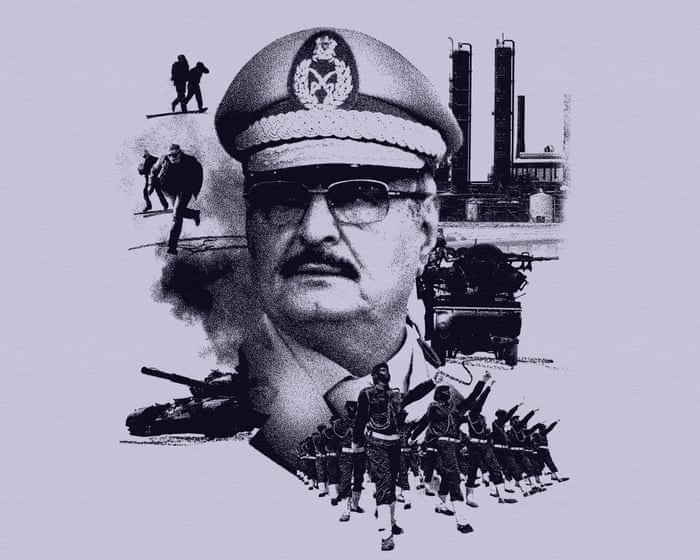
Haftar is 82. His title, General Commander of the Libyan National Army—a coalition of militias assembled in 2014 and later rubber-stamped by the eastern parliament—does not convey the vast extent of his power. His forces hold the oilfields and export terminals across central Libya. His coastline units police the eastern shore and run the smuggling routes that feed Europe’s migration crisis. His bases host the foreign militaries fueling Sudan’s war. For Europeans confronting migration, energy insecurity, and regional spillover, Haftar controls everything that matters.
The European delegation had come to Benghazi hoping for a private audience with Haftar. Upon arrival, they learned he had one condition: they must first meet, publicly and on camera, with ministers from the eastern administration he claims to serve. Europe does not officially recognize that government. Meeting its ministers would legitimize it; refusing would mean no access to Haftar. When the Europeans declined, they were denied entry. The delegation never made it past the airport lounge. The humiliation exposed Libya’s central fiction: to reach the country’s most powerful man, you must pretend he is not the country’s most powerful man.
In 2011, foreign powers intervened to overthrow Gaddafi. This is what they built. As bombs fall on Iran and the architects of yet another intervention promise that force will deliver freedom, Libya stands as the parable they refuse to read. Every intervention makes the same promise: remove the dictator and the people will be free. Libya is what happens when the dictator is removed and the people are forgotten.
For more than a decade, as Libya’s politicians fought over diplomatic recognition, Haftar was changing the facts on the ground, accumulating the oil, territory, and foreign backers that constitute real power. He claims to be a servant of the eastern government—but it is a government whose ministers he approves, whose parliament his soldiers surround, and whose laws apply only when he permits. Meanwhile, the rival government in Tripoli survives on oil revenues and infrastructure that run through territory he can close at will. Both governments are officially responsible for everything, but neither has power over anything essential. This is Haftar’s system: control everything that matters, be answerable for nothing, and force everyone to pretend the arrangement does not exist.
This system is propped up from outside by foreign powers and held together inside by enforced silence. Egypt, Russia, and the UAE officially recognize the government…In Tripoli, foreign powers effectively support Haftar. The UAE funds his operations and supplies the weapons that uphold his authority. Egypt provides intelligence and allows him to use a military base on its soil. Russia sends mercenaries to guard his oilfields and fight his battles. In May 2025, Vladimir Putin hosted Haftar at the Kremlin and promised him diplomatic protection at the UN Security Council. Without these backers, Haftar’s system would fall apart. With them, it remains untouchable. “The foreign powers keep up the charade just as much as Haftar does,” said Tarek Megerisi of the European Council on Foreign Relations. “They can claim to support Libya’s sovereignty while backing the man who undermines it.”
In eastern Libya, no one is deceived. Haftar’s face stares down from billboards across Benghazi and hangs in government offices. In May 2025, the eastern government even named a new city after him. His sons command military units, oversee reconstruction contracts, and conduct foreign meetings like heirs in waiting. Yet speaking this truth is dangerous. In eastern Libya, everything is watched. “People believe Haftar’s reach has no limit,” says Hanan Salah of Human Rights Watch. “His forces take people from their homes—whether citizens or parliamentarians—and they disappear. He controls the courts. He controls the investigations. He operates with total impunity because the international community has chosen appeasement over accountability.”
Everyone sees the reality, but no one dares say it aloud. Haftar is Libya’s great pretender. As former U.S. special envoy Jonathan Winer put it, Haftar sees himself as “the Dune messiah, a messianic figure out of the desert who controls the fate of nations while pretending to be the instrument of the people.”
Haftar has spent 50 years studying how power works: beside Gaddafi, who ruled through committees and councils while claiming no official title; in a Chadian prison camp, where he made himself indispensable to both captors and captives; as a CIA asset in Virginia who later played the CIA against the Gaddafi regime; and as a failed commander in a revolution that rejected him—until he outlasted everyone who did. Each experience taught him the same lesson: power doesn’t require a throne. He rules in the gap between what everyone knows and what no one can say.
Haftar’s political life began with betrayal. On September 1, 1969, the 25-year-old Haftar stood shoulder to shoulder with Muammar Gaddafi as one of the junior officers who overthrew King Idris, Libya’s pro-Western monarch. In the years that followed, Haftar rose through the ranks of Gaddafi’s revolutionary state, becoming one of his most trusted military commanders.
In 1986, Gaddafi promoted Haftar to colonel and sent him to command Libyan forces in neighboring Chad. By then, the two countries had been fighting for nearly a decade, with the war evolving into a struggle for control over smuggling routes and armed networks across the Sahel—a strategic zone linking Libya, Niger, and Sudan. Gaddafi wanted the frontier secured, and Haftar was the colonel he chose for the job.
The mission ended in disaster. In March 1987, at the remote airbase of Ouadi Doum, Chadian forces backed by French and American air power crushed Haftar’s army. Hundreds of Libyan soldiers were killed. Haftar and more than 1,000 of his men were captured and taken to a prison compound outside Chad’s capital. Gaddafi had always denied any Libyan military presence in Chad, and he refused to acknowledge the humiliation at Ouadi Doum. When officials mentioned Haftar’s name after the defeat, Gaddafi mockingly replied, “Do we have someone in the army by that name? Perhaps you mean a shepherd in the desert called Hfaytar.” Nearly two decades of loyal service were betrayed in a single sentence.
For most prisoners of war, the story would have ended there.Haftar saw the prison camp as the next phase of his education in power. The Reagan administration, viewing Libya as a Soviet ally, wanted Gaddafi removed, and the CIA was closely monitoring the situation. They identified Haftar as a trained commander with a thousand resentful soldiers and a personal grudge they could exploit. In the spring of 1987, U.S. intelligence officers entered the camp disguised as humanitarian inspectors, bringing food, medicine, and recordings of Gaddafi’s speeches—in which the Libyan leader denied the prisoners’ existence and mocked them. The goal was to turn them against Gaddafi, and it succeeded. “The Americans planted the seed,” recalled a former Libyan opposition figure based in Chad, “but it was Haftar’s wounded pride that made it grow.”
The Americans began meeting with Haftar regularly, and he was occasionally allowed to leave the camp to meet Chad’s dictator, President Hissène Habré. According to former detainees and opposition figures, Haftar soon took charge of distributing food and medicine, controlling communications, and enforcing discipline within the camp. Survival meant obeying him.
In August 1987, Habré informed the leader of the main exiled Libyan opposition movement that Haftar and the captives wanted to join them. “It was a shock,” recalled Mukhtar Murtadi, then a senior member of the National Front for the Salvation of Libya (NFSL). “He had enforced Gaddafi’s system. Now he wanted to be an ally. We didn’t know how to place him, but we saw a chance to hurt the regime.”
Murtadi visited Haftar soon after and was unsettled by what he found. The prison compound was a scene of misery: overcrowded barracks reeking of sewage and disease, with men emaciated by hunger and heat. At the center stood a small, untouched villa with a porch, a kitchen, and running water—Haftar’s quarters. For their meeting, Haftar emerged freshly showered, wearing a spotless white kaftan, his beard neatly trimmed. “He didn’t look like a prisoner,” Murtadi recalled. “He looked like a guest.”
In June 1988, Haftar announced the formation of the NFSL’s armed wing, naming it the Libyan National Army—a title he would revive decades later. Though it was an army without a state, the name was enough to restore Haftar’s status as a commander and give the CIA a recognizable entity to support. The agency trained Haftar and his men in guerrilla warfare at camps outside Chad’s capital, N’Djamena. In Washington, they were known as the Libyan Contras. “He had a way of commanding the space,” recalled a former NFSL member who trained with Haftar. “Tall, broad-shouldered, rigid. He made you feel he was in charge, even in a dusty tent.”
Then, in December 1990, the arrangement collapsed when a Chadian general backed by Gaddafi overthrew Habré. The Americans rushed to extract their assets. “We got 300 of Haftar’s men onto a C-130. No bags. We cheered when the plane took off,” said a former CIA officer who worked on Libya. For the next six months, Haftar and his men were moved between African capitals as governments balanced American pressure against Libyan threats. Gaddafi was determined to capture them.
The idea of a CIA-trained army led by his former colonel, broadcasting into Libya and recruiting defectors, became an obsession for Gaddafi. As his paranoia deepened, he sent hit squads across Europe and the Arab world to hunt opposition figures—or “stray dogs,” as he called them. Inside Libya, people disappeared over rumors or jokes. Of the more than 1,000 Libyan soldiers captured in Chad, only about 300 had reached the U.S. by May 1991. The rest were scattered or returned to Libya, many never to be seen again.
My father, one of Libya’s most distinguished…My father, a physicist, left Tripoli in the 1970s to earn his doctorate in England. Back in Libya, the universities he left behind were sites of terror, with students hanged from campus gates for their political views. This reality shaped him, and he made enemies of the regime by speaking out about it. I grew up in York, England, in the early 1990s, spending summers with my mother in Tripoli while my father stayed behind—it was too dangerous for him to return.
In Tripoli, survival depended on pretense. When a relative vanished, my aunt told the neighbors he was on holiday. I once found her sobbing in the kitchen at midnight, hands clamped over her mouth to stifle the sound. At dinner, my cousin kicked me under the table if I mentioned my father’s missing friend, Hussein. I learned to act as if he never existed. Every morning during our visits, a Peugeot with tinted windows would park outside my uncle’s house for surveillance, remaining until the streetlights flickered on at night. We pretended not to see it, and the men inside pretended not to watch us.
In late 1995, my mother flew from our home in England to Tripoli for her brother’s funeral. Weeks turned into months with no word. We later discovered she had been detained at the Tripoli airport. Intelligence officers pressured her to lure my father back to Libya, claiming they only wanted to talk. Instead, she secretly sent the opposite message through a family friend: “It’s not safe, don’t come, look after the children.” It was her goodbye; she didn’t know if she’d see us again. She remained under house arrest until mid-1996, when a relative bribed a senior military official to return her passport. Given only hours to leave, she crossed into Tunisia by land and flew home. We reunited at the airport. She was thinner than I’d ever seen her. After a long embrace, she simply asked what I wanted for dinner. We talked about everything except where she had been.
Haftar would later build his own system upon these same foundations: disappearances, silence, and the pretense that nothing was wrong.
While Libyans in the west lived with these fears, Haftar was building a new life in the U.S. By the summer of 1991, he lived in a one-bedroom apartment at Skyline House in Falls Church, Virginia, near CIA headquarters in Langley. He never fully adapted to American life, being driven between meetings at Langley and community gatherings, where he appeared withdrawn and socially awkward.
Salah Elbakkoush, a Libyan dissident living in the same building, recalled a scene that captured Haftar’s years in America: a former Libyan prisoner of war served them tea in silence, head bowed, just as he had in a Chad prison camp. “Here we were in suburban Virginia,” Elbakkoush said, “and this broken man was serving us as if nothing had changed. It told me everything about Haftar. He wasn’t building a new life; he was recreating his old one.”
The CIA had resettled Haftar, but there were expectations. “Washington was full of useless dissidents,” a former CIA officer told me. “The Agency wanted more—useful intelligence from inside the country. The deal was simple: we’re glad to resettle you, but we need actionable intel from your networks. Otherwise, you’re just a burden.”
In 1992, the CIA and the National Front for the Salvation of Libya (NFSL) began planning a coup. Haftar was tasked with recruiting regime officers willing to defect. For over a year, he traveled to Zurich to meet Libyan military officers ready to risk everything to overthrow Gaddafi. On those same trips, it later emerged, Haftar also met secretly with Ahmad Gaddaf al-Dam, Gaddafi’s cousin and a senior regime fixer.
According to Mukhtar Murtadi and Mohamed Megareyef, then-leader of the NFSL—both of whom worked closely with Haftar—he played both sides. To the Americans and the NFSL, he claimed his meetings with regime figures were for intelligence gathering ahead of the coup. To Gaddafi’s people, he offered something more valuable: the names of every officer wwho had promised to betray the regime. In October 1993, a coup was launched inside Libya. It failed within hours. The regime arrested hundreds of conspirators, most of whom were executed.
The full truth may never be known, but what followed told its own story. In 1995, Haftar received a villa in Cairo as a personal gift from Gaddafi—something he would openly admit decades later, when it no longer mattered. That same year, Haftar broke with the NFSL and founded a rival organization, the Libyan Movement for Change and Reform. The split proved fatal to the opposition: infighting consumed what remained of the NFSL. Gaddafi had wanted the exiles divided, and he got his wish.
The former CIA officer was hesitant to confirm how or if the relationship with Haftar officially ended. What is clear is that by the mid-1990s, U.S. intelligence considered Haftar an unreliable Cold War asset with no war left to fight. But his ties to Gaddafi endured. In 2005, Gaddafi visited Haftar’s family at their villa in Cairo. Haftar was not there, but in leaked audio of the meeting, Gaddafi told Haftar’s eldest son that Haftar was like a brother to him.
By 2011, Haftar had lived in Virginia for two decades, long since abandoned by the CIA but still holding his U.S. citizenship and his grievances. When the Libyan revolution erupted that February, he watched it on television. “His eyes were fixed on the TV screen,” recalled a Libyan dissident who met him at that time. In early March, Aly Abuzaakouk, a prominent dissident and later parliamentarian who had known Haftar for more than 20 years, drove him to Dulles Airport for his return to Benghazi. “We hugged,” Abuzaakouk told me. “But the man who arrived in Libya was different from the one I dropped off. I believed he was joining the revolution, but he was going to take it over.”
When Haftar landed in Benghazi on March 15, 2011, he arrived late to a revolution that did not need him. Gaddafi still held Tripoli and the west. In the east, revolutionaries had formed a transitional council—a loose coalition of defectors, lawyers, and academics determined to replace military rule with civilian government. On the ground, power rested with protesters who had formed armed brigades and paid for it in blood. They distrusted career military officers, people with foreign ties, and officials with old-regime baggage. Haftar embodied all three.
Within days, Haftar’s sons began approaching brigade commanders, speaking of their father’s desire to “protect the revolution.” A week later, the council’s military spokesperson announced Haftar as their new commander without consulting the political leadership. “I control everybody,” Haftar told the New York Times that April. “The rebels and the regular army forces.” This was pure bluster: at the time, he controlled no one.
The war moved on without him. In late March, a NATO air campaign, led by Britain and France with U.S. support, began bombing Gaddafi’s forces. In August, rebels took Tripoli. In October, Gaddafi was captured and executed. In July 2012, Libya went to the polls for the first time since 1969. Mohamed Megareyef, Haftar’s former boss in exile, was elected president of the parliament. Haftar withdrew to a farmhouse south of Tripoli. Just like in Chad, it seemed he was finished. But failure had taught him patience. “What drove him wasn’t just ideology like Gaddafi, or even just raw power,” said Mohamed Buisier, who served as Haftar’s political adviser from 2014 before breaking with him in 2016. “It was more personal than that. He wanted to know his name would be remembered in Libya’s history. Not as the defeated commander from Chad, but as the man who saved Libya.”
What followed was the collapse of the order that had rejected him. In the west, revolutionary brigades turned into militias and divided Tripoli into armed fiefdoms. In the east, judges, activists, and military officers were assassinated. With armed groups operating oOpenly under jihadist banners, the term “Islamist” became so commonly used as an accusation that it lost all meaning. It served as a label to mark an enemy, whether they were actual jihadists or not. Meanwhile, the mood across the region was shifting. In July 2013, Egypt’s military, backed by the UAE and Saudi Arabia, overthrew the Muslim Brotherhood government. A narrative solidified: Islamists were the disease, and generals were the cure.
Haftar saw his opportunity. In February 2014, he attempted to launch a coup, but when no troops rallied to his side, he was forced to flee to Benghazi with an arrest warrant issued against him. It was there that he began to build a real power base to achieve his goals. Just as in the Chadian prison camp, Haftar saw Benghazi as a place full of men who felt abandoned, humiliated, and excluded: former regime officers locked out of power, and armed groups that had once fought Gaddafi but were now sidelined. Haftar realized he could organize them if he found a unifying cause.
On May 16, 2014, Haftar launched Operation Dignity, declaring a “war on terror” against Islamists and reviving the Libyan National Army—a title he had first used in Chad in 1988. In Chad, the name had provided the CIA with a fiction to support. Now it gave Egypt and the UAE the same cover: they were not backing a warlord with militias, but an army fighting terrorism. Backed by Egyptian and Emirati airstrikes, his forces attacked jihadist factions and revolutionary brigades in Benghazi and Tripoli on the same day, plunging the country into civil war. Everyone who opposed Haftar was branded an Islamist.
Weeks later, Libya’s second parliamentary elections deepened the split. The new parliament convened in the east, while the old one in Tripoli refused to disband. By the end of the year, the country had two governments, two parliaments, two claims to legitimacy, and no mechanism to replace or reconcile them. That division largely continues today.
In early 2015, Aguila Saleh, chief of the eastern parliament, used Islamic State bombings as a pretext to appoint Haftar head of the army. On paper, Haftar answered to Saleh. In reality, the parliament sat in territory his forces controlled—politicians who dissented disappeared or fled. The eastern parliament gave his militias what the NFSL had once given him in Chad: legal cover. When the UN brokered a unity government that December, it demoted the western parliament and required a confidence vote from Saleh’s parliament. His parliament refused and appointed a rival government. The UN had not unified Libya; it had handed Haftar a veto.
The revolution had tried to build something without Haftar and failed. Now he had what he needed: an army that answered to him, a parliament that depended on him, and foreign backers—the UAE, Egypt, and later Russia—invested in his survival. He would not govern or hold office, but he controlled the men who did. What he had rehearsed in Chad, refined in exile, and tested in Benghazi was complete. The system had found its country.
Today, from an aging Soviet-era airbase in Rajma, just outside Benghazi, Haftar runs his system. From the outside, the compound is unremarkable. Inside, it functions as the headquarters of a power that exists nowhere on paper but controls everything that matters: the oilfields, the export terminals, the parliament, the courts, and the men with guns.
The foundation of his power is oil. In September 2016, Haftar’s forces seized the “oil crescent,” a 250-mile coastal strip that includes Libya’s four major export terminals. Two-thirds of Libya’s crude oil flows through these ports. Under international pressure, Haftar handed operational control back to the National Oil Corporation (NOC) in Tripoli, the only exporter the world recognizes. But he kept military control of the territory, giving him extraordinary leverage. In August 2024, Aguila Saleh cautioned that replacing Libya’s central bank governor—which Haftar opposed—“may result in shutting down oil.” Meanwhile, Western embassies consistently condemn any disruptions to oil flow without naming Haftar directly.The commander whose forces control every terminal maintains this fiction on all sides.
From 2016 to 2019, while two governments claimed legitimacy, Haftar was welcomed at summits in Paris and Abu Dhabi. Despite repeated meetings with the UN-backed Prime Minister, Fayez al-Sarraj, Haftar rejected every compromise. “We offered him legitimate power,” former U.S. special envoy Jonathan Winer told me. “Control of a military council under civilian oversight, or leadership through elections if the Libyan people chose him. He just shook his head. He would not be subservient to anyone, elected or not.”
Inside Haftar’s territory, a simpler system prevailed. Since 2014, dissent has been classified as terrorism. A protest, a conversation, a Facebook post—any criticism could carry a death sentence. In October 2016, so many bodies were found on Al-Zayt Street on the outskirts of Benghazi—bound, shot, and dumped among the rubbish—that locals renamed it “Corpse Street.” “When I enquired about a 16-year-old boy who’d disappeared in Benghazi in early 2016, they told me, matter-of-factly, that they’d murdered him for spying,” Buisier told me. “I protested—we were supposed to be building a state of institutions, of law. They looked at me like I was naive. One officer suggested I might be sympathetic to the terrorists myself.” Buisier left Haftar’s circle shortly after and returned to the U.S.
By 2019, Haftar had racked up $25 billion in debt, funding his army through unofficial bonds, commercial bank loans, and even Russian-printed dinars circulating in his territory. He needed the central bank in Tripoli to open its vaults. On April 4, 2019, he launched a full assault to capture the capital. The Trump administration had effectively authorized the move: National Security Adviser John Bolton told him to act “quickly” if he wanted to seize Tripoli and unify the country under his control. Days after the assault began, Trump himself called to praise Haftar’s “counterterrorism” efforts. By the summer, Russian mercenaries had joined Haftar’s ground forces, turning what was meant to be a lightning coup into a protracted siege.
After years of fruitless peace talks, Haftar had finally abandoned the diplomatic charade entirely. That July, Benghazi MP Seham Sergiwa appeared on a pro-Haftar television channel to urge dialogue over war. Her broadcast was cut mid-sentence. That night, gunmen dragged her from her home and spray-painted “the army is a red line” on the building. She hasn’t been seen since, and her family suspects she was taken by forces loyal to Haftar.
Ultimately, Haftar’s assault on Tripoli failed. In late 2019, Turkey intervened on behalf of the UN-backed government to try to force Haftar to negotiate for peace. The following month, at a conference in Berlin convened to end the war, world leaders waited to announce an agreement, but Haftar was nowhere to be found. He had gone to take a nap. “It wasn’t fatigue,” former UN envoy Stephanie Williams told me. “It was theatre, designed to show that he operated outside the rules.” No agreement was reached.
In late 2020, the UN brokered a ceasefire to end the war. The deal required Haftar to place his forces under civilian command. Again, he refused. Elections were promised for December 2021, but after disputes over candidate eligibility and electoral laws, they collapsed. None have been held since, and the country has returned to division.
Haftar’s financial grip has only tightened. In late 2024, officials at the central bank in Tripoli discovered nearly 10 billion new dinars in circulation bearing serial numbers that did not exist in their system. Counterfeit notes had flooded the economy from the east. The scheme helped finance Haftar’s forces and pay debts owed to his Russian mercenaries. The counterfeit notes circulated as real currency.In eastern Libya, these notes were exchanged for US dollars on the black market, providing Moscow with hard currency that had been cut off by Western sanctions following the invasion of Ukraine. The central bank was left with a dilemma: expose the fraud and risk another financial crisis, or quietly absorb the loss. “We knew exactly where the notes came from,” a central bank insider revealed. “But speaking out would mean confrontation, and confrontation would halt oil exports and further devalue the dinar. So we took them in and stayed silent. That’s how institutions survive here—you accept what you can’t challenge.”
By October 2025, the counterfeit notes were quietly withdrawn and written off in the bank’s records, while Haftar’s wealth continued to grow. “It’s easier to handle a manageable lie,” a former Western official remarked, “than an unfixable truth.”
Now 82, Haftar faces the ultimate challenge of his own making: how to transfer power in a system that relies on institutions functioning only because no one acknowledges who truly controls them. What happens when the architect of this pretense is gone?
Observers agree that Haftar hopes to secure his legacy through his children. “His eyes would light up when he introduced you to his sons,” recalled former UN envoy Williams. Those familiar with the family say one son held a special place. “Saddam was always his favorite,” Buisier noted. “Perhaps because he most closely mirrored his father’s stature and demeanor.”
Haftar’s sons have carved up the system among themselves ahead of a rumored year of succession. Saddam, appointed deputy commander-in-chief in August 2025, is the heir apparent, leading the most powerful of his father’s brigades. Khaled serves as chief of staff, maintaining control over the army. Belkacem, an engineer turned businessman, directs billions in reconstruction contracts to rebuild cities destroyed by his father’s wars. Al-Siddiq, a poet, manages tribal politics through reconciliation commissions that promise peace and forgiveness but fail to deliver. Okba oversees the cryptocurrency and AI sectors. Each holds a title, but none holds elected office. The succession plan has been rehearsed so openly it hardly remains a secret. Recent reports suggest even U.S. diplomats are now involved in discussions to unify Libya’s rival governments with Saddam as president.
But Haftar built his system for one man, not five. His sons must now divide what their father never shared—territory, money, mercenaries, and an economy propped up by counterfeit currency—in a fractured Libya where a rival government commands its own militias and foreign backers. Gaddafi spent decades grooming his sons, giving them an ideology to recite, however hollow, and yet they were still at each other’s throats before the revolution swept them away. Haftar’s sons share no common creed, only the pragmatism of survival. While Gaddafi claimed to preside over a system of popular rule, Haftar’s system demands nothing but silent assent.
Frequently Asked Questions
Of course Here is a list of FAQs about Power without a crown How Khalifa Haftar rules Libya designed to answer questions from basic to more advanced
BeginnerLevel Questions
1 Who is Khalifa Haftar
Khalifa Haftar is a Libyan military commander and the leader of the Libyan National Army which controls eastern Libya and significant parts of the south He is a key player in Libyas civil conflict having been involved in Libyan politics since the 1969 coup that brought Muammar Gaddafi to power
2 What does Power without a crown mean in this context
It refers to Haftars style of rule He holds immense military and political power effectively governing territories like a head of state but he does not hold an official internationally recognized title like President or Prime Minister His authority comes from force alliances and patronage not a formal office
3 Which parts of Libya does Haftar control
Haftar and the LNA primarily control eastern Libya including major cities like Benghazi and Tobruk as well as most of Libyas southern region which contains critical oil fields and smuggling routes
4 Is Haftar the official leader of Libya
No Libyas internationally recognized government is the Government of National Unity based in the capital Tripoli in the west Haftar is a rival authority leading a parallel administration in the east The country remains divided
IntermediateLevel Questions
5 How does Haftar maintain his power without being the official ruler
He uses a combination of
Military Force The LNA is his primary power base
Foreign Support He receives backing from countries like Russia the United Arab Emirates Egypt and France which provide weapons drones and political cover
Tribal Alliances He cultivates support from key eastern and southern tribes
Control of Resources Controlling oil ports and fields allows him to influence national revenue and fund his operations
Patronage Networks Distributing money jobs and privileges to loyalists
6 What are his main goals
Publicly he states his goals are to fight terrorism and unify Libya In practice his