It came as no surprise, especially to the residents of Osaki, that “bear” was chosen as Japan’s kanji character of the year earlier this month.
This northeastern town of 128,000 is best known for its Naruko Onsen hot springs, autumn foliage, and kokeshi dolls. But this year, it has gained attention as a bear hotspot, as Japan deals with a record number of bear encounters and deaths. Warnings suggest winter won’t bring immediate relief.
“This year has been particularly bad,” says Kazuhide Otomo, an official in the town’s rural environment division. “There have always been bears here, so people were used to them. But this year is different… it’s the biggest topic of conversation.”
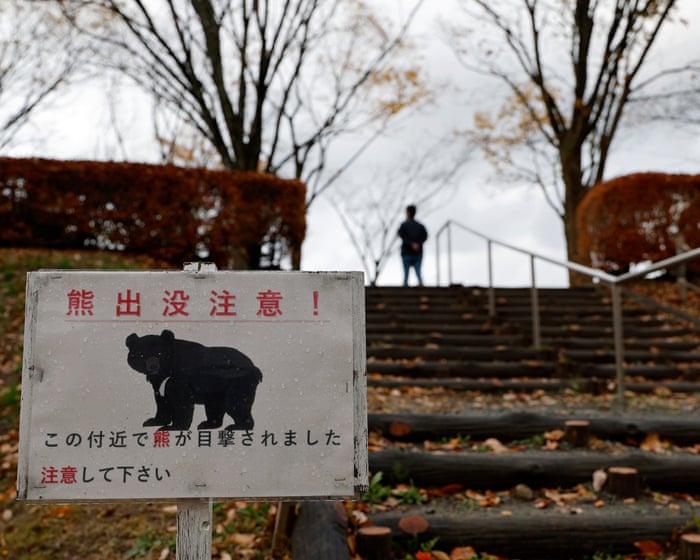
In Naruko Onsen, hikers equipped with bells and repellent spray head into the forest to see the last autumn colors, while posters at the local tourism office warn visitors in multiple languages on how to stay safe.
Tourist numbers are lower than usual, and local inns report guests canceling reservations.
Satoru Onoma, who runs a coffee shop, admits he’s tired of hearing about bears after months of intense media coverage. “It’s hard to ignore the bear problem because it’s been all over the news,” he said, adding that he hasn’t encountered any bears himself. “But I’ve heard plenty of stories about people spotting them in the mountains.”
Osaki authorities have reported 400 bear sightings so far this year, compared to fewer than 100 in 2024. In one incident, a woman in her 70s was seriously injured in a bear attack outside her home. In another, residents saw a bear grab their dog and run off.
Similar encounters have been reported across Japan, with northern prefectures at the center of an unprecedented wave of attacks.
A record 13 people died in suspected bear maulings nationwide between April and November, according to the environment ministry, while attacks reached 197—another high.
Experts say hungry bears are venturing into residential areas in search of food after poor acorn and beechnut crops in their natural habitat.
Japan’s bear population is growing, with one estimate putting the number of Asian black bears at 44,000—up from 15,000 in 2012. That figure doesn’t include Hokkaido, home to about 12,000 Ussuri brown bears, whose population has more than doubled since 1990.
Sightings have even been reported on the western tip of Honshu, raising concerns that bears could appear on Kyushu, where they were previously thought to be extinct.
Cold weather used to ease fears, as bears would hibernate after fattening up. But their desperate search for food is now delaying hibernation.
The problem is made worse by a shortage of licensed hunters—many of whom are older and lack experience with bears—and the disappearance of natural borders between forests and villages in aging farming communities.
As a result, northern prefectures are seeing a surge in bear sightings.Bears are still being spotted even in December and January. Earlier this month, police reported that an 80-year-old member of a local hunting club was found dead near a trapped bear on a mountain. In another incident, a man in his 70s was attacked while clearing snow outside his home.
Toshio Mizoguchi, a bear expert, told NHK that from 2019 to 2023, reported bear sightings in the region during December ranged from 30 to 50. That number jumped to 284 the following year and has remained high, with 271 sightings so far this year. Mizoguchi links this increase to bears spending more time searching for persimmons to build up nutrients before hibernation.
Maki Yamamoto, an associate professor specializing in wildlife management at Nagaoka University of Technology, wrote this month that black bears are now entering Japan’s urban areas. She urged that wildlife management be treated as a national policy issue, not just a problem for remote mountain communities.
Authorities in Osaki initially declared a state of emergency expected to end in November, but it has been extended through December due to ongoing sightings. Residents are advised to avoid going out early in the morning or late at night—when bear encounters are more likely—and to remove persimmons and other fruit from trees, as these are becoming part of the bears’ changing diet.
“Bears are clever animals,” said Otomo. “If they find something good to eat, like sweet persimmons, in a certain spot, they remember and return. In the past, bears often fled when they saw humans, but now they’re growing accustomed to people and no longer see them as a threat.”
Public concern led the governor of Akita prefecture—where most sightings occur—to call in the self-defense forces to trap and dispose of bears, though they are not allowed to shoot them.
Akita’s governor, Kenta Suzuki, said this unprecedented step followed four deaths and 62 injuries from bear attacks. He noted that a key feature this year is incidents occurring in urban areas, adding that the prefecture has culled over 2,000 bears.
“We’re hearing about people opening their front doors to find a bear on their doorstep or wandering in their garden,” he said. “This proximity to homes is causing significant fear. We’ve faced criticism for culling so many bears, but it’s not by choice—it’s due to the damage they’re causing in urban and agricultural areas. It’s unavoidable.”
In Osaki, residents hope 2026 will bring relief, as poor beechnut harvests seem to follow a two-year cycle—a pattern some scientists link to the climate crisis and intense summer heat. If this holds, more food should be available next year, meaning fewer hungry bears in towns and villages.
However, it also means the following year could see a return to more frequent sightings, injuries, and deaths.
“It’s about balancing resident safety with preserving bears’ natural habitats,” Otomo said. “We need a clear separation between bear and human populations. But as long as bears keep losing their fear of people, the problem will persist.”
Frequently Asked Questions
Of course Here is a list of FAQs about a Japanese town overwhelmed by record bear sightings written in a natural tone with clear direct answers
Basic Information The Situation
Q Which town in Japan is having all the bear problems
A While several towns across Japan are affected the situation has been particularly severe in places like Takikawa City in Hokkaido and numerous towns in the northern prefecture of Akita Reports have been high nationwide
Q Why are there suddenly so many bear sightings
A Experts point to a combination of factors a poor acorn and beechnut harvest in the mountains causing bears to venture into towns to scavenge a growing bear population and increasing overlap between human settlements and bear habitats
Q Are these bears aggressive What kind of bears are they
A They are almost exclusively Asian black bears While they generally avoid humans a hungry bear in a populated area is unpredictable and can be dangerous especially if surprised or protecting cubs
Q Has anyone been hurt
A Yes Tragically there have been multiple fatal attacks and numerous injuries in the past year which is why the situation is being treated with such urgency
Safety Prevention
Q What should I do if I visit or live in one of these towns
A Be extremely vigilant especially at dawn and dusk Make noise while walking Carry bear spray if possible Never approach a bear or its cubs Secure all garbage and remove any food sources from around your home
Q Whats the number one thing residents are told to do
A Secure your garbage completely Bears have an incredible sense of smell and are drawn to towns by easily accessible food waste in bags or open bins Using bearproof containers is crucial
Q What should I do if I actually encounter a bear
A Do not run Stay calm avoid direct eye contact and back away slowly Do not turn your back Give the bear a clear escape route If it approaches try to make yourself look bigger and use a firm voice Fight back only as a last resort if attacked
Community Government Response