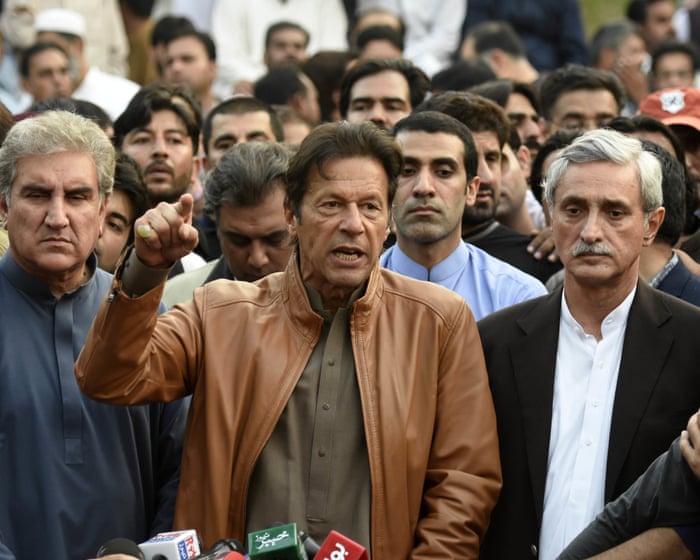
Let’s be clear: this is a fact, not an opinion, viewpoint, or hot take. There is no Pakistani—man or woman, living or dead, real or imagined—as famous as Imran Khan. Every chapter of his multifaceted public life has been defined by fame: first as a cricket legend, then as a beloved philanthropist who built a cancer hospital for the poor, later as a maverick politician who swept to power promising reform, and now, as the sole occupant of a cell in Pakistan’s most notorious prison. He is so famous that he has been the subject of two death hoaxes—most recently in November, when he disappeared from public view so long that many assumed he had died.
Others may have achieved more, and others may emerge in the future. But in Pakistan’s nearly 79-year history, in the pure currency of fame—of being known, recognized, and talked about, the one Pakistani everyone can name—no one comes close to Imran. (He is almost universally known by his first name alone.) This remains true even now, two years into the state’s attempts to erase him from public life. In that time, they have barred TV channels from saying his name on air, stopped newspapers from publishing his picture, and even scrubbed him from footage of his greatest sporting triumph.
In cricket-obsessed countries, it’s often said that the prime minister’s job is second in difficulty only to captaining the national team. Imran is the only person who can say for sure. He burst onto the public stage 50 years ago, delivering Pakistan its first famous cricket win in Australia. He did it in the sport’s most thrilling, masculine way: by bowling exceptionally fast. He went on to become, unquestionably, Pakistan’s greatest cricketer, leading the team to its most exhilarating victories. But his premiership was neither as successful nor as enduring as his captaincy, ending like every tenure before it—incomplete, and often with its occupant under arrest or in jail.
That is where he has been since August 2023, following a political rupture with the ruling authorities: a domineering military establishment with a weakened civilian government in tow. This is a serious matter with consequences for over 250 million people, yet it has also unfolded like a bitter breakup—burning your ex’s photos in hopes of burning them from your heart.
An authoritarian government trying to make a popular leader disappear is hardly a new story. But it’s a far harder task in the digital age—and harder still when that leader happens to be the country’s most famous person, with a fame that long predates his political career.
He is the subject or author of at least 10 English-language books. At the peak of his sporting career, his face sold magazines; when he moved through London’s social scene, he was a tabloid fixture. By a rough estimate, he appeared on nearly one-fifth of Pakistani cricket magazine covers in the 1980s. He served as editor-in-chief of his own publication, Cricket Life International, where his editorials offered the first glimpses of his political awakening. He has fronted advertising campaigns for some of Pakistan’s biggest brands—and even for Indian ones, which was once unthinkable for a Pakistani. And, of course, he has been celebrated in songs.
A former BBC journalist in Pakistan once told me that while researching a feature when Imran became prime minister in 2018, they found 90 hours of audio and video footage in the archives alone. To put that in perspective: if you started watching on Monday morning without stopping, you wouldn’t finish until early Friday. And that’s just the BBC’s archives.
No Pakistani has spanned so many spheres, or for so long. Imran was the country’s biggest cricket star when the USSR invaded Afghanistan. When the Berlin Wall fell, he was wearing tuxedos and surrounded by women—like a Pakistani James Bond, minus the spying and killing. By 9/11, he was a politician. When COVID-19 hit, he was prime minister. Consider the vast biographical reach of this fame.Imran’s presence, already overwhelming in our physical world, now saturates our digital one as well. Over the past fifty years, he has become not just ubiquitous but, in a sense, omnipresent. He has been a tangible figure—held in our hands, framed on our walls, boxed into our TVs, and scrolled through on our devices—and an intangible one, living in our idolization and aspirations, our lust and disgust, our adoration and grudges, our prayers and curses.
So no, he cannot simply be erased. Yet, last November, he vanished so completely that many wondered if he had died, until one of his sisters was finally permitted to see him.
This felt like a foretaste of something darker, especially since Pakistan is still grappling with the unresolved, unnatural deaths of four of Imran’s predecessors. Aside from Zulfikar Ali Bhutto, who was executed by the generals who overthrew him, the deaths of Liaquat Ali Khan, Zia-ul-Haq, and Benazir Bhutto remain unsolved, with the most popular theories pointing to military involvement. Given that history, an ending like this can feel inevitable.
Over the past two and a half years, there has been only one sighting of the most visible man in Pakistan’s history: a screenshot from a leaked video hearing in jail, showing Imran with a stern expression. It went viral instantly, unsettling authorities so much that it prompted a swift inquiry and even swifter suspensions. This glimpse revealed the contours and scale of the battle: trying to erase Imran can feel like trying to erase the sky.
On May 9, 2023, a year after being removed as prime minister, Imran was arrested on corruption charges. He was released on bail within days, but not before his arrest sparked nationwide riots, with anger directed squarely at the military. Stunned by the backlash, senior military officials summoned owners of major media organizations, publishers, news directors, and anchors to a meeting in Islamabad.
When I spoke with someone who attended that meeting, they asked me to turn off my recorder before discussing it. We were overlooking Islamabad’s Constitution Avenue—a hopeful stretch of road near D-Chowk, the square that has hosted some of Pakistan’s (and Imran’s) largest protests. “We were told that Imran’s name and images should not appear on TV,” the attendee said. “Told expressly and emphatically.”
A few days later, these instructions were formalized in an official directive from Pakistan’s media regulator. Without naming Imran or his party, PTI (Pakistan Tehreek-e-Insaf), the order barred channels from giving airtime to the “hate mongers, rioters, their facilitators and perpetrators” of May 9.
Broadcast media complied immediately. Imran, who had dominated the news since his removal, suddenly disappeared. Coverage of rallies protesting his ouster—usually prime material for 24/7 news channels—ceased. His name was scrubbed from the airwaves. News readers, anchors, and tickers began referring to him as “Bani PTI”—the PTI leader.
Asad Umar, a minister in Imran’s government who had been briefly arrested, was invited on a current affairs show soon after the orders were issued. Unsure if he could speak freely, he recalled asking the anchor, “Are you sure you can interview me and air what I say?” During the interview, Umar spoke about Imran as usual, and after the first break, the anchor told him, “Bro, you’ll get me killed—you’ve said Imran’s name 17 times!”
One well-known anchor on ARY News accidentally used Imran’s name, then quickly corrected himself: “I apologize… the chairman of Pakistan Tehreek-e-Insaf.” The same channel blurred Imran out of a photo from his meeting with IMF officials. The most absurd contortion came from Imran’s former employers.The Pakistan Cricket Board (PCB) released a video celebrating Pakistan’s greatest cricket triumphs, which included footage of the team that Imran Khan captained to victory in the 1992 World Cup. However, Imran himself had been completely edited out—on the instructions of the PCB chair, a political appointee. According to a PCB official I spoke with, Zaka Ashraf was not acting on orders from above; he simply read the room and thought it was the expedient thing to do. After intense backlash, the board was forced to release an updated version that briefly restored Imran. They explained, “Due to its length, the video was abridged and some important clips were missing.”
Newspapers and other print publications did not conform as uniformly, partly because print media’s relevance in Pakistan has been dwindling. But the instructions were clear: no photographs of Imran, no headlines with his name. “I returned to a very different landscape,” one newspaper editor, who had gone on holiday before Imran’s arrest, told me. “Reality had changed within two weeks.”
Urdu newspapers, with larger circulations, implemented the restrictions more strictly—”to a degree it is instruction, after which it is equal parts fear and equal parts being more loyal than the king,” as the editor put it. Punchier publications managed tiny rebellions, such as printing a front-page photo of a protester holding a poster of Imran. The blows to press freedom were one thing, but there were more prosaic editorial challenges too: how many different ways can you headline a story about Imran without using his name?
This became especially relevant once he was rearrested in August 2023, and his trials became an ongoing story. Reporting on these was controlled at the source, with only a handful of journalists allowed into the closed hearings held inside the jail. Initially, Imran could interact with them. But by the time his words filtered down to the wider press pool, past the on-site reporter’s filters of newsworthiness and self-censorship, they were, according to the editor, inevitably “squeezed of their essence.” After a while, partitions were set up between the media and Imran to impede their interactions. Eventually, a judge ordered Imran to stop making incendiary comments and the media to stop reporting them.
By the time national elections approached in February 2024, it had become common, one broadcaster told me, for journalists to slip phones under their thighs or turn on Spotify when discussing Imran, even in private. Imran was in jail and disqualified from running, and the media faced an expanded edict not to display PTI’s flag or even identify PTI candidates as such. Instead, they were categorized as independents.
A month before voting, the Supreme Court upheld the election commission’s ban on PTI’s electoral symbol, a cricket bat—an old tactic in a country with low literacy rates, where people identify candidates through symbols. Despite this and other credible allegations of rigging, PTI’s independents won the most seats of any party, though not enough to form a government. Had Imran not been hidden from sight—if he had been visible, campaigning and rallying—the PTI might well have won an outright majority.
For a generation that remembers Imran before politics, his galvanizing rhetoric, which has spooked the establishment, will always be surprising. As a cricketer, he was diffident in public, his oratory exemplified by the underwhelming speech he delivered after winning the 1992 World Cup, in which he forgot to thank his teammates. It’s impossible to reconcile that awkward presence with the demagogue he became, able to summon a furious, righteous energy on stage and draw visceral power from the crowd like only a handful ever have in Pakistan.
His use of language, in particular, has been revelatory. There’s a rich history of political slogans in Pakistan, but the modern era is dominated by Imranisms that have spread like viruses through the population—tabdeeli (change), naya Pakistan (new Pakistan).”Go Nawaz go” is just one example. A constitutional expert suggested to me that Imran’s talent for redefining words reflects the later philosophy of Ludwig Wittgenstein. My own, simpler view is that he is now benefiting from his years on television in the mid-2000s. His party was electorally irrelevant at the time, but Pakistan was in the midst of a media boom, with many new channels giving him a nightly platform. There, he honed a set of soundbites and catchphrases around the more straightforward—and popular—themes of his politics: fighting corruption and dynastic rule, criticizing U.S. interference (which he blamed for terrorism in Pakistan), and promoting self-sufficiency and an Islamic welfare state. He was testing his message on a captive audience while energizing his urban, middle-class base, which had previously been politically inactive.
Whatever the reason, it explains why the state wants him silenced. To that end, keeping him in a 6-by-8-foot cell in Adiala jail in Rawalpindi, serving consecutive sentences of 14 and 17 years for corruption, is ideal. While many other cases are pending, it’s fair to say that Pakistan’s judicial system may not be the final arbiter of whether—or for how long—he remains imprisoned.
He is isolated in an eight-cell complex, with cells facing each other across an open-air corridor. The other seven cells are empty, except for one used as a kitchen, where another inmate cooks his meals, and another that stores his books. His collection includes Nelson Mandela’s Long Walk to Freedom, Oriana Fallaci’s Interviews with History and Power, and works on Rumi, the Ottoman Empire, and Henry Kissinger.
In Islamabad last July, I met Faisal Fareed Chaudhry, who had been a senior member of Imran’s legal team until earlier that year. His brother Fawad served as a minister in Imran’s government. While some are critical of Chaudhry’s current role, he remains a strong defender of Imran.
Chaudhry described Imran’s cell as a “death cell,” though it was unclear whether he meant this literally or figuratively. Basic amenities included a TV, two newspapers (Dawn and the Express Tribune), and books. Visits were heavily restricted and controlled. Initially, Imran was allowed weekly meetings with family and, separately, with party leaders and lawyers. These often ran long; his eldest cousin, Jamshed Burki, once visited, and they spent an hour discussing historical battles.
He also reached a larger audience during his hearings, held in a makeshift courtroom in the jail’s community hall (which Chaudhry compared to “that room in Shawshank Redemption where they watch movies”). With other defendants and legal teams present, these sessions could include nearly 100 people and stretch late into the evening—an unexpected advantage. “It gave Imran five to seven hours with so many people, and he really enjoyed that,” his sister Aleema Khan told me.
But all of this depends on the political climate outside. By the time I was reporting in Pakistan last summer, Imran’s jailers had taken away his newspapers and books and severely limited his visitors. Hearings had stopped, and he was only allowed to see two of his sisters, Uzma and Noreen Khan, under strict supervision. Aleema was barred from visiting because she had become his messenger, relaying instructions to the party and briefing the media.
In November, all visits were halted after the government complained that Imran was using them to stay politically active (a government spokesperson told Sky News in December that Imran had met his sisters 137 times in about 112 weeks). For nearly a month, no one outside the jail staff saw or heard from him. His sisters and supporters camped outside Adiala, demanding access.Frenzied speculation swirled around #WhereisImranKhan on social media, sparking rumors of his death—even prompting a prominent near-obituary—and triggering a blizzard of mainstream coverage. By the time Uzma was permitted to meet him and confirm he was physically unharmed, his disappearance had made him more visible than he had been in months.
This brought to mind the popular idiom Chaudhry had cited: “Aankh ojhal, Pahaar ojhal.” (“Hidden from the eye, even a mountain disappears.”) He added, “They think if he’s not in front of people’s eyes, they’ll forget him. They are wrong.”
If history repeats itself, first as tragedy and then as farce, in Pakistan it requires the military’s permission to do so. Their backing is the Faustian pact every politician must confront, and the reason no prime minister has ever completed a full term. In a sense, Imran’s current fate was sealed the day he entered politics in 1996, with the explicit support of former spymaster Hamid Gul.
When a parliamentary vote of no-confidence ousted Imran as prime minister in April 2022, the manner of his removal was unprecedented for Pakistan. Yet the mechanisms of power were timeless. Imran’s relationship with the military leadership—widely seen as instrumental to his 2018 election victory—had broken down. The specifics—rumored ego clashes, disputes over military appointments—matter less than the inevitability of the rift.
As prime minister, his government operated in a power-sharing arrangement with the military, which set the broad agenda while civilians handled day-to-day affairs. Often termed a “hybrid regime,” this label—a relatively new bit of wordplay—essentially describes most democratic phases in Pakistan’s history.
Imran vowed to end corruption in 90 days, yet Pakistan’s ranking on Transparency International’s corruption index worsened under his watch. The economy fluctuated wildly, with some achievements (like a free health insurance program for the poor and a large-scale afforestation drive) and notable failures (an IMF bailout, politically motivated accountability campaigns). In truth, it was much like governments past.
During the 2010s, in opposition, Imran twice led massive anti-government marches to the capital, where thousands of supporters staged sit-ins for months. These protests defined him—politics as a throbbing carnival, with Imran as ringmaster, railing against rigged elections (in 2014) and corruption (in 2016). When removed in 2022, he responded in signature style, launching two long marches.
The system, in equally traditional fashion, retaliated by burying him in court cases. Many were dubious, like the iddat case, which alleged his marriage to Bushra Maneka violated Islamic law regarding the waiting period after divorce. There were also corruption cases, most notably one involving a land deal with the country’s top real estate tycoon and another concerning the improper sale of state gifts. It was in these two cases that he was convicted and sentenced to a total of 31 years in prison.
Pakistan convulsed. After surviving an assassination attempt during his second long march in November 2022, Imran escalated tensions by publicly accusing senior military officials of plotting to kill him. When police tried to arrest him at his home in the secluded Zaman Park in March 2023, they were thwarted by an army of his supporters. Following the siege, Imran posed for a photo with hundreds of tear gas shells fired at his residence—a shocking sight even for Pakistanis accustomed to urban violence.
On 9 May 2023—one of those chaotic days Pakistan experiences periodically, where it’s unclear whether you’re witnessing an accidental blaze or a celebratory bonfire—Imran was at Islamabad High Court for a hearing in the Al-Qadir Trust land deal case. Taking no chances, a phalanx of Rangers, one of the army’s paramilitary forces,They smashed through the courtroom windows to arrest him. In footage from the scene, Imran looks bored, his cheek resting on his palm—though it’s hard to tell whether this was an act of cool detachment or genuine calm.
The Rangers are not known for a light touch, and in the ensuing chaos, Imran claimed he had been manhandled. As they led him to a waiting pickup truck, the escort was far from gentle. Yet the scene’s symbolism could not have been more powerful even if his supporters had staged it: Imran, in his white shalwar kameez, standing out in a sea of black uniforms; Imran, exposed and unarmed, facing the armored might of the state; Imran against the world.
After his arrest, he was handed over to Pakistan’s anti-corruption agency, NAB. An official familiar with the events told me that the arresting officers had to be reminded not to take selfies with their prisoner. They were reportedly in awe during his medical examination: expecting to find signs of strain in a 70-year-old man, they instead found his heartbeat as calm as if he had been at rest all day. When one officer called his wife to say he would be late because of the detainee, she told him just to make sure Imran came to no harm.
He did come to no harm, but the same could not be said for Pakistan. Since his removal from power, Imran had intensified his criticism of the military leadership. Then, on May 9th, his supporters unleashed a wave of anger toward the military. They attacked several military installations and ransacked a senior general’s home, prompting troops to restore order and launch an immediate crackdown on Imran’s party, the PTI.
Imran’s freedom was short-lived. Three months later, on August 5th, he was arrested again. This time, the scene was relatively mild. Police pushed past security and entered his home in Zaman Park. Imran appeared irritated and angry, with his wife Bushra by his side and in a confrontational mood, according to an officer present. “She tried to talk, but I told her, ‘Sister, we have to take Khan saab—there is no argument with you,’” the officer said. When she tried again, she was told more firmly to stay out of it.
The plainclothes officer, sensing trouble, sent the others out and gave Imran two options—though in reality, there was only one: come quietly now with his dignity intact, or let the uniformed officers take over, who would not be polite. Imran, as the officer put it, was kind enough to oblige.
Dressed in a blue polo shirt, black tracksuit bottoms, and trainers, and without handcuffs, Imran walked into a car to be taken to Lahore airport, then on to Attock jail in Rawalpindi. This is the last photograph of him on the outside—and perhaps the last such picture ever taken. He sits in the foreground inside the car, next to Deputy Inspector General Liaqat Malik, who led the operation. Malik smiles pleasantly, his cheeks full, while Imran sits puffy-eyed and inscrutable, perched somewhere between Clint Eastwood and Robert Redford on the scale of craggy handsomeness. Aesthetically, it is an unremarkable photo, revealing little of the occasion’s weight. It seems to cry out for a black-and-white filter or a sepia tint—some nod to the burden of history it carries.
Pakistani leaders wear this kind of shadow as a badge of honor. In fact, one way to view Imran’s predicament is as a composite of the silencing tactics many of them have faced: jail time (like the Sharifs and Bhuttos), bans from media appearances (like Altaf Hussain and Nawaz Sharif—the latter under Imran’s own government), attempts to erase archives (as with Zulfikar Ali Bhutto’s records, ordered by Zia-ul-Haq), and newspapers being censured for publishing opponents’ photos (as happened with Benazir Bhutto, again under Zia, in an era that represents a censorship bingo card of sorts).
Yet these methods have rarely felt more sluggish and misdirected than when used against Imran, because no one in Pakistan has—or has ever had—as vast a digital footprint. So even…Although Imran Khan has been physically hidden from view, he remains a powerful presence online—the political arena he first mastered. In the early 2000s, he was mocked as “Facebook Khan” for his anti-corruption pledges, his hazy vision of an Islamic welfare state, and his post-9/11 criticism of the U.S. These ideas resonated with younger voters, who remembered his earlier fame as a cricket star. Yet until the 2013 elections, his appeal didn’t translate into votes, and many dismissed him as a politician popular mainly with the diaspora and a small urban elite.
What changed after that wasn’t so much his message—which has stayed consistent—but the medium, as digital platforms became central to public life. Imran’s political identity needed a space to grow, and his party, the PTI, had been building that space from the start. Even before social media took off, they were running online membership drives, fundraising campaigns, and building a vast supporter database and video archive. At the time, few realized this early investment would later help them win power—and even fewer could have guessed it would become the key to keeping Imran visible after he disappeared from public view.
Four months after Imran was last seen as a free man, with elections approaching and the PTI banned from campaigning, the party unveiled a new digital weapon: a virtual Imran. At the end of a five-hour YouTube “virtual rally,” an old clip of Imran appeared, paired with an AI-generated voice delivering a fresh four-minute speech. It was a clever subversion. Once ridiculed as an online party, the PTI now used the digital realm to defy attempts to erase them—more than a million people watched the rally on YouTube.
Since then, more AI-generated videos have emerged, including one in English that sounds like Imran parodying himself in a strange hybrid accent. But the party hasn’t needed many new recordings, thanks to the enormous archive of clips Imran already made. According to Jibran Ilyas, the PTI’s digital head, the team planned ahead: “We always knew when Imran Khan gets arrested we would have enough content to run forever. We needed to make sure he was current, so you’ll see relevant 30-second clips every day. And because he’s been in the public eye so long, he has spoken about every imaginable subject.”
These clips were perfect for TikTok, which Imran joined just weeks before his arrest. His first video there has racked up over 367 million views. TikTok’s video-first format pushed Imran’s reach deeper into the country, far beyond the urban Facebook and X users. Still, X remained his go-to platform for reacting to events almost in real time.
So active was his online presence that last July, authorities at Adiala jail felt compelled to note—in a statement defending his detention conditions, but likely also out of frustration—that he had tweeted 413 times since his arrest. Each post was a polished operation: dictated to his sisters and lawyers, released in separate Urdu and English versions, often with graphics and strategic hashtags.
According to Ilyas, the “huge majority” of Imran-related content comes from people with no official ties to the party—they may not even be PTI supporters. They engage purely out of personal admiration, seeing in Imran an image of what they aspire to, or a version of a life they wish to lead. They pick their preferred version of Imran: the cricket champion, the 1980s bachelor, the philanthropist, the opposition crusader, the populist prime minister, or the political prisoner. How do you erase a multiverse of user-generated content?
For its part, the state often falls into the trap of seeing every problem as a nail because all it has is a hammer. The arrests of members of the PTI’s digital team are part of that pattern.The arrests of several ordinary citizens for posting pro-Imran or anti-military content after May 9 served as a stark warning to the public. As expected, internet and social media controls were tightened immediately following that day and remained in place long after the 2024 elections.
When I met Imran’s sister Aleema last summer, she began our conversation by fiercely dismissing the idea that Imran had vanished. She sat me down in a corner of her living room as if I were a misbehaving schoolboy and spent fifteen minutes scolding me. She’d had a difficult day after being barred from visiting Imran, though family members later told me she doesn’t always need a reason. Her main point was that it was absurd to claim Imran had disappeared—he was everywhere, at the very center of public life.
Aleema was obliged to say Imran hadn’t disappeared, and she wasn’t wrong. In their own statement, Adiala jail authorities—without naming Imran—pointed out that he had “made headlines” 145 times since August 2024 and had “interacted with 10 international media channels including the Telegraph, Reuters, WSJ, Fox News, and others.”
When I was in Pakistan in July, Imran was constantly in the news after being stripped of his privileges and as internal party disputes intensified. By then, the red lines around mentioning him were fading. I watched a current affairs show where one anchor used his name while the other still referred to him as “Bani PTI.”
Some media outlets had reclaimed small freedoms, often because it was impossible to keep his overwhelming presence on social media from spilling into traditional media. People no longer hid their phones when discussing him, though some still lowered their voices.
By all evidence, his popularity hasn’t faded. One pollster told me that Imran’s personal approval ratings in private surveys have remained strong—consistently in the early 60s—through the elections, his arrest, imprisonment, and the India-Pakistan conflict. That puts him 10 to 15 points ahead of any rival. And even though PTI came second in an official Gallup poll right after the four-day conflict with India, no one I spoke to doubted that Imran would win if an election were held today.
When he was jailed, he was assigned prisoner number 804. Soon, the number began appearing on car license plates (one TikToker was arrested for driving with a forged IK-804 plate). It was set to music, most famously by Malkoo. It appeared as graffiti. During major cricket matches at Lahore’s Gaddafi Stadium, crowds chanted: “Tera yaar, mera yaar, Qaidi No 804!” (“Your friend, my friend, prisoner No 804”—rhyming with “chaar,” Urdu for four). A sandal-maker in Peshawar printed the number on one of his designs, and it became his bestseller. In Leicester and Jeddah, you can eat at restaurants named 804. At a takeaway in Birmingham, you can order the special 804 biryani. The very symbol of his captivity became its own form of freedom.
There’s more—jail officials detained for helping Imran pass messages, cricketer Aamer Jamal fined heavily for writing 804 on his hat, and perhaps one of those NAB officials really did sneak in a selfie. In fact, there’s so much that it’s hard to disagree with Umar, partisan as he is: “Imran was 6-foot-plus tall as prime minister. Pushing him out doubled that. Putting him in jail made him 18 feet. What more do you want? Make him 24 feet?”
Last October, Imran turned 73. For perspective, Zulfikar Ali Bhutto was 51 when he was executed, and Benazir Bhutto was 54 when she was assassinated. PTI and its supporters don’t like to talk about it, but a future without Imran is inevitable. They avoid the topic because that future is unclear. In Imran’s absence, the party has turned inward. Under pressure, senior members have resigned. Grassroots supporters feel abandoned and lost. Mistrust is widespread, factions are forming, and there’s even dark talk of…The establishment-backed forces are tearing the party apart from within. Imran has no clear successor, certainly not his sons, Sulaiman and Kasim—not because they lack interest, but because opposing dynastic politics is one of his core principles. This is how he distinguished himself and his party from the Bhuttos and Sharifs. “We are not like that,” he would say. Right now, it might have been useful if they were.
Another reason they avoid the topic is that it highlights an uncomfortable truth: the PTI isn’t really a party. The party is Imran. The ideology is Imran. People joined for Imran. People voted for Imran. The military bet on Imran. It has always been Imran and will remain Imran until he is gone. He is its life force and also its expiration date.
This leads to a theme that has always surrounded Imran, especially during his years in jail: his physical presence and its central role in his appeal, as well as in the calculations to sideline him. Nearly everyone who has met him in prison mentions—often without prompting—how fit he looks. Jail has turned him back into an athlete. He spends hours each day working out. He had developed a slight paunch toward the end of his premiership and disliked it. Now, with time on his hands, he has lost it and is fitter than ever. One of the first privileges his lawyers secured was an exercise bike and a set of 12kg weights.
This focus on his physique was natural when he was an athlete, celebrated even then as exceptional. But as his political career advanced, he embraced the idea that physical strength makes him a better man and leader.
A mythology of invulnerability has grown around him. Party workers, for example, recall how quickly he recovered after fracturing his back in a fall from a stage during a 2013 election rally. When he was shot three years ago, multiple witnesses stressed that he remained the calmest person in the chaos. Despite being hit in the shin, he refused to be carried out on a stretcher, insisting on walking out upright in front of his supporters.
This underscores how impossible it is to engage with Imran without considering his physical presence and its impact—whether on supporters, opponents, or those in between. No matter how much his party leans into an online Imran, an AI Imran, or recycled versions of him, nothing can match Imran in the here and now.
Perhaps this is the truth the establishment, despite its clumsy and heavy-handed ways, has stumbled upon. At 73, no matter how healthy and strong Imran is, it might be as simple as waiting. Let him have his online fiefdom, even if it spills into real life. Let him become one of those leaders whose ideas and legacy outlive them.
Because for all that social media has influenced elections and changed politics—and AI may take this even further—politics remains a fundamentally human activity, played out daily in flesh-and-blood acts of people choosing people. Physically removing any part of that, therefore, remains the surest way to influence elections and change politics. Even if the establishment cannot erase the sky, it is enough for them to simply draw the curtains.
We’re not quite there with Imran yet, though earlier this year there was another hint of mortality when it emerged he had lost much of the vision in one eye—a result, his lawyers claimed, of prison authorities neglecting to treat him promptly. Several people close to him recognize that he has resigned himself to captivity. The dispute with the army is growing increasingly bitter. After his sister Uzma finally met him in November, his X account posted sharper criticism of the military establishment, which retaliated with an ominous briefing from the head of the ISPR.The media wing referred to Imran as a “narcissist,” “mentally unwell,” and a “security risk.” He spoke for over an hour without ever saying Imran’s name.
Yet, we are clearly witnessing the turbulent emergence of another version of Imran. Perhaps the longer he remains unseen, the more his supporters project onto him—investing in him something they would not invest in an ordinary person, something reserved for a murshid, a Sufi spiritual guide. And perhaps this will become the ultimate Imran, one for whom it no longer matters whether he is freed from jail or whether we ever see him again—the Imran under whose shadow all other versions of him will come to rest.
Support for this article was provided by a grant from the Pulitzer Center. Listen to our podcasts here and sign up to The Long Read weekly email here.
Frequently Asked Questions
Of course Here is a list of FAQs about Prisoner 804 The Plan to Eliminate Imran Khan presented in a clear and natural tone
Beginner Definition Questions
1 What is Prisoner 804 The Plan to Eliminate Imran Khan
It is a 30minute investigative documentary film by the UKbased media outlet The Independent It examines the allegations made by former Pakistani Prime Minister Imran Khan and his supporters that there is a coordinated conspiracy to remove him from politics through imprisonment and legal cases
2 Who is Prisoner 804
Prisoner 804 is a reference to Imran Khans prisoner identification number assigned to him when he was incarcerated in Attock Jail in August 2023 following his conviction in the Toshakhana case
3 What is the main claim or plan the documentary discusses
The central claim is that there is a deliberate highlevel strategy involving powerful state institutions and political rivals to sideline Imran Khan by convicting him in a series of court cases thereby disqualifying him from holding public office and contesting elections
4 Who made this documentary
It was produced by The Independents video team featuring reporting by their Chief News Reporter Andrew Feinstein and other journalists
Content Claims Questions
5 What evidence does the documentary present
It features interviews with Imran Khans lawyers PTI party members political analysts and includes footage of Khans speeches It analyzes the rapid succession of court cases against him and the circumstances of his arrests
6 Does it interview Imran Khan or his main opponents
The documentary does not feature a new interview with Imran Khan from prison but uses his past statements It also does not include interviews with representatives of the Pakistani military or the government in power at the time of its release who have consistently denied the existence of any plan
7 What specific incidents does it highlight
It focuses on key events the Toshakhana conviction the cipher case the violence on May 9 2023 and the crackdown on PTI members and media following those events
8 What is the London Plan mentioned
This refers to allegations by PTI leaders that a conspiracy to remove Imran Khan was hat