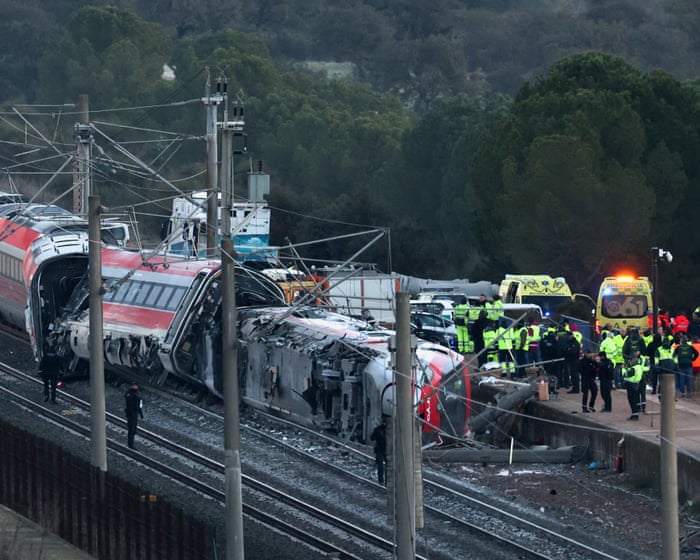
Spain will observe three days of mourning starting Tuesday as rescue teams continue to search through the wreckage of twisted train cars and scattered debris for victims following a collision that killed at least 40 people and injured dozens.
By Monday, more than 18 hours after a high-speed train carrying about 300 passengers to Madrid derailed and hit an oncoming train, people across the country were still desperately trying to reach missing loved ones caught in Spain’s worst rail disaster in over a decade.
Many family members of those on board were awaiting news about their relatives. Juan Barroso said five members of his extended family had been among the nearly 200 people traveling by train from Madrid to the southern city of Huelva. After the collision near Adamuz in Córdoba province, only one of them, a six-year-old child, had been located.
“Now we’re searching for the four who are missing,” Barroso told reporters. “We’ve been all over. All of the hospitals in Jaén, Úbeda and in Córdoba.”
Others turned to social media, posting photos of their loved ones and pleading for information. One message read: “If anyone in Adamuz recognises this man, he’s my father, please contact me.”
Police said they had set up several offices where people could file reports and provide DNA samples to help with identification.
During a visit to the site, Prime Minister Pedro Sánchez promised a full and transparent investigation into the cause of the crash.
“Spanish society, like all of us, is wondering what happened, how it happened, how this tragedy could have occurred,” he said on Monday as he announced three days of mourning starting at midnight. “And I’m convinced that time and the work of experts will provide us with those answers.”
The collision happened just before 8 p.m. on Sunday when the rear part of the Madrid-bound train derailed into the path of an oncoming train.
The impact knocked the first two carriages of the southbound train off the track, sending it down a 4-meter (13-foot) slope, said Spain’s transport minister, Óscar Puente.
While the cause remains under investigation, Puente called it “really strange” that a derailment occurred on a straight section of track. He added that this particular section had been renovated in May.
The derailed train was less than four years old and had been inspected four days earlier, according to Iryo, the private company that operated it.
The president of the state rail company, Renfe, Álvaro Fernández Heredia, said it was too early to determine the cause but noted the accident happened under “strange conditions,” telling broadcaster Cadena Ser that “human error is practically ruled out.”
A source told Reuters that technicians had identified a broken joint on the rails, which created a gap between sections that widened as trains passed over it. The faulty joint could be key in determining the exact cause, the source added.
Neither Adif, the state-owned rail infrastructure administrator, nor the Spanish commission investigating rail accidents responded to requests for comment.
Since 2022, Adif has publicly reported 10 infrastructure issues in the area where the collision took place, ranging from signaling failures to problems with overhead power lines. In August, the train drivers’ union warned in a letter that increased rail traffic had caused severe wear and tear on the tracks, leading to frequent breakdowns and train damage.
On Monday, the train drivers’ union called for a thorough investigation.Officials urged caution in connecting their earlier warning to the crash, emphasizing that the cause of the collision was still unknown.
As news of the crash spread on Sunday evening, emergency crews raced to the remote location. Working through the night in darkness and constrained by the single-track road leading to the site, they pulled survivors from the wreckage. Some passengers escaped on their own, using emergency hammers to break windows and climb from overturned carriages and twisted steel.
The mayor of Adamuz, Rafael Moreno, who was among the first on the scene, described it as “horrific” and “a tremendously tough, sad night.” The small Andalusian town, located a few kilometers from the crash site, was in shock on Monday. Its municipal hall had been quickly converted into an emergency response center, providing first aid, food, and warmth to victims before they were transported elsewhere.
Officials warned that the death toll was expected to rise. Juanma Moreno, head of the Andalucían government, stated that some carriages were severely damaged, describing the scene as a “twisted wreck” that required heavy machinery for the rescue effort. He noted the search area had been expanded, saying, “The impact was so incredibly violent that we have found bodies hundreds of metres away, which means that people were thrown through the windows.”
The accident deeply affected Spain, where the advanced rail network is a point of national pride. According to Adif, Spain’s high-speed network is the largest in Europe and the second largest in the world after China, with nearly 4,000km of track. Renfe reported that more than 25 million passengers had traveled on its high-speed trains in 2024.
Frequently Asked Questions
Of course Here is a list of FAQs about Spains three days of mourning following the tragic train crash
General Factual Questions
1 What happened
A passenger train derailed in a serious accident resulting in the tragic loss of at least 40 lives with many more injured
2 Why is Spain observing three days of mourning
The threeday national mourning is a formal symbolic act decreed by the government to express collective grief solidarity with the victims and their families and national respect for the lives lost in the tragedy
3 What does national mourning mean in practical terms
During this period all national and public buildings will fly the Spanish flag at halfmast Official ceremonies and events of a festive nature are typically postponed or toned down
4 When do the three days of mourning start and end
The decree specifies the exact dates Typically it begins the day after the decree is signed and lasts for three consecutive calendar days
Impact on Daily Life Public Events
5 Will businesses and schools be closed during the mourning period
Generally no National mourning does not automatically mean a public holiday Normal work school and commerce continue though some scheduled public events may be altered
6 I have a trip planned to Spain during this time Should I cancel
There is no need to cancel your trip Daily life for visitors will continue largely as normal However be respectful of the somber national mood Some scheduled cultural or festive public events might be canceled or scaled back
7 Will there be a minute of silence
Yes it is very common for the government to call for an official minute of silence often at noon on the first day of mourning This is observed in public squares government institutions and sometimes encouraged in workplaces
8 Are sporting events and concerts canceled
Major events especially those with national significance or held in public venues are often postponed or begin with a minute of silence League football matches for example would likely observe a period of silence and players would wear black armbands
Deeper Procedural Questions
9 Who declares national mourning and whats the process
The Spanish government specifically the Council of Ministers