Donald Trump has stated that a U.S. “armada” is heading toward the Middle East and that the U.S. is closely monitoring Iran, as activists report the death toll from Tehran’s violent crackdown on protesters has reached 5,002.
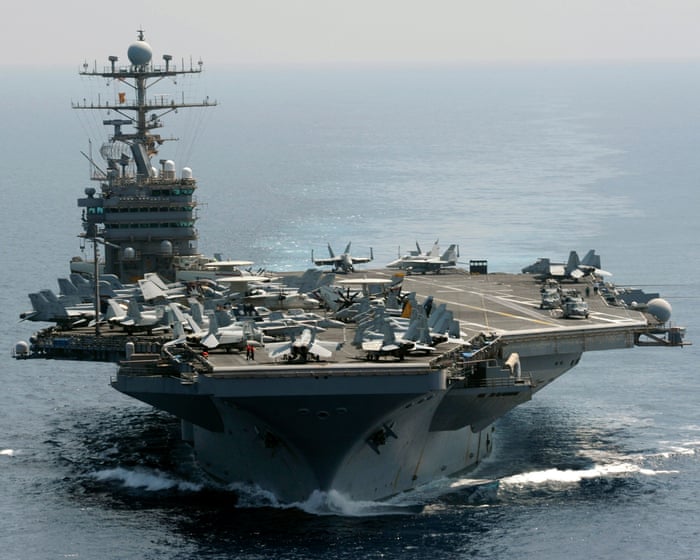
Speaking on Air Force One after returning from the World Economic Forum in Davos, he said: “We have a lot of ships going that direction, just in case. I’d rather not see anything happen, but we’re watching them very closely … we have an armada … heading in that direction, and maybe we won’t have to use it.”
The aircraft carrier USS Abraham Lincoln and several guided-missile destroyers are expected to arrive in the Middle East in the coming days. Additional air defense systems are being deployed, likely around U.S. and Israeli airbases. At Doha’s request, the UK said it would send RAF Eurofighter Typhoon jets from 12 Squadron to Qatar.
Two weeks ago, the U.S. president refrained from attacking Iran, despite promising “help is on its way,” largely because he felt no military option presented to him would decisively secure regime change in Tehran. Gulf states also urged restraint.
In an update on Friday, the U.S.-based Human Rights Activists News Agency (HRANA) reported the death toll from the Iranian crackdown had reached 5,002, including 4,716 demonstrators, 203 government-affiliated individuals, 43 children, and 40 civilians not involved in the protests.
The agency’s figures have been accurate in past unrest in Iran, relying on a network of activists to verify deaths. HRANA also stated at least 26,541 people have been arrested.
The UN Human Rights Council is meeting in Geneva to discuss the crackdown. Protests began on December 28 when traders took to the streets in Tehran after a sudden drop in the rial’s value. The demonstrations spread, with demands expanding to include calls for an end to the government, marking the most serious and deadliest unrest since the 1979 revolution.
Ali Abdollahi Aliabadi, head of Iran’s Khatam-al Anbiya Central Headquarters, which coordinates the army and the Revolutionary Guards, warned the U.S. on Thursday that any military strike on Iran would make all U.S. bases in the region “legitimate targets.”
The protest movement has largely dwindled amid the crackdown and an unprecedented internet blackout, though chants of “death to the dictator” continue at somber, often well-attended funerals.
Videos still emerging from Iran show security forces were given license to shoot to kill protesters, especially from January 5-8.
One of the main reformist newspapers, Ham-Mihan, has been shut down for publishing two stories: one on the pursuit of protesters in a hospital and another detailing the severity and brutality of the suppression.
Many leading reformists have been unable to express their views on the crackdown. Those allowed to address wider audiences seem to blame both sides for a collapse in social solidarity triggered by the currency crash. The extent to which sanctions or internal inefficiency caused these problems is debated.
In his most extensive remarks on the violence to date, Iranian President Masoud Pezeshkian, a reformist elected 18 months ago, claimed “the civil and just protest of the people was turned into a bloody and violent battle due to a conspiracy by those who wish Iran ill will.”
U.S. Treasury Secretary Scott Bessant, while in Davos, took credit for the protests, saying U.S. sanctions…The unrest was caused by economic sanctions, which he claimed “worked because in December, their economy collapsed.” He noted, “We saw a major bank fail. The central bank has started printing money. There is a dollar shortage. They cannot get imports, and this is why the people took to the streets. This is economic statecraft—no shots fired—and things are moving in a very positive way here.”
Trump has repeatedly kept the possibility of new military action against Iran on the table, following Washington’s support and involvement in Israel’s 12-day war in June, which aimed to weaken Iranian nuclear and ballistic missile programs. However, the likelihood of immediate American action appears to have diminished recently, as both sides emphasize giving diplomacy a chance.
Frequently Asked Questions
Of course Here is a list of FAQs about the reported US naval fleet movement and the situation in Iran designed to be clear and helpful
BeginnerLevel Questions
1 What is this news about
This refers to recent reports that former President Donald Trump claimed a US naval fleet is heading to the Middle East while separately international reports indicate the death toll from protests in Iran has surpassed 5000
2 Is a US naval fleet actually moving to the Middle East right now
As of the latest official information from the US Department of Defense there is no confirmation of a new largescale naval deployment specifically prompted by Trumps statement The US Navy maintains a constant presence in the region
3 What is the death toll surpassing 5000 in Iran referring to
This figure is reported by human rights groups and refers to the estimated number of people killed including protesters and security forces during the widespread protests that began in Iran in September 2022 following the death of Mahsa Amini
4 Are these two events directly connected
Not directly They are separate issues occurring in the same region The protest death toll is an internal Iranian matter The naval fleet claim relates to regional military posture and tensions often influenced by USIran relations
5 Why would the US send more ships to the Middle East
Historically the US increases its naval presence to deter regional adversaries protect shipping lanes reassure allies or respond to specific threats
Advanced Practical Questions
6 What is the typical composition of a US naval fleet sent to the region
It often centers on a Carrier Strike Group which includes an aircraft carrier guidedmissile cruisers and destroyers and a supply ship This represents a significant show of force
7 What is the strategic impact of such a deployment announcement
It can escalate or deescalate tensions It signals resolve to allies and adversaries potentially deterring conflict However it can also be seen as provocative and lead to miscalculation
8 How reliable are claims about military movements from political figures not in office
They should be treated with caution and verified through official channels Such claims