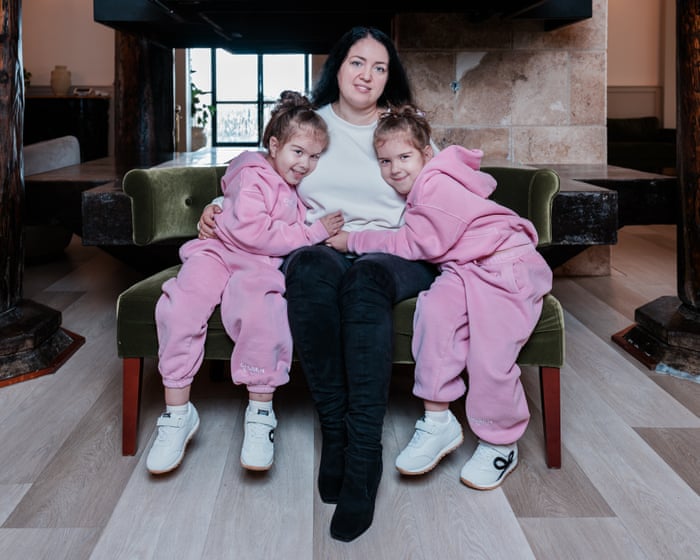
I was already a mother of three when I went for my 10-week ultrasound in 2019. At first, the familiar routine—the gel on my stomach, the flickering black-and-white screen—felt soothing. Then I saw the sonographer’s face change.
She put down the probe and ran out of the room without a word. I tried to stay calm, but when she rushed back in with a doctor who looked at the screen and said, “Oh my goodness,” I was terrified.
I now live in California, but I was born in Ukraine; English is my second language. I heard the words, “It looks like you have conjoined twins,” but I didn’t fully understand what that meant. It wasn’t until I got back to my car and looked it up that the reality sank in.
I called my husband, Anatoliy, sobbing. He promised to come home right away. As I drove, I was a mess—swinging between thinking I’d need to end the pregnancy and denying any of this was happening. I felt like I was losing my mind. Then, stopped at a red light, a sudden calm washed over me. It felt like a sign from God.
Anatoliy rushed through the front door, worried but steady. “These are our children, and we already love them,” he said as we hugged. I told him calmly that I had decided to take each day as it comes.
A few days later, at a specialist clinic, doctors explained our girls were craniopagus twins—conjoined at the head. It’s incredibly rare, happening in only about one in 2.5 million live births. As we listened, I held Anatoliy’s hand tightly. They told us the babies’ chance of surviving to delivery was slim, but I thought of the little ones I’d seen on the screen and refused to give up hope.
Despite constant medical appointments, I tried to live normally. My friends were surprised to see me out for meals or celebrating at baby showers, but that routine helped keep the fear away.
Four months later, we got hopeful news: an MRI showed there was a good chance the girls could be separated one day. We felt relief but stayed cautious, knowing many hurdles remained.
More than 200 medical staff prepared for my delivery. One twin would be cared for by “team orange,” the other by “team purple”—each with neurologists, heart specialists, and plastic surgeons.
My waters broke early. Being rushed to the hospital was stressful. All I remember is asking people to pray for me, and then the girls being taken quickly to intensive care while I lay in a medicated haze.
When I finally saw my daughters the next day, all I could think was: they’re perfect. We named them Abigail and Micaela. Holding them, I was overwhelmed with love.
Everything—from changing diapers to breastfeeding—took creativity and instinct. A regular bath wouldn’t work, so we used a clear plastic box. But to me, they were just my girls. They had their own personalities: Abigail was alert, Micaela calm. Every milestone—the first smile, the first babble—felt precious.
Finally, in October 2020, when they were 10 months old, they were ready for separation. The surgery lasted 24 hours and involved 30 medical staff. Because of COVID-19, we couldn’t wait at the hospital. We got updates by text at every stage. When we learned the operation had succeeded, I was so relieved I could hardly breathe.
I cried with happiness as I ran into the hospital and saw them separated for the first time. They could turn and look each other in the eye—a moment most mothers of twins might take for granted, but to me, it felt like a miracle.
That sense of wonder hasn’t faded. Now I watch six-year-old Abigail dart around and Micaela carefully follow behind.I listen to their private twin conversations, see how much their brothers adore them, and marvel at their very existence. It was incredible when, at age five, they could look at their own baby pictures and tell which girl was Micaela and which was Abigail.
This journey has revealed a strength I never knew I possessed, and the power of living in the present. Today, they are here—and that is enough for me. As told to Kate Graham.
Do you have an experience to share? Email experience@theguardian.com.
Frequently Asked Questions
Of course Here is a list of FAQs about conjoined twins specifically those joined at the head written in a natural compassionate tone
Understanding the Basics
What does it mean that my daughters were born conjoined at the head
This means your daughters were physically connected at their skulls at birth This is a very rare condition called craniopagus twinning
How rare is this
It is extremely rare Conjoined twins occur in about 1 in 50000 to 200000 births and only about 5 of those are joined at the head
What causes conjoined twins
The leading theory is that a single fertilized egg starts to split into identical twins very early in pregnancy but the separation process is not completed The exact reason this happens is not fully understood
Could this have been prevented
No It is not caused by anything the parents did or did not do It is a random occurrence in early embryonic development
Medical and Daily Life
What are the biggest medical challenges for craniopagus twins
The main challenges depend on how deeply they are connected They may share critical structures like parts of the skull blood vessels in the brain and sometimes brain tissue itself This can affect neurological function and make separation surgery incredibly complex
Can they be separated
Separation is a possibility for some but not all craniopagus twins It is one of the most difficult surgeries in the world The decision depends on extensive imaging to map exactly what is shared the potential for each twin to have an independent life and the immense risks involved
What is daily life like for conjoined twins
It varies greatly They learn to coordinate their movements from infancy They may face challenges with mobility positioning for sleep and social interactions They also develop an incredibly deep unique bond and often learn to collaborate in amazing ways
Do they share thoughts or feelings
While they share an unparalleled physical and emotional connection they are two distinct individuals with their own personalities thoughts and preferences There is no scientific evidence that they literally share thoughts
Looking Forward Practical Concerns
What is the longterm outlook
The outlook depends entirely on the specifics of their connection and overall health With modern medical care many conjoined