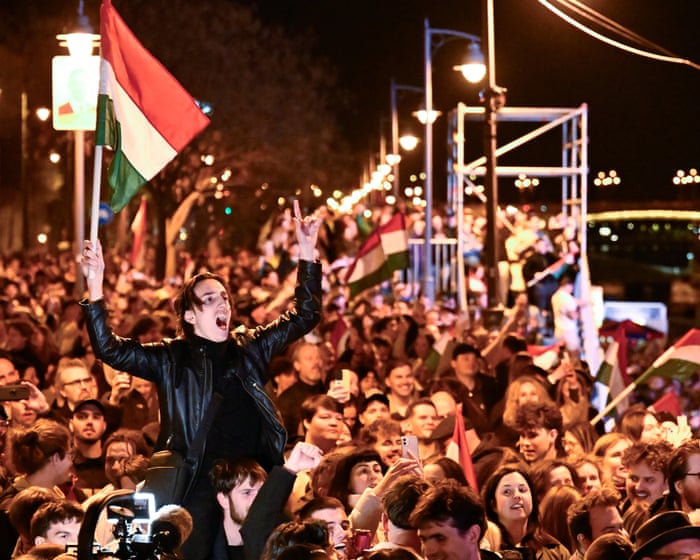
The tide turned against the forces of darkness on Sunday. The combined might of Vladimir Putin’s Russia and Donald Trump’s America was defeated in Hungary, as European liberal democratic values prevailed.
The populist, nativist right gave their all to keep Viktor Orbán in power. U.S. Vice President JD Vance, amid a war in Iran, took time to parade his support in Budapest, a month after the hard-right U.S. Conservative Political Action Conference met there. In January, Benjamin Netanyahu appeared in a video endorsing Orbán, with volleys of support from Italy’s Giorgia Meloni and France’s Marine Le Pen. Herbert Kickl of Austria’s Freedom Party declared that “a patriotic wind is blowing across Europe.” Perhaps, but not in their direction. Patriotism does not belong to them.
Orbán’s defeat at the hands of the conservative Péter Magyar’s Tisza party weakens them all. Orbán lost despite years of gerrymandering by the party-state, constitutional changes, corruption, and the subversion of the media, judiciary, and other public offices. Hungarians finally broke free, sending a chill through Europe’s authoritarian right.
Orbán’s Hungary played a key role for the global right. As the investigative climate activists at DeSmog noted, he “has used a network of state-backed think tanks, media outlets, and conferences to promote his brand of ‘illiberal democracy’ across Europe, including in the UK.”
The rise of the European hard right has been perilous: it won roughly a quarter of European Parliament seats in 2024, held power in Italy, and joined or supported ruling coalitions in Finland, Sweden, Austria, Slovakia, and (until recently) the Netherlands. Europe’s post-World War II self-image as a global bastion of liberal democracy is under threat. Magyar is no social liberal, but he returns Hungary to the EU mainstream.
The result in Hungary aligns with the tide turning against Trump and his major blunder: igniting not just war in Iran, but a global inflationary spike. Cycles of power and influence move slowly, but a U.S. president stumbling toward midterm elections with gasoline prices up 21% will no longer be a beacon for hard-rightists, but a connection to avoid.
In 2018, Nigel Farage, an Orbán supporter, posted, “Viktor Orbán is the strongest leader in Europe and the EU’s biggest nightmare.” The Reform UK leader may now feel the effects of any decline in support for hard-right politics. After all, his party rose on that wave but is already starting to slide, according to pollster Peter Kellner. Failing to win Gorton and Denton was a significant blow, demolishing his star candidate, Matt Goodwin. His cringe-worthy support for the U.S. president is an embarrassment, when just 16% of UK voters favor Trump. Watch his screeching tires: on Friday, he would only admit “I happen to know [Trump] but that’s by the by.”
What Farage never mentions is that Brexit made him—and he made Brexit. That’s because 58% of the country now says leaving the EU was the wrong decision, according to Statista. Nor should he be allowed to forget his line, echoing Putin, that the West “provoked” Russia’s invasion of Ukraine. Or that in 2014, Putin was the leader he most admired, albeit “as an operator, but not as a human being.”
For now, leading in the opinion polls at 25%, Reform is set for a stunning win in next month’s local elections. But that doesn’t mean Farage will look like a prime minister in three years’ time. Signs of change include this from Kellner: Reform has overtaken Labour as the party people would most vote against, which will be crucial when tactical voting comes into play.
It’s doubtful most Reform voters waited breathlessly for Hungarian election results, but there is often a mysterious osmosis in political opinion, a vibration through which people, even if not news-obsessed, sense the shift.A shift is in the air. Professor Rob Ford, a political scientist at Manchester University, considers this potential “turning tide,” noting he has seen many such mirages fade before. We will have to wait and see if Orbán’s defeat sends shockwaves through his conservative admirers. “Will those commentators in the Telegraph and Spectator change their minds about thinking Reform may be the answer?” Ford asks.
The British right flew too close to Orbán. Just this year, the Good Law Project reported that the Mathias Corvinus Collegium thinktank, funded by the Hungarian state, gave over £500,000 to the UK’s Roger Scruton Legacy Foundation. The latter’s directors include not only Reform’s head of policy, James Orr, but also the Spectator editor and former Tory minister, Michael Gove. What happened to the cordon sanitaire that once protected conservatism from the hard right?
There’s a warning here for Labour, too. Ford advises them to draw no comfort from the Hungarian result. Facing what may be “their worst hammering in history,” Labour’s greatest risk is their current “daze of complacency.”
Exactly 70 years after the failed Hungarian uprising, the country’s resounding rejection of Fidesz may spark renewed enthusiasm for European unity and liberal democracy. This is a vote to send hard-right populism back to the fringes where it belongs. A raft of European elections next year will tell us if this was just a Hungarian story—or if it resonates across the continent. But good news is pitifully scarce, so we should make the most of it now.
Polly Toynbee is a Guardian columnist.
Guardian Newsroom: Can Labour come back from the brink? On Thursday 30 April, join Gaby Hinsliff, Zoe Williams, Polly Toynbee and Rafael Behr as they discuss the threat Labour faces from the Green party and Reform UK—and whether Keir Starmer can survive as leader. Book tickets here.
Frequently Asked Questions
FAQs Viktor Orbáns Influence Potential Defeat
BeginnerLevel Questions
1 Who is Viktor Orbán and why is he so influential
Viktor Orbán is the Prime Minister of Hungary serving since 2010 He is influential because he has built a political model often called illiberal democracy which emphasizes national sovereignty conservative social values and strong state control challenging mainstream EU policies on migration LGBTQ rights and federalism
2 What does it mean that hes an inspiration for rightwing figures in Europe
It means that other nationalist populist and conservative politicians in the EU and UK look to his success They admire his ability to win repeated elections reshape institutions to consolidate power and defiantly oppose EU directives while remaining within the bloc
3 What would his potential defeat refer to
It refers to him or his party Fidesz losing a future national election in Hungary Given his long dominance such a loss would be a major political earthquake suggesting his model has limits or that Hungarian voters seek a change
4 How could his defeat signal a shift in the political landscape
A defeat could demoralize and fragment the European rightwing movements that emulate him It might be interpreted as a rejection of his confrontational style with the EU and a potential resurgence of support for more mainstream proEuropean Union politics within member states
Advanced Questions
5 What specific policies of Orbáns do other rightwing figures admire most
Key admired policies include
Hardline immigration stance Building fences rejecting EU migrant quotas
Family protection policies Incentivizing childbirth and promoting traditional family structures
Control over media and judiciary Consolidating influence over public discourse and state institutions
Economic nationalism Using state power to favor domestic businesses
6 Hasnt the EU tried to counter Orbáns influence What tools does it have
Yes The EU has used legal infringement procedures withheld billions in recovery funds over ruleoflaw concerns and activated a mechanism that can suspend funding to member states violating democratic standards However Orbán has often used these conflicts to bolster his image as a defender of Hungary against EU overreach
7 What are the main vulnerabilities or challenges to Orbáns political model
Ch