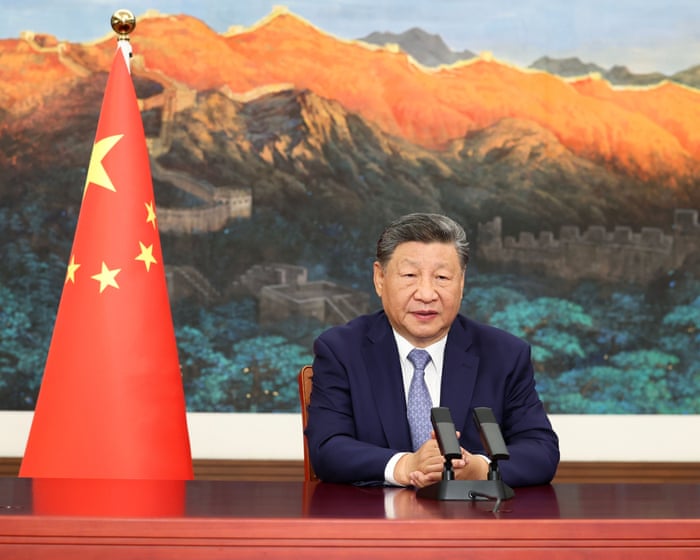
On Wednesday, China unveiled its plans for future greenhouse gas emission cuts, drawing sharp criticism from experts who called the targets too weak to prevent global disaster. As the world’s second-largest economy and by far the biggest emitter of carbon dioxide, China’s decisions on how quickly and deeply it transitions to a low-carbon model will play a crucial role in determining whether global temperatures remain within safe limits.
China aims to reduce emissions by 7% to 10% from their peak by 2035—far below the 30% cut that experts believe is both achievable and necessary. President Xi Jinping announced the plan during a United Nations General Assembly summit on the climate crisis in New York.
U.S. President Donald Trump, who dismissed the climate crisis as a “con job” in a rambling speech the day before, was not present at the summit. Xi made a veiled reference to the U.S., stating that “some countries” were failing to meet their climate responsibilities. He urged the international community to stay focused and ensure that developing countries’ rights are respected.
However, experts argued that China is not demonstrating leadership with its climate commitments. Kaysie Brown of the E3G think tank noted that the 2035 target falls critically short of what is needed and is inconsistent with China’s decarbonization efforts and its own 2060 carbon neutrality goal. She warned that without more ambitious near-term action, China risks undermining its credibility on multilateralism and clean energy leadership.
Some observers pointed out, though, that China has a history of setting modest targets and then exceeding them. One climate diplomacy insider remarked, “Underpromising and overdelivering is what we expect from China.”
Bernice Lee of Chatham House suggested that the global business community and other governments will focus more on China’s overall direction than the specifics of its plans. She highlighted that China invested $625 billion in clean energy last year—31% of the global total—and its clean energy boom is already transforming the global economy and reducing coal use domestically.
China’s national climate plan, part of its Paris Agreement commitment, also includes goals to increase non-fossil fuels to over 30% of energy consumption and expand wind and solar capacity to 3,600 gigawatts—more than six times the 2020 level. Clean energy already accounts for over 10% of China’s GDP and about a quarter of its economic growth. The country has driven down global renewable costs by around 90% in the past decade through exports like solar panels and has revolutionized electric vehicle and battery technology.
Despite these advances, China remains heavily reliant on coal, which has strong political backing. New coal plants are still being developed, even after a 2021 pledge to “phase down” coal use.
Paul Bledsoe, a former climate adviser to the Clinton administration, commented that China’s new commitment is a positive sign that their climate efforts are progressing.The clean energy transition is starting to reduce emissions in China, but progress is not happening fast enough. The country could achieve its climate goals much sooner—by the end of this decade.
A key step would be for China to commit to closing many of its outdated coalmines. These mines are not only the world’s single largest source of CO₂ emissions, but also account for 20% of global methane emissions from fossil fuels.
China’s commitments will play a major role in shaping the upcoming Cop30 UN climate summit in Brazil this November. There, all countries are expected to present their updated national climate plans, known as NDCs, in line with the Paris Agreement.
The UN’s climate chief has already acknowledged to the Guardian that the pledges expected in Belém will fall short of the emissions cuts needed to limit global warming to 1.5°C above pre-industrial levels—the central goal of the Paris Agreement.
The challenge for the UN, Brazil, and other nations hoping to avoid the worst impacts of the climate crisis will be to demonstrate how these insufficient national targets can be strengthened, and to outline a global strategy that puts the Paris Agreement back on track.
Frequently Asked Questions
Frequently Asked Questions
Topic Experts warn that Chinas emission reduction targets are insufficient to prevent a global disaster
BeginnerLevel Questions
1 What are emission reduction targets
Emission reduction targets are specific goals set by countries or organizations to lower the amount of greenhouse gases they release into the atmosphere
2 Why are Chinas emission targets in the news
Experts are concerned that Chinas current goals arent strong enough to help avoid severe global climate impacts such as extreme weather or rising sea levels
3 What is a global disaster in this context
It refers to largescale irreversible harm caused by climate changelike food shortages ecosystem collapse or more frequent natural disastersthat could affect people worldwide
4 Why does Chinas emissions matter so much
China is the worlds largest emitter of greenhouse gases so its policies have a major impact on global climate efforts
5 What can ordinary people do about this
You can reduce your own carbon footprint and advocate for stronger climate policies locally and globally
AdvancedLevel Questions
6 How do experts measure if a countrys targets are sufficient
Targets are compared against scientific models like those from the IPCC which show how much emissions must drop to limit global warming to 15C or 2C
7 What specific shortfalls do experts point to in Chinas plans
Critics note that Chinas targets allow emissions to peak by 2030 and rely heavily on coal in the short term despite investments in renewables
8 Are other major countries also falling short
Yes many nationsincluding the US India and Russiaare not on track to meet global climate goals but Chinas scale of emissions makes its shortfall particularly significant
9 What would it take for China to set stronger targets
This would require political will economic shifts away from coal international pressure and advances in green technologyall while balancing growth and energy security
10 How does this affect international climate agreements like the Paris Agreement
If large emitters like China dont strengthen their commitments