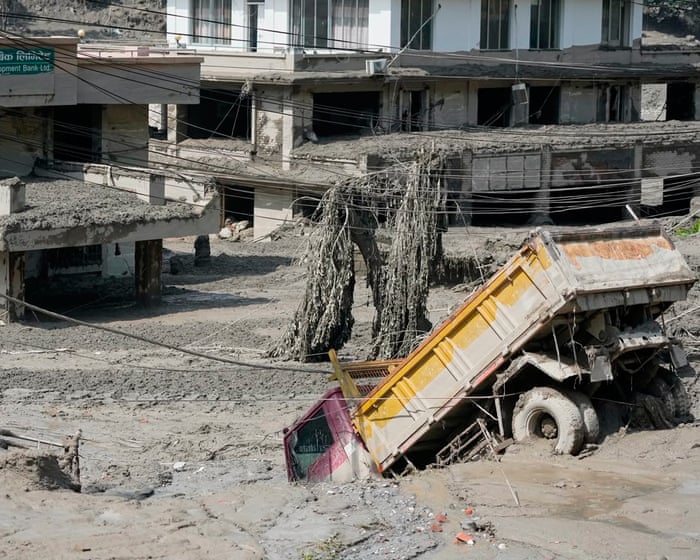
Mindestens 95 Menschen sind gestorben und Hunderte werden noch vermisst, nachdem Sturzfluten die Himalaya-Grenzgebiete von Nepal und Tibet in China getroffen haben. Beamte haben gewarnt, dass Teile Indiens ebenfalls gefährdet sein könnten.
Die Katastrophe wurde durch einen plötzlichen Strom aus Schlamm, Wasser und Geröll verursacht, der aus einem Fluss zwischen China und Nepal überlief. In Nepal wurden Häuser, Straßen, Brücken und Kraftwerke zerstört, während Beamte in Tibet befürchteten, es gebe "schwere Opferzahlen".
Die Behörden gaben Warnungen heraus, die Anwohner in mehreren Bezirken aufforderten, sich von den Flüssen Bhote Koshi, Trishuli und Narayani in Nepal fernzuhalten. Beamte berichteten, dass 384 Touristen, darunter 291 aus Ländern wie Indien, den USA, Großbritannien und Malaysia, vermisst wurden. Nepal erklärte außerdem, dass 44 Armeeangehörige und 30 Polizisten nicht aufgefunden worden seien.
Bild in voller Größe anzeigen
Die Folgen der Sturzflut im Bezirk Nuwakot in Nepal. Foto: Xinhua/Shutterstock
Beamte des Tourismusverbands von Nepal sagten, die meisten Vermissten seien wahrscheinlich indische Touristen und Mitglieder der indischen Diaspora auf einer Pilgerreise zum Berg Kailash in Tibet, einer heiligen Stätte für Hindus.
Es wird angenommen, dass die Sturzfluten durch einen Eis-Fels-Lawinenabgang von einem Gletscher ausgelöst wurden, der einen plötzlichen Wasserschwall flussabwärts im Fluss Lhende Khola, einem Nebenfluss des Bhote Koshi, verursachte. Beamte warnten, dass die Überschwemmungen schlimmer werden könnten, da der Fluss flussaufwärts noch blockiert war.
Hochwasserwarnungen wurden auch in den indischen Bundesstaaten Bihar und Uttar Pradesh herausgegeben, die an Nepal grenzen und flussabwärts der betroffenen Flüsse liegen.
Die Polizei in Nepal sagte, sie sei noch nicht in der Lage, das volle Ausmaß der Schäden zu erfassen. Rettungskräfte sagten, Hubschrauber könnten in den betroffenen Gebieten von Syapru Besi und Timure im bergigen Bezirk Rasuwa erst landen, wenn das Flusswasser zurückgegangen sei.
Videoaufnahmen zeigen das Ausmaß der Überschwemmungen in Nepal
Bilder von eingestürzten Häusern in den Flutwasser, treibenden Autos, einer weggespülten Metallbrücke und Dörfern, die von Wasser, Schlamm und Geröll bedeckt waren, wurden im nepalesischen Fernsehen gezeigt.
"Es könnte schwere Opferzahlen oder Sachschäden geben", sagte der Bezirksverwalter Narendra Pariyar, der die Menschen entlang des Bhote Koshi aufforderte, sich in höher gelegene Gebiete zu begeben.
"Es gibt Verwüstung, wohin wir auch schauen", sagte Tula Bahadur BK, ein Gesundheitsarbeiter in Rasuwa, gegenüber Reuters. "Die Siedlungen neben dem Fluss sind vollständig weggespült worden. Fünf meiner eigenen Verwandten werden vermisst."
Die chinesische Nachrichtenagentur Xinhua meldete, dass die Sturzflut auf der nepalesischen Seite der Grenze auftrat und Straßen, Kommunikations- und Stromverbindungen in der Region Shigatse unterbrach.
Bild in voller Größe anzeigen
Rettungskräfte nutzen einen Bagger, um einen Überlebenden der Sturzflut im Bezirk Nuwakot in Nepal in Sicherheit zu bringen. Foto: Prakash Mathema/AFP/Getty Images
Chinas Präsident Xi Jinping rief zu "umfassenden" Suchbemühungen nach den Vermissten und besseren Überwachungs- und Frühwarnsystemen auf, um Folgekatastrophen zu verhindern.
Das Energieministerium Nepals sagte, die Stromversorgung sei erheblich beeinträchtigt worden, hauptsächlich aufgrund zerstörter Wasserkraftwerke.
Polizei und Militärangehörige schlossen sich den Rettungsbemühungen Nepals an, so der Premierminister des Landes, Balendra Shah. "Es wurden Anweisungen gegeben, Menschen, die in tiefer gelegenen Gebieten leben, an sicherere Orte zu bringen. Menschen entlang des Flusses wird geraten, besondere Vorsicht walten zu lassen und wachsam zu bleiben."
Eine Sturzflut am Bhote Koshi im letzten Jahr tötete neun Menschen und spülte eine "Freundschaftsbrücke" weg, die Nepal und China verband, was Handel und Transport für Monate unterbrach. Diese Flut wurde durch das Abfließen eines supraglazialen Sees in Tibet ausgelöst, so ein regionales Klimaüberwachungszentrum.
Die Himalaya-Region, die Nepal, Indien, China und Bhutan umfasst, ist besonders anfällig für Überschwemmungen und Erdrutsche, da sie sich aufgrund der Klimakrise schneller erwärmt als der Rest der Welt. Die Forschung zeigt, dass extreme Wetterereignisse wie Hitzewellen und starke Regenfälle häufiger geworden sind.
Forscher in Kathmandu fanden außerdem früher in diesem Jahr heraus, dass Gletscher in der gesamten Hindukusch-Region mit zunehmender Geschwindigkeit schmelzen. Die Zahlen haben sich seit 2000 verdoppelt.
Häufig gestellte Fragen
Hier ist eine Liste von FAQs zu den verheerenden Sturzfluten entlang der Grenze zwischen Nepal und Tibet
Allgemeine Situationsfragen
F: Was genau ist an der Grenze zwischen Nepal und Tibet passiert
A: Starke Regenfälle lösten massive Sturzfluten und Gletscherseeausbrüche aus, die Ströme von Wasser, Schlamm und Geröll durch Bergtäler schickten. Dies fegte Häuser, Straßen und Brücken weg und verursachte weitverbreitete Zerstörung und erheblichen Verlust von Menschenleben.
F: Warum ist dieses Gebiet so anfällig für Sturzfluten
A: Der Himalaya ist ein junges, steiles Gebirge mit fragiler Geologie. In Kombination mit intensiven Monsunregen und dem schnellen Abschmelzen von Gletschern aufgrund des Klimawandels ist die Region äußerst anfällig für plötzliche und heftige Überschwemmungen.
F: Wie viele Menschen sind betroffen
A: Die offiziellen Zahlen ändern sich noch, aber Berichte deuten darauf hin, dass Dutzende als tot bestätigt wurden, während Hunderte weitere als vermisst gemeldet sind. Viele Dörfer sind vollständig abgeschnitten, sodass das volle Ausmaß der Katastrophe noch bewertet wird.
F: Steht diese Flut im Zusammenhang mit dem Klimawandel
A: Wissenschaftler sagen, dass, obwohl dieses spezifische Ereignis durch starken Regen ausgelöst wurde, der Klimawandel ein Hauptfaktor ist. Wärmere Temperaturen führen dazu, dass Gletscher zurückweichen und instabile Gletscherseen entstehen. Wenn diese Seen ausbrechen, setzen sie katastrophale Fluten frei, die häufiger und schwerer werden.
F: Welche Gebiete sind am stärksten betroffen
A: Die am härtesten getroffenen Gebiete sind abgelegene Bergdörfer und Städte entlang der Grenzflüsse, insbesondere in Nepals Karnali-Provinz und der Autonomen Region Tibet in China. Die Überschwemmungen haben wichtige Autobahnen und Trekkingrouten zerstört und diese Gemeinschaften isoliert.
Ursachen und wissenschaftliche Fragen
F: Was ist ein Gletscherseeausbruch
A: Ein GLOF passiert, wenn ein See, der durch schmelzendes Gletscherwasser entstanden ist, plötzlich freigesetzt wird. Dies kann auftreten, wenn ein natürlicher Damm aus Eis oder Gestein, der den See zurückhält, kollabiert, oft ausgelöst durch ein Erdbeben, einen Erdrutsch oder einen plötzlichen Wasserschub durch starken Regen. Das Ergebnis ist eine gewalttätige, zerstörerische Wasserwand.
F: Welche Rolle spielten Wolkenbrüche bei dieser Katastrophe
A: Ein Wolkenbruch ist ein extremer, plötzlicher Regenguss in kurzer Zeit über einem kleinen Gebiet. In bergigem Gelände fließt dieses Wasser schnell in enge Täler und verwandelt kleine Bäche innerhalb von Minuten in reißende Flüsse, was die Menschen unvorbereitet trifft.