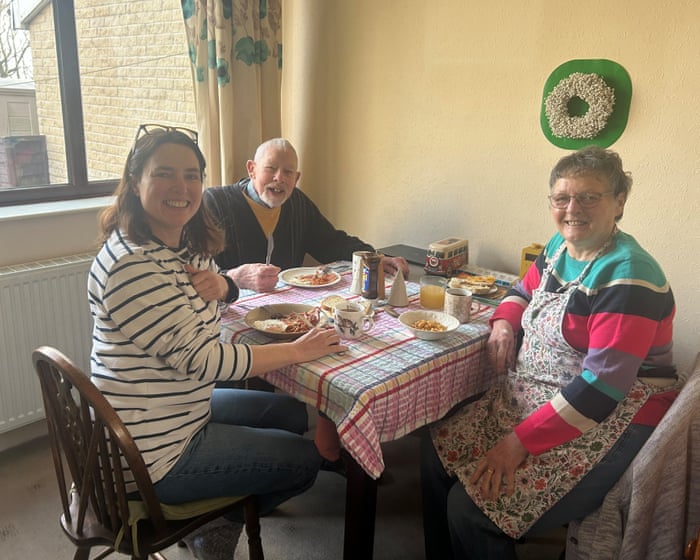
Weekend breakfasts have always been a big affair in our house. Typically, we start with cereal followed by a full English breakfast. What makes it special for me is the presentation—the colorful tablecloth, the assortment of bread and toast (so you can fold a slice of your choice into a mini bacon sandwich), the teapot, and the ginger biscuits you dunk into your tea for “afters.”
When I used to visit home in Yorkshire from London, where I lived for 20 years, I cherished these breakfast moments, sitting around the table with Mum and Dad and savoring the well-practiced ritual in the suburban three-bedroom semi-detached house where I grew up.
In January 2025, I sat down for my final breakfast at that table, marking a turning point in all our lives. After having twins and becoming a family of five, my partner and I decided to move our three young children back to Yorkshire in 2020 to be closer to Mum and Dad.
Around the same time, they sold their house, and we decided to build them a bungalow in our garden. We put 80% of their belongings into storage and moved Mum and Dad in with us until the build was complete.
Packing up Mum and Dad’s house—my childhood home—felt like a massive goodbye. That bedroom, those memories, the sense of safety and refuge I always felt there. I knew exactly where all the creaks were on the stairs and how many steps there were in total (13).
That evening, I relaxed in the blue glow of the gas fire, watching a Jane McDonald travelogue on Channel 5, temporarily free of my own responsibilities, lulled by nostalgia. We ordered “an Imran’s”—curry from the best takeaway in town—as a treat after a day of packing.
Even though I’m a grown woman in my 40s with my own family, it felt scary to take the leap and no longer have “home” to go back to.
On our final morning in the house, Mum diligently wrapped mixing bowls and jugs of every size, along with separate biscuit containers for each type of biscuit. We packed at least four kinds of vacuum cleaners (they’re big on cleaning) and crockery I’ve known since childhood: the odd pot with a face on it that holds scouring pads, the bright red bread bin.
We took a break from the overwhelming, endless task of packing to sit down for that last breakfast. Mum voiced what we were all thinking: it was strange to see the place so empty. I worried they might start to think they’d made a mistake.
“How do you feel?” I asked tentatively. There was a pause as Dad continued to pour the tea, and I held my breath.
“Well, it’s pretty awesome, isn’t it?” he replied.
I breathed a huge sigh of relief. I had expected sadness, maybe even doubt—but, ever the optimist, he was already looking to the future. His response shifted something in me, too.
Yes, it was a huge goodbye in so many ways, but it was also the start of something new: an adventure in multigenerational living—and building a house with zero experience. I realized this wasn’t about loss at all, but about movement and trust. Moving them into our home wasn’t a rescue mission; it was our next adventure.
For months, I’d been quietly spiraling about the future—as an older mum of three small kids with two aging parents, it’s hard not to worry about the practicalities. I had a creeping panic that time was speeding up and kept returning to the idea that if we were going to do something bold to future-proof our family setup, it had to be now—while they were still well enough to enjoy it, and while the kids were young enough to see it as normal rather than an intrusion. I didn’t want care to reach a crisis point; I wanted it to be a choice.
Hearing Dad’s cheerfulness—his complete absence of regret—I realized that what I’d been framing as “the end of an era” was actually the start of a new one. Sitting at the table, making my mini bacon sandwich, I realized I was ready for our next chapter.
I’ve leaI’ve learned that future-proofing isn’t just practical planning—it’s optimism disguised as logistics. Breakfast still happens; it’s just at a different table now. And we’re creating new rituals: I talked Dad into trying a breakfast burrito with me the other day. He watched me prepare the avocado (his nemesis), refried beans, and other unfamiliar ingredients, and I could almost hear a drumroll in my head as he took his first bite of the filled tortilla wrap. A pause. “Mmmmmm.” Then his face lit up, and in the style of Peter Kay, he proclaimed: “It’s the future.” Alison Taylor can be found at: alitaylormovesmumanddadin.substack.com
Frequently Asked Questions
FAQs Selling My Childhood Home Finding Relief
BeginnerLevel Questions
1 What is this story about
Its a personal story about the author feeling a deep sense of anxiety and panic tied to their childhood home and how selling it finally brought them a sense of peace and closure
2 Why would selling your childhood home be a relief Isnt that usually sad
While its often a sad event this story highlights a different experience For the author the home was associated with negative memories unresolved feelings or a pressure to hold onto the past Letting it go released that emotional burden
3 What does creeping panic mean in this context
It describes a slowbuilding persistent feeling of anxiety or dread that the author felt whenever they thought about the home or visited it It wasnt a sudden attack but a constant lowlevel stress
4 Whats the main takeaway from this experience
That letting go of a physical place even one filled with memories can sometimes be necessary for emotional health and personal growth Closure can come from release not just preservation
Advanced Practical Questions
5 How can a place cause panic or anxiety
A home isnt just a building its a container for memories and emotions If it holds memories of trauma conflict loss or even just a version of yourself youve outgrown returning to it can trigger a stress response making it feel like a trap rather than a sanctuary
6 What are signs that holding onto a family home might be harmful
Constant dread at the thought of maintenance or visits feeling stuck in the past financial strain from upkeep avoiding the place entirely or realizing youre preserving it for others expectations rather than your own wellbeing
7 How do you emotionally prepare to sell a home with deep personal history
Acknowledge the complexity Give yourself permission to feel both grief and relief
Create rituals Take photos save a small memento or write a letter to the house to say goodbye
Focus on the future Frame the sale as making space for new memories and a new chapter
Seek support Talk to family friends or a therapist who understands the weight of the decision