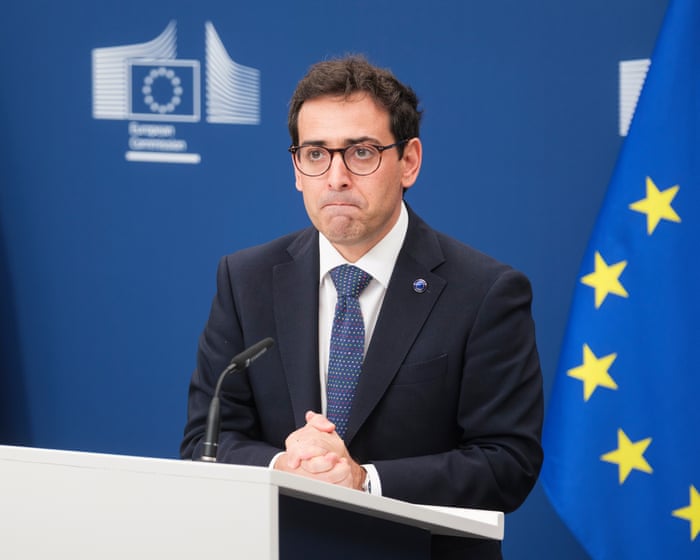
The EU is “pulling out all the stops” to fend off a potential trade crisis with China, industry commissioner Stéphane Séjourné has said, as the bloc announced its backing for a series of critical materials projects. Séjourné said on Friday that the EU would support 46 new strategic projects to speed up supplies of critical raw materials across the bloc by 2030. “We could face a crisis in the coming months,” he said. “We may face trade tensions that could also trigger a crisis in a number of sectors. We need to be prepared for that. And we’re getting ready right now.” The new projects include plants for supplies of lithium, gallium and rare earths needed for the auto, defence and renewable energy industries, with a funding cost of €21bn (£17.8bn). They were unveiled just as the EU works to avert a trade war with China, with trade commissioner Maroš Šefčovič continuing talks on Friday in Beijing aimed at reducing China’s “unsustainable” £1bn-a-day trade surplus with the bloc. EU unveils ‘buy European’ public procurement rules to counter China Read more “We’re pulling out all the stops to move as quickly as possible. The primary objective is the targets set by law, and beyond that, there’s a geopolitical challenge that could catch up with us very quickly,” said Séjourné. “Mines are opening, factories are being built, financing agreements are being signed, and a European value chain is emerging,” Séjourné added. Amid some scepticism over the EU’s ability to meet its 2030 targets to reduce dependencies on China, Séjourné cited three “emblematic” projects which have previously been identified as strategic, earmarking them for accelerated permits. These included a rare earths plant near Pau in south-western France. The Carester plant, which is expected to be up and running in late 2026, produces dysprosium and terbium, “two raw materials for which we are almost entirely dependent on China”, used in magnets for electric vehicles and offshore wind turbines. “This single project could account for about 15% of global production of these oxides. That is no small feat,” Séjourné said. He also name-checked a gallium plant in Greece which is already up and running. The third, Keliber, a lithium extraction and processing plant in Finland, is also operational after €150m support from the European Investment Bank. The 46 projects are the second batch of initiatives to receive flagship status since the Critical Raw Materials Act of 2024, which legally mandates the European Commission to reduce the bloc’s dependency on foreign countries. skip past newsletter promotion Sign up to This is Europe Free weekly newsletter The most pressing stories and debates for Europeans – from identity to economics to the environment Enter your email Sign up after newsletter promotion The EU hopes to follow in the footsteps of Japan, which has reduced dependency on China for rare earths to 60% from 90% since 2011, when Beijing prohibited exports of about 20 entities to Japan, claiming they were being used for military purposes. Although the flagship status does not bring the projects direct funds, it enables accelerated permitting, and help in mobilising funds. However, there has been criticism in industry within the EU that the scheme is not strong enough to deliver targets to mine 10%, process 40% and recycle 25% of the bloc’s needs by 2030. The French lithium refiner Viridian Lithium, which received EU strategic status in 2025, went into judicial liquidation in March this year. Earlier this year, a group of 23 of the 60 projects designated strategic in 2025 wrote to the European Commission calling for more action to “urgently unlock projects, particularly those working towards final investment decision which face acute liquidity and market pressure and immediate jeopardy”. Séjourné said member states had unlocked €1bn for six ofThe European Investment Bank is providing another €660 million for eight of the projects.
Frequently Asked Questions
FAQs The EUs Critical Minerals Push and Its Trade Tensions with China
Beginner Questions
1 What are critical minerals anyway
Theyre raw materialslike lithium cobalt and rare earthsthat are essential for things like EV batteries solar panels and electronics and that face supply risks The EU publishes an official list of them
2 Why does the EU care so much about minerals right now
Because it needs huge amounts of them for the green and digital transition and it currently depends heavily on importsespecially from China That makes supply vulnerable to political pressure
3 What does China have to do with all this
China dominates global processing and refining of many critical minerals It also controls most rare earth production That gives it leverage the EU worries could be used as a trade weapon
4 What is the EU actually doing about it
Its main tool is the Critical Raw Materials Act which sets targets to mine process and recycle more minerals within Europe and to diversify suppliers Its also signing deals with countries like Chile Canada and Kazakhstan
5 Is the EU in a trade war with China right now
Not officiallybut tensions are high The EU has imposed tariffs on Chinese electric vehicles and China has retaliated with probes into EU brandy pork and dairy Both sides say they want to avoid a fullblown trade war
6 What would a trade war with China mean for regular people
Higher prices on electronics cars and batteries plus possible shortages of key components It could also slow the EUs green energy plans
Advanced Questions
7 What are the CRMAs specific targets
By 2030 extract 10 of the EUs annual consumption domestically process 40 recycle 15 and ensure no single third country supplies more than 65 of any strategic raw material
8 Can the EU realistically hit those targets
Its a stretch Mining projects in Europe face long permitting times local opposition and environmental rules The 65 diversification target is the most achievable the mining and recycling targets are tougher
9 How is the EU trying to avoid a trade war while still pushing back
Its using a mix of tools tariffs on Chinese EVs antidumping investigations and diplomacy The goal