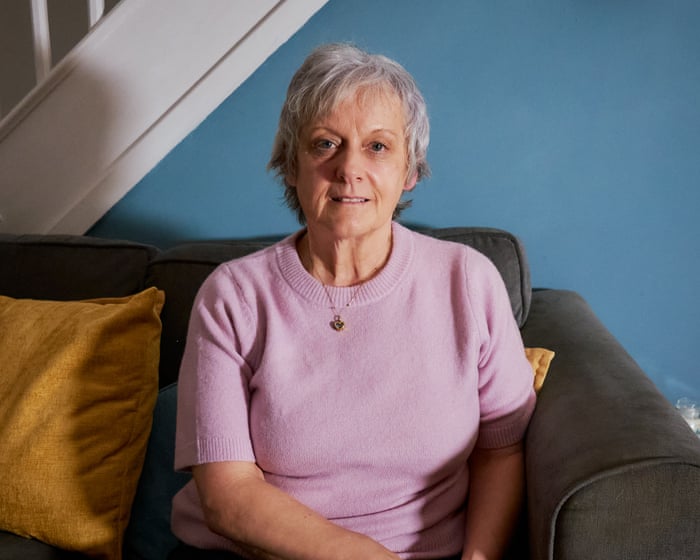
Every time she lifts her arms to get dressed or hang out the washing, Julie Ford feels a painful reminder of one of the most terrifying experiences of her life. At 7 a.m. one day in April 2021, she went into the hospital alone, wearing a mask, to have her right breast and lymph nodes removed in an effort to stop her breast cancer from spreading. Later that day, still groggy from anesthesia, in pain, and with surgical drains hanging from both sides of her chest, she staggered to the door with the help of two nurses. She was eased into a friend’s car and driven home to fend for herself.
While Julie’s breast had been removed, it was not reconstructed. Usually, both procedures are performed in the same operation. But because reconstruction using tissue from the patient’s abdomen is a complex, eight-hour procedure requiring a large surgical team, it was considered “non-essential” and paused by most NHS trusts during the Covid-19 pandemic.
Like hundreds of women with breast cancer who underwent urgent mastectomies without reconstruction in 2020 and 2021, Julie was assured she could have the procedure once Covid restrictions lifted.
But five years later, Julie, now 62, is still waiting.
A national shortage of specialist surgeons and operating room space, along with the need to prioritize new cancer cases, means many women like her, who had breasts removed during lockdown, feel they have been abandoned. They live with daily physical discomfort and mental distress as they continue to wait for the reconstructions they were promised years ago.
“I have to look at this hideous mess every day,” Julie says despairingly of her body after the mastectomy. “It’s really knocked my confidence. I don’t look right in clothes because everything hangs wrong. I’m so self-conscious—I don’t feel able to go out or socialize—and I haven’t been able to have a relationship.”
Julie is a child social care support worker from Sheffield. She was fitted with a temporary implant at the time of her mastectomy, but during the radiotherapy that followed, the implant became fused to her body, causing it to distort. It now triggers a raw, tugging pain every time she moves. “It’s like it’s superglued to the inside of my skin,” she says. “I can’t lift my arm up—it really pulls and hurts.”
After a year to recover from cancer treatment, Julie was referred to the reconstruction waiting list in 2022. But lockdown cancer survivors like her are the least likely to be given a surgery slot.
Patients with active cancer understandably get priority and have their breast removals and reconstructions done at once. Any additional spaces that become available are given to women at high risk of developing cancer because they carry genetic mutations.
This means that many cancer survivors awaiting delayed reconstruction are “put to the bottom of the list,” says Simon Wood, an NHS consultant plastic surgeon and president-elect of the British Association of Plastic, Reconstructive and Aesthetic Surgeons. He says a postcode lottery means that while some trusts—including his own, Imperial College Healthcare NHS Trust—have worked to ensure no patient waits longer than a year for reconstruction, others seem to have “barely got started” since the pandemic. A 2024 study found at least 2,200 patients who have survived breast cancer, or who were at high risk of developing it, were waiting for surgery across 40 NHS centers in England, with an average wait of 2.5 years.
And Wood fears there is little to encourage struggling hospitals to clear the backlog. Instead of investing resources into “expensive and lengthy” surgeries such as breast reconstructions, NHS trusts that want toTo reduce the size of their overall waiting list, hospitals have an incentive to prioritize quick, simple operations where several patients can be treated in a short time, he says. “There are capacity issues, with growing demand and a shortage of operating theatre time and surgeons’ time, but to tackle it you need management that is committed to finding a solution, not just sitting on their hands.”
For Alison Wilson, 63, from Stockport, Greater Manchester, the wait for breast reconstruction causes daily distress. “I just want to have back the part of me that is gone—to look and feel like myself again,” she says, breaking down in tears. “I’ve lost all confidence. I really admire women who can show their scars, but that isn’t me. I want some normality back in my life after losing so much.”
After a cancer diagnosis, she had a mastectomy in April 2020 to remove her right breast but has been told she will have to wait until September this year for reconstruction surgery. While she waits, she has been given a prosthesis to wear, which she dislikes. “It’s so uncomfortable and horrendous in hot weather,” she says. Working in airport security, Alison must often pass through body scanners that regularly detect her prosthesis as an abnormality. “Every time I walk into work, I worry about whether I’ll have to explain my breasts to a stranger,” she says with a sigh. “It’s impossible to forget—you’re reminded constantly.”
Like Julie, Alison was discharged on the same day as her mastectomy and expected to recover at home. At the time, she was isolating with her husband, Stuart, who had a severe chronic lung condition. “I was numb,” she says. “We had suddenly gone into lockdown. My husband’s health was deteriorating, and I could only wave through a window at my newborn first grandchild. To be told I needed my breast removed too was just surreal. I couldn’t process it at the time.”
Alison was told no breast reconstructions were being performed due to lockdown restrictions but never heard anything further from her doctors. It was only through a chance conversation on a bus with someone who worked at her local hospital that she learned the waiting list had reopened in summer 2021.
But when she managed to get an appointment, she was told she was a stone (6kg) too heavy to join the waiting list. When her husband died a few months later, she struggled to manage her weight while grieving. She also found it difficult to exercise with one breast. “I tried aqua-aerobics, but the prosthesis floated off across the pool,” she says.
Having reached the target weight in 2024, she was finally approved for reconstruction surgery in February 2025. “I completely broke down,” she says. “I was finally able to grieve for this part of my body that I had lost. At the same time, I felt the grief of knowing I would have to go through this surgery without my husband.”
But an administrative error meant Alison was mistakenly referred as a skin cancer patient and had to restart the process, so she only joined the 65-week waiting list in June 2025. She has been told she should get surgery by September. “Mentally, it has been a horrendous journey,” she says. “If I had been able to have the reconstruction at the time of the mastectomy, I wouldn’t be carrying all this extra grief now about what’s happened to my body, on top of losing my husband.”
A spokesperson for Manchester University NHS Foundation Trust says it “sincerely apologizes” for the administrative error and has since introduced a new electronic referral system. “We understand how important reconstructive surgery is to recovery and emotional wellbeing after breast cancer, and we treat all our patients based on clinical need.”The pandemic’s impact continues to affect waiting times for breast reconstruction surgery for new breast cancer patients.
Rebecca Joselyn, 43, had a mastectomy in December 2023 but was recently told she is unlikely to receive reconstruction before the end of 2027. As a 34GG, she experiences extreme discomfort while waiting. Her heavy prosthetic must be worn in a special bra, which she calls “the ugliest thing on the planet.”
“It’s awful,” she says. “It has completely destroyed my confidence.” Her mental health has suffered and her marriage has ended. “Going through cancer is hard enough without having to go through this for years afterwards,” she adds.
Like Julie, she is awaiting surgery at Sheffield Teaching Hospitals NHS Foundation Trust. Data obtained by campaigners and seen by the Guardian shows that as of last December, 25 of the 56 reconstruction patients at the trust had been waiting at least three years.
Rebecca was too unwell from immunotherapy to have reconstruction at the time of her mastectomy and was initially told to expect a 12 to 18-month wait. Since then, she has received conflicting messages about the timeline. After several appointments, she was scheduled for a “preoperative appointment” in December 2025, which she believed meant surgery within 12 weeks. However, when she called in February, she was told she likely had another two years to wait.
“I broke down in tears,” she says. “I can’t move on from cancer while I look like this. Every time I see my body I’m reminded of what I went through. All I long for is to feel normal again. Of course, I am grateful I don’t have cancer, but I have no life.”
She explored private surgery, but the £48,000 cost is too much to borrow. As a self-employed silversmith, she canceled plans to attend trade fairs and exhibitions to keep her schedule open for surgery. “My income has been demolished,” she adds.
The trust has since clarified that the December 2025 appointment was part of a lengthy process to approve her for the waiting list. Jane McNicholas, chief medical officer at Sheffield Teaching Hospitals, admits the trust has not been “explicit enough” in explaining the referral process to patients. “We are very sorry that some patients, including Rebecca and Julie, have been waiting longer than we would like, and understand their frustration and distress,” she says, adding that the trust is improving communication and urgently addressing delays.
Louise Grimsdell, a senior clinical nurse specialist at Breast Cancer Now, notes significant variation in services across different trusts since the pandemic. “While some progress has been made in recent years to rectify the issues behind the delays, we’d like to see the NHS prioritising increasing capacity, in terms of the number of trusts offering breast reconstruction surgery, theatre availability, and having enough specialists trained to carry it out,” she says.
Many waiting for reconstruction hope for a last-minute cancellation slot. However, committing to major surgery, which requires a 12-week recovery, with as little as 24 hours’ notice is not always possible.
In October 2024, Julie had been awake for 24 hours at her dying father’s bedside when she received a call about a cancellation for surgery the next day. “I panicked because I was shell-shocked. I said it was a bad time,” she recalls.”My father had just died, and I had to arrange the funeral,” she says. “I immediately regretted turning it down and called back twenty minutes later, but it was too late—the appointment was already taken.”
Finally, last month, she received another call offering her a reconstruction surgery date at the end of April. If it proceeds, it will have been nearly five years since her mastectomy. “For years, I’ve waited week after week for that call,” she says. “Even now, I hardly dare to believe it will really happen—that I’ll finally have the surgery and this nightmare could be over.”
Frequently Asked Questions
FAQs Breast Reconstruction Delays After the Pandemic
Beginner General Questions
1 What is this article about
Its about women who had mastectomies and are still waiting for reconstructive surgery years later largely because the pandemic caused massive delays and backlogs in the healthcare system
2 What is breast reconstruction
Its a surgical procedure to rebuild the shape and appearance of a breast after a mastectomy It can be done using implants or tissue from another part of the patients own body
3 Why is there still a wait years after the pandemic
During lockdowns most elective and nonurgent surgeries were postponed to prioritize COVID19 patients and conserve resources This created a huge backlog Recovery has been slow due to ongoing surgical waitlists staffing shortages and the continued strain on healthcare systems
4 Why is the wait such a big deal Isnt it just cosmetic
No its not just cosmetic For many women reconstruction is a crucial part of their physical and emotional recovery from cancer The delay can prolong feelings of trauma affect selfimage and intimacy and leave women feeling incomplete during a time when they are trying to move forward with their lives
Common Problems Emotional Impact
5 What are the main challenges women face while waiting
Emotional Distress Prolonged feelings of loss anxiety and a disrupted sense of self
Physical Discomfort Dealing with prosthetics surgical expanders or asymmetry
Practical Issues Difficulty finding clothes that fit avoiding certain activities and constant reminders of their cancer journey
Uncertainty Not knowing when their surgery will happen can be incredibly stressful
6 What does I just want to feel like myself again mean in this context
It speaks to the desire to reclaim ones body and identity after the trauma of cancer and mastectomy Reconstruction is often seen as a final step in healing helping women feel whole confident and less defined by their illness
Practical Advanced Questions
7 Is anyone trying to fix this backlog
Yes hospitals and health authorities are working to clear waitlists but progress is often slow Some advocate groups are pushing for more funding dedicated surgical time and better patient prioritization